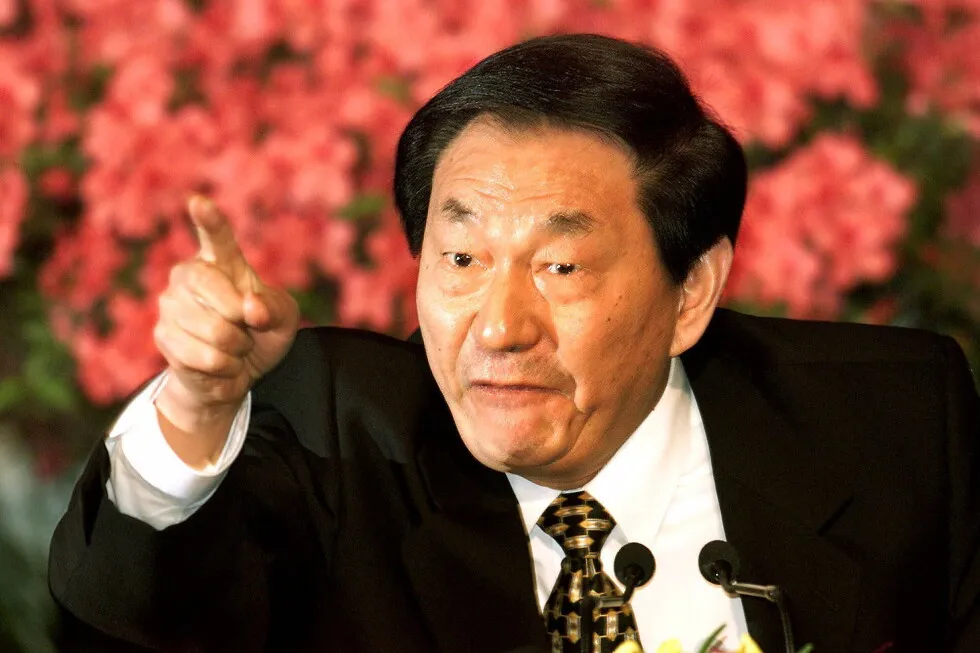
Ex-Chinese Premier Zhu Rongji, who drove economic reforms and led China into the WTO, dies at 97 1 of 4 | Chinese Premier Zhu Rongji speaks during a news conference in Beijing, Wednesday, March 15, 2000. (AP Photo/Greg Baker, File) 2 of 4 | Chinese Premier Zhu Rongji greets journalists at the start of a press conference in Beijing, Wednesday March 15, 2000. (AP Photo/Greg Baker, File) 3 of 4 | Former Chinese Premier Zhu Rongji stands during a parade commemorating the 70th anniversary of Japan’s surrender during World War II held in front of Tiananmen Gate in Beijing, Thursday, Sept. 3, 2015. (AP Photo/Ng Han Guan, File) 4 of 4 | Former Chinese Premier Zhu Rongji, center, listens to a speech by Chinese President Xi Jinping during the opening session of China’s 19th Party Congress at the Great Hall of the People in Beijing, Wednesday, Oct. 18, 2017. (AP Photo/Mark Schiefelbein, File) 1 of 4 | Chinese Premier Zhu Rongji speaks during a news conference in Beijing, Wednesday, March 15, 2000. (AP Photo/Greg Baker, File) 1 of 4 Chinese Premier Zhu Rongji speaks during a news conference in Beijing, Wednesday, March 15, 2000. (AP Photo/Greg Baker, File) Add AP News on Google Add AP News as your preferred source to see more of our stories on Google. Share 2 of 4 | Chinese Premier Zhu Rongji greets journalists at the start of a press conference in Beijing, Wednesday March 15, 2000. (AP Photo/Greg Baker, File) 2 of 4 Chinese Premier Zhu Rongji greets journalists at the start of a press conference in Beijing, Wednesday March 15, 2000. (AP Photo/Greg Baker, File) Add AP News on Google Add AP News as your preferred source to see more of our stories on Google. Share 3 of 4 | Former Chinese Premier Zhu Rongji stands during a parade commemorating the 70th anniversary of Japan’s surrender during World War II held in front of Tiananmen Gate in Beijing, Thursday, Sept. 3, 2015. (AP Photo/Ng Han Guan, File) 3 of 4 Former Chinese Premier Zhu Rongji stands during a parade commemorating the 70th anniversary of Japan’s surrender during World War II held in front of Tiananmen Gate in Beijing, Thursday, Sept. 3, 2015. (AP Photo/Ng Han Guan, File) Add AP News on Google Add AP News as your preferred source to see more of our stories on Google. Share 4 of 4 | Former Chinese Premier Zhu Rongji, center, listens to a speech by Chinese President Xi Jinping during the opening session of China’s 19th Party Congress at the Great Hall of the People in Beijing, Wednesday, Oct. 18, 2017. (AP Photo/Mark Schiefelbein, File) 4 of 4 Former Chinese Premier Zhu Rongji, center, listens to a speech by Chinese President Xi Jinping during the opening session of China’s 19th Party Congress at the Great Hall of the People in Beijing, Wednesday, Oct. 18, 2017. (AP Photo/Mark Schiefelbein, File) Add AP News on Google Add AP News as your preferred source to see more of our stories on Google. Share Updated [hour]:[minute] [AMPM] [timezone], [monthFull] [day], [year] Beijing (AP) — Former Chinese Premier Zhu Rongji, the impatient, sharp-tongued reformer who helped ignite China’s explosive economic boom by forcing wrenching change on state industry in the 1990s and leading the country into the World Trade Organization, has died of illness, state media reported Wednesday. He was 97.Zhu died in Beijing at around 11 a.m. on Wednesday, the official news agency Xinhua reported. Once sent into rural exile to do manual labor for praising reforms in other communist countries, Zhu pushed through a dizzying array of changes as premier, China’s top economic post, from 1998 to 2003 under former President Jiang Zemin.Zhu clashed with Communist Party conservatives and state industry bosses as he pushed state-owned companies to become efficient and profitable. That cost millions of layoffs, but helped propel China to overtake Japan as the second-largest economy behind the United States in 2010.Building on former leader Deng Xiaoping’s 1979 reforms, Zhu is credited with supplying the resourcefulness and tenacity to push through history-making changes such as China’s WTO membership, which helped to transform China into the world’s biggest exporter.Those changes helped to keep economic growth above 8% a year from 2000 to 2010, peaking at 14.2% in 2007. A spiky personality who fought corruption and conservativesNamed premier in 1998 at age 69, Zhu became a popular figure by criticizing official bungling and graft and accepting blame when the government fell short. His demanding style earned him the nicknames Boss and Zhu Fengzi, or Madman Zhu.“I have prepared 100 coffins here — 99 for corrupt officials and one for myself,” Zhu said in 1998, according to the party newspaper People’s Daily.
SRCAssociated Press (AP)
LANGEN
LEANCenter
WORDS783
ENT10
WED · 2026-08-12 · 10:23 GMTBRIEF NSR-2026-0812-101552
NSR-2026-0812-101552News Report·EN·Economic Impact
Ex-Chinese Premier Zhu Rongji, architect of growth, dies of illness at 98
Former Chinese Premier Zhu Rongji, a key architect of China's economic boom, has died of illness in Beijing at the age of 97. During his tenure as premier from 1998 to 2003, Zhu implemented significant reforms to state-owned industries, pushing for efficiency and profitability, which led to millions of layoffs but propelled China's economic growth.
By
JOE McDONALDAssociated Press (AP)Filed 2026-08-12 · 10:23 GMTLean · CenterRead · 4 min
Associated Press (AP)FIG 01
Reading time
4min
Word count
783words
Sources cited
0cited
Entities identified
10entities
Quality score
100%
§ 01
Briefing Summary
AI-generatedNEWSAR · AI
Former Chinese Premier Zhu Rongji, a key architect of China's economic boom, has died of illness in Beijing at the age of 97. During his tenure as premier from 1998 to 2003, Zhu implemented significant reforms to state-owned industries, pushing for efficiency and profitability, which led to millions of layoffs but propelled China's economic growth. He was instrumental in leading China into the World Trade Organization, a move that transformed the country into the world's largest exporter. Known for his sharp-tongued, impatient reformist style, Zhu also battled corruption and clashed with party conservatives to achieve these changes. His efforts built upon earlier reforms and significantly contributed to China surpassing Japan as the world's second-largest economy.
Confidence 0.90Claims 4Entities 10
§ 02
Article analysis
Model · rule-basedFraming
Economic Impact
Human Interest
Tone
Measured
AI-assessed
CalmNeutralAlarmist
Factuality
0.90 / 1.00
Factual
LowHigh
Sources cited
0
No named sources
FewMany
§ 03
Key claims
4 extracted01
The article includes file photos from news conferences in 2000 and 2017, and a parade in 2015.
factual
Confidence
1.00
02
Zhu Rongji played a key role in China's accession to the World Trade Organization (WTO).
factual
Confidence
1.00
03
Zhu Rongji was known for his role in economic reforms in China.
factual
Confidence
1.00
04
Former Chinese Premier Zhu Rongji, who drove economic reforms and led China into the WTO, has died at age 97.
factual
Confidence
1.00
§ 04
Full report
4 min read · 783 words§ 05
Entities
10 identifiedKey playerOppositionContextPositiveNeutralNegative
Organizations1
Locations5
§ 06
Keywords & salience
8 termszhu rongji
1.00
economic reforms
0.90
china
0.80
wto
0.70
growth
0.60
former premier
0.50
news conference
0.40
xi jinping
0.40
§ 07
Topic connections
Interactive graph No topic relationship data available yet. This graph will appear once topic relationships have been computed.