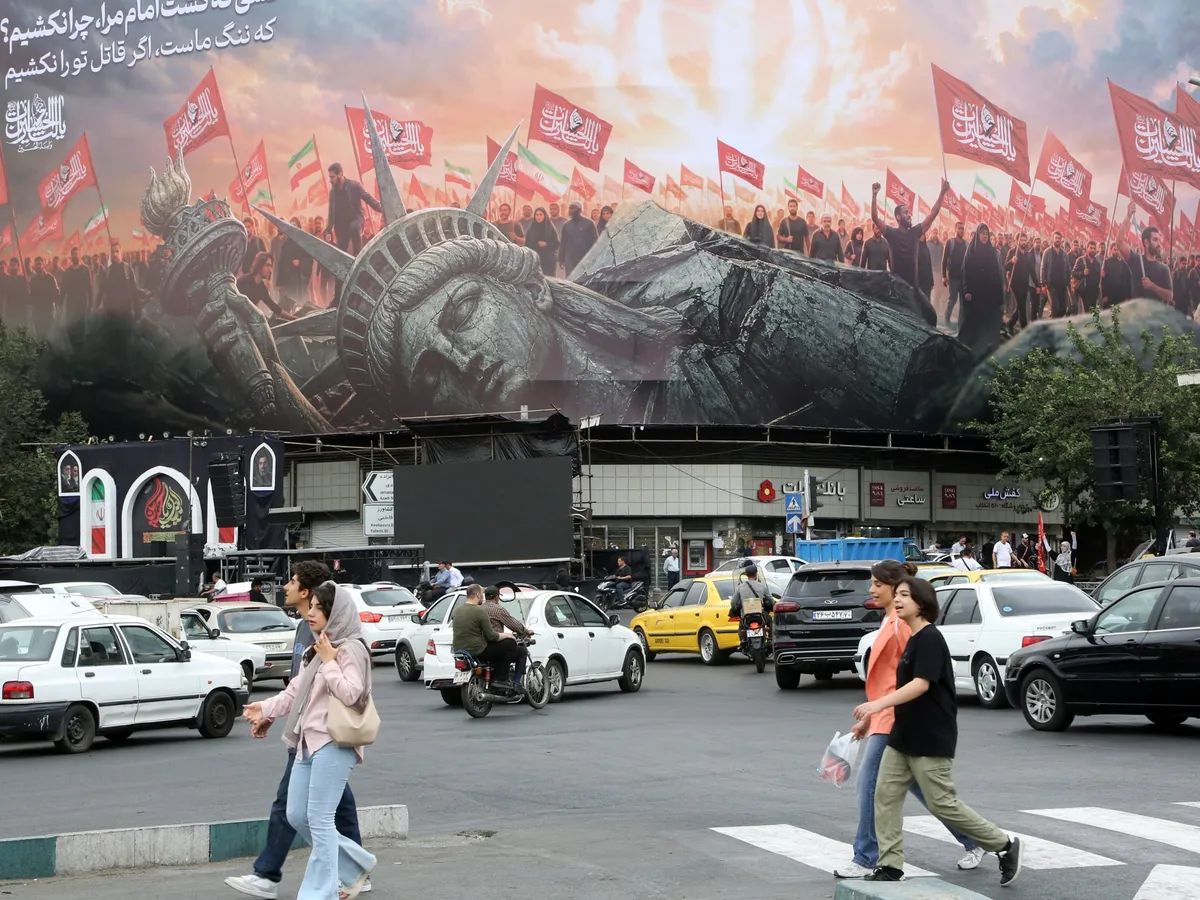
Regardless of its current hostile rhetoric, the Islamic Republic will likely reach a settlement with the US and Israel.Associate professor of philosophy at Northeastern University London.Published On 12 Aug 2026A giant anti-US billboard is displayed at Enghelab Square in Tehran, Iran, on August 3, 2026 [Fatemeh Bahrami/Anadolu]More than five months into the Israel-war-on-Iran" class="entity-link entity-event" data-entity-id="38678" data-entity-type="event">US-Israel war on Iran, the prospects for a deal that would end the confrontation remain unclear. Earlier this week, Iranian Foreign Minister Abbas Araghchi said there were no direct negotiations with the United States.Meanwhile, hostile rhetoric and calls for revenge continue to emanate from Tehran. Some Western commentators, especially on the right, have claimed that Iran is incapable of striking a deal because of its anti-American ideology. But that is a flawed assumption.One just needs to look at the Iranian constitution and its recent history to discover that the Islamic Republic is not governed solely by ideology. The regime, in its present form, would not shy away from reaching a settlement with the US and even Israel, if it fell in line with its guiding principle: regime survival.The limits of Iranian anti-imperialismIn January 1988, Iranian Supreme Leader Ruhollah Khomeini settled an internal dispute over the scope of velayat-e faqih, the guardianship of the Islamic jurist, by declaring that the Islamic government ranks above all other rulings of Islam, including prayer, fasting and pilgrimage. The following month, he ordered the creation of a body to resolve deadlocks between the parliament and the Guardian Council by determining what was in the interest of the governing system.The revisions to the constitution in 1989 gave it a permanent place as Article 112: the Council for Discerning the Expediency of the System.The message was explicit. Preservation of the system — hefz-e nezam — was the highest religious obligation, and an organ was established to license departures from religious law whenever the system required them.In the following years, this principle was clearly applied in how the Islamic Republic deployed official ideology, including its hostility towards Washington and Tel Aviv.Today Tehran presents its anti-imperialist doctrine as a moral commitment grounded in opposition to domination, colonialism and Western hegemony. That self-presentation has earned it sympathy well beyond its borders, including among people who acknowledge its repression at home while treating it as an indispensable pillar of resistance abroad.But Iran’s anti-imperialism is positional rather than universal. It opposes domination when the Islamic Republic is the object of it, but it has not consistently opposed domination as a political relationship.The doctrine of “forward defence” has often treated Lebanon, Syria, Iraq, Yemen and Palestine as arenas in which Tehran deters enemies, projects power and acquires leverage. The anti-imperialist principle is therefore applied selectively.Iran invokes sovereignty and self-determination when resisting external interference in its own affairs, while its regional strategy has often compromised those same principles elsewhere by subordinating other societies to its own security interests.This behaviour is not peculiar to Iran, nor does it make Iran uniquely cynical. Realist theory has long held that survival is the primary end of states, from which other objectives are derived. On that reading, Iran is not an aberration. It is an ordinary state with an unusually elaborate justificatory apparatus.That is exactly the point, and it is what makes a bargain thinkable.The Islamic Republic’s commitments operate on two levels. Enmity towards the US and Israel, support for allied movements and the rejection of accommodation all guide policy. Above them sits a second-order norm that determines when the first-order commitments may be revised. That norm is hefz-e nezam, and Article 112 is its institutional expression.Survival is the core; anti-imperialism is the protective belt, and belts can be loosened.A settlement with the enemyThe Islamic Republic speaks the language of principle honoured regardless of cost while governing by calculation of consequence. That gap is not hypocrisy so much as a structural feature of any state that rules in a doctrine’s name, but it leaves a standing problem. It must compromise without appearing to have compromised.The record shows how this is possible. In July 1988, Khomeini accepted the ceasefire with Iraq, saying publicly that doing so was more lethal to him than poison.During that war, with the immediate danger coming from Saddam Hussein rather than the “Great Satan”, Tehran accepted American weapons routed through Israeli channels and entered secret dealings with Washington in what eventually would be known as the Iran-Contra affair. After the 9/11 attacks and the US invasion of Afghanistan, Iranian and American diplomats cooperated at the Bonn conference to shape the post-Taliban government.None of this made Iran pro-American or pro-Israeli, and none of it shows that its doctrine was decorative. It shows that apparently absolute prohibitions have an off-switch, and that the switch is labelled survival.This year the mechanism has operated under far greater strain. Strikes by the US and Israel on February 28 killed Supreme Leader Ali Khamenei on the first day of a war whose declared aims included forcing regime change in Tehran. Within days, the Assembly of Experts for Leadership installed his son Mojtaba in a hereditary succession that the republic’s own doctrine disparages — another first-order norm surrendered to protect the core.On June 17, President Masoud Pezeshkian signed the Islamabad memorandum of understanding (MoU), which included an end to hostilities, sanctions relief, access to frozen funds and reconstruction support. Mojtaba Khamenei endorsed it in writing while recording his misgivings. Again, the core held, but the belt was loosened.The memorandum left much unresolved, and renewed fighting exposed its fragility. But its existence remains significant. Under existential pressure, the Islamic Republic accepted direct arrangements with Washington and made confrontation itself negotiable.How can a state enter such an arrangement without renouncing the identity that legitimises it? Not by announcing that anti-imperialism has been abandoned, but by revising what it means. Ali Khamenei supplied the vocabulary in 2013 when he spoke of “heroic flexibility”, invoking a wrestler who gives ground without forgetting his opponent’s capabilities. Concession becomes strategic patience, and retreat becomes the preservation of the struggle.Supporters largely follow, and not out of confusion. Where an institution interprets its own doctrine, that doctrine cannot constrain it, and a follower who defers to the leader’s reading is applying the principle as the system defines it. So the leadership can cross its own red line without losing its base, because much of the base crosses along with it.The MoU follows the same logic. anti-imperialism was not abandoned but reinterpreted as preserving Iran’s capacity to resist under changed conditions.The Joint Comprehensive Plan of Action signed in 2015 had already framed negotiation not as surrender but as another means of defending Iran’s interests. The same logic could support a future settlement involving the US and, indirectly, Israel, without recognition or reconciliation, if mutual restraint is judged better for the system’s survival than continued confrontation.An agreement with the enemy reduces the risk of war and eases economic strangulation, both of which matter enormously to ordinary Iranians. But relief abroad does not mechanically produce liberty at home.The state has already invoked wartime conditions to expand arrests, expedite prosecutions and accelerate executions. That repressive apparatus was not built by sanctions and will not be dismantled by their removal. Sanctions relief may ease hardship for Iranians, but without political reform it could also leave the state with greater resources to sustain the institutions of repression.Therefore, the usual debate offers a false choice between confrontation that breaks the Islamic Republic and diplomacy that moderates it. A third and more likely possibility is already visible: an accommodation with the US that preserves the system but brings it no closer to democracy. One form of domination eased, another consolidated. Iran better protected from foreign attack; Iranians no less exposed to their own state.Anyone still asking whether the Islamic Republic would trade its enmities for its survival should read Article 112 again. The answer has been in the constitution since 1989.The views expressed in this article are the author’s own and do not necessarily reflect Al Jazeera’s editorial stance.
SRCAl Jazeera
LANGEN
LEANCenter
WORDS1 323
ENT12
WED · 2026-08-12 · 14:23 GMTBRIEF NSR-2026-0812-101604
NSR-2026-0812-101604Analysis·EN·Political Strategy
Iran is not anti-imperialist. It is a state calculating survival
Despite its hostile rhetoric, Iran's Islamic Republic is likely to reach a settlement with the US and Israel, driven by the principle of regime survival. The article argues that Iran's anti-imperialist ideology is not absolute but rather a tool used to protect its interests when it is the object of domination.
Hossein DabbaghAl JazeeraFiled 2026-08-12 · 14:23 GMTLean · CenterRead · 6 min
Al JazeeraFIG 01
Reading time
6min
Word count
1 323words
Sources cited
1cited
Entities identified
12entities
Quality score
100%
§ 01
Briefing Summary
AI-generatedNEWSAR · AI
Despite its hostile rhetoric, Iran's Islamic Republic is likely to reach a settlement with the US and Israel, driven by the principle of regime survival. The article argues that Iran's anti-imperialist ideology is not absolute but rather a tool used to protect its interests when it is the object of domination. This is supported by historical instances, such as the 1989 constitutional revision establishing the Council for Discerning the Expediency of the System, which prioritizes the preservation of the governing system. The article points to past compromises, like the 1988 ceasefire with Iraq and cooperation with the US after 9/11, as evidence that Iran will prioritize its survival over ideological purity, allowing for strategic concessions.
Confidence 0.90Sources 1Claims 5Entities 12
§ 02
Article analysis
Model · rule-basedFraming
Political Strategy
Conflict
Tone
Measured
AI-assessed
CalmNeutralAlarmist
Factuality
0.40 / 1.00
Mixed
LowHigh
Sources cited
1
Limited
FewMany
§ 03
Key claims
5 extracted01
Iranian Foreign Minister Abbas Araghchi stated there were no direct negotiations with the United States.
factualAbbas Araghchi
Confidence
0.95
02
Preservation of the system ('hefz-e nezam') was declared the highest religious obligation by Ruhollah Khomeini.
factualRuhollah Khomeini
Confidence
0.95
03
The Islamic Republic is not governed solely by ideology and would reach a settlement with the US and Israel if it aligned with regime survival.
factual
Confidence
0.90
04
Iran's anti-imperialism is positional rather than universal, opposing domination only when it is the object of it.
factual
Confidence
0.85
05
The doctrine of 'forward defence' has treated Lebanon, Syria, Iraq, Yemen, and Palestine as arenas for Tehran to deter enemies and project power.
factual
Confidence
0.80
§ 04
Full report
6 min read · 1 323 words§ 05
Entities
12 identifiedKey playerOppositionContextPositiveNeutralNegative
Organizations2
Locations5
§ 06
Keywords & salience
10 termsregime survival
1.00
iranian anti-imperialism
0.90
islamic republic
0.80
us-israel war on iran
0.70
settlement with the us
0.70
hostile rhetoric
0.60
hefz-e nezam
0.50
council for discerning the expediency of the system
0.50
ideology
0.40
western hegemony
0.40
§ 07
Topic connections
Interactive graph Network visualization showing 29 related topics
View Full Graph Person Organization Location Event|Click node to navigate|Edge numbers = shared articles