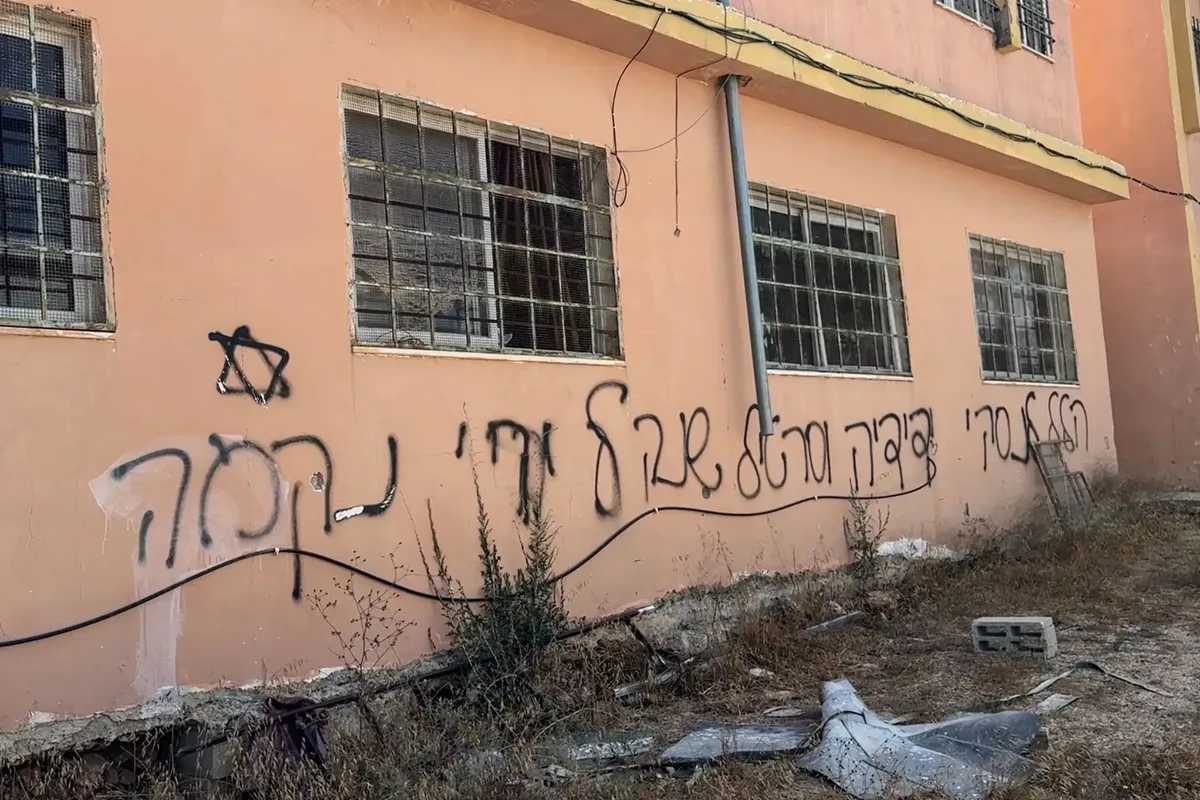
Walls across occupied West Bank have been transformed into canvases for racist slogans, signaling a brazen drive for displacement of Palestinians.Israeli settlers have repeatedly targeted the village of Jalud, defacing its walls and schools with racist and hostile Hebrew slogans [Al Jazeera]Published On 12 Aug 2026Scrawled in black graffiti, the word “Revenge” stains the terracotta facade of a school in Jalud, a village in the occupied West Bank.Other slogans carry a more direct threat: “Burn in hell,” reads one. “Get out of the village,” says another.Recommended Stories list of 3 itemslist 1 of 3Israeli government accused of complicity as settlers demolish Jericho homeslist 2 of 3Israeli raids, arrests continue as UN warns West Bank at ‘breaking point’list 3 of 3Palestine weekly: Netanyahu hedges on Gaza roadmapend of listIt is a familiar sight across this community, located 27km (17 miles) south of Nablus and home to some 1,000 Palestinians.Under the cover of darkness or in broad daylight, Israeli settlers have been targeting Palestinian public institutions and homes with increased intensity, spraying slogans with racist and threatening messages, as well as invoking biblical passages to justify committing their crimes.Residents and officials say the defacing of the buildings typically accompanies violent settler attacks. Jalud has been subjected to five major assaults since last January, the latest being on August 4 when settlers burned vehicles and sprayed racist slogans on a residential building.A Palestinian man stands next to a vehicle torched by Israeli settlers during a recent violent assault on the village of Jalud in the occupied West Bank [Al Jazeera]‘Take revenge here’Jalud resident Misbah al-Haj Mohammed said some of the slogans bear the names of settlers who carried out previous attacks, as if wanting to “challenge” people in the village and neighbouring areas.He added that the messages written on school walls are aimed specifically at children to create a sense of fear in them about attending classes, while those threatening expulsion want to signify that “killing and displacement are inevitably coming”.The head of the village council, Raed al-Haj Mohammed, described the slogans as “racist and liquidationist”, saying they are usually used by members of the Hilltop Youth group calling for the expulsion of Palestinians.A decentralised network made up mostly of Jewish youths between the ages of 15 and 20, the Hilltop Youth is among the most prominent violent settler groups in the West Bank.The group takes its name from a strategy of establishing settlement outposts on “hilltops”, a term referring not only to the land itself, but also to a settlement model based on creating new outposts outside existing illegal settlements and later imposing a fait accompli to pave the way for their legalisation.“When a soldier is killed in Gaza, they take revenge here, and write the names of their dead on our walls,” Raed told Al Jazeera, adding that residents immediately move to remove the slogans.The illegal Israeli settlement of Shiloh, built on confiscated Palestinian land, physically encircles and suffocates the village of Jalud [Al Jazeera]‘Zero-Arab state’Azzam Abu al-Adas, a researcher in Israeli affairs, said the settlers’ choice of writings was a “reflection of deep ideological concepts”.He cited the slogan “Death to Arabs”, describing it as “an explicit call for genocide, within a replacement settlement vision seeking to reach a zero-Arab state in the region extending between the Jordan River and the Mediterranean Sea”.Abu al-Adas pointed out that the idea of genocide has become a “mainstream current” in Israeli society since the start of the war on Gaza in October 2023, entrenching a conviction that solving the “Palestinian problem” could only happen through “annihilating Palestinians or expelling them permanently, and destroying the urban environment they inhabit to get rid of their presence completely”.Referring to The Price Tag movement, a clandestine network of far-right settler groups that emerged in 2008, Abu al-Aldas said that from an ideological perspective, its members see Palestinians as the “occupier” of the land who must pay the price for their stay until they are “forced to leave and exit … permanently”.He added that the scrawled slogans often include the names of killed settlers, meant to signal that the attack was a “retaliatory act for their memory” and pointed to an escalation in the use of religious texts employed to incite the killing of non-Jews, alongside slogans about “the promise of the Lord”.Hebrew graffiti covers the walls of a burned mosque in the town of Qusra, south of Nablus. According to locals, the slogans include explicit threats such as ‘Death to Arabs’ and ‘We came for revenge’ [Al Jazeera]Walid Habbas, a researcher in Israeli affairs, said the violent settler groups “want to punish the Palestinian existence itself because it obstructs the project of controlling the land and not only because it carried out resistance”.Habbas said that burning crops, mosques and homes “is not a random choice” as it targets the elements of survival and connection to the place.Habbas also noted that some of the messages, which are written in Hebrew, are not primarily directed at Palestinians, who may not read the language. Instead, they serve as an “ownership mark” addressing other settlers, as well as the Israeli state and public. Consequently, “the Palestinian wall turns into a banner declaring that the place has become, symbolically, a reclaimed land”, said Habbas.He added that the writing of such slogans aims to strip Palestinians of their humanity and make harming them acceptable, as well as providing “holy cover” to perpetrators and entrenching the argument that the land “does not accommodate two peoples”.Habbas cited an attack last month on the village of Qusra, where settlers set fire to a mosque and sprayed slogans and a Star of David on its walls. The targeting of the mosque “is not a revenge against an individual, but a strike at the unifying structure that produces collective identity and connection to the place”, he said.The Star of David serves as a “sovereign signature”, saying that “this place is subject to us”, added Habbas.He also highlighted what he believes is the attack’s most dangerous aspect: the writing is “crude, fast and unhidden”, drawn on a facade overlooking the public road so it is seen and photographed.He described this deliberate act as “not recklessness”, but a “declaration of confidence that the perpetrator will not be held accountable”, and that “the public nature of the crime itself is a message about the balance of power and a structural complicity that makes this violence possible and recurrent”.
SRCAl Jazeera
LANGEN
LEANCenter
WORDS1 066
ENT10
WED · 2026-08-12 · 13:58 GMTBRIEF NSR-2026-0812-101606
NSR-2026-0812-101606News Report·EN·Human Rights
‘Burn in hell’: Israeli settlers spread hate through graffiti, attacks
Israeli settlers are increasingly defacing Palestinian homes and schools in the occupied West Bank with racist and threatening graffiti. Slogans like "Burn in hell" and "Get out of the village" are appearing, particularly in villages like Jalud, often accompanying violent settler attacks.
By Ola MohammadAl JazeeraFiled 2026-08-12 · 13:58 GMTLean · CenterRead · 5 min
Al JazeeraFIG 01
Reading time
5min
Word count
1 066words
Sources cited
2cited
Entities identified
10entities
Quality score
100%
§ 01
Briefing Summary
AI-generatedNEWSAR · AI
Israeli settlers are increasingly defacing Palestinian homes and schools in the occupied West Bank with racist and threatening graffiti. Slogans like "Burn in hell" and "Get out of the village" are appearing, particularly in villages like Jalud, often accompanying violent settler attacks. Residents report that these messages aim to instill fear and signal an intent for Palestinian displacement. Researchers attribute these actions to deep ideological concepts within some settler groups, such as the Hilltop Youth, who advocate for expelling Palestinians and establishing Jewish control. The graffiti sometimes includes the names of deceased settlers, presented as a call for revenge, and invokes biblical passages to justify their actions.
Confidence 0.90Sources 2Claims 4Entities 10
§ 02
Article analysis
Model · rule-basedFraming
Human Rights
Conflict
Tone
Sensational
AI-assessed
CalmNeutralAlarmist
Factuality
0.60 / 1.00
Mixed
LowHigh
Sources cited
2
Limited
FewMany
§ 03
Key claims
4 extracted01
Slogans found include 'Revenge', 'Burn in hell', and 'Get out of the village'.
factualAl Jazeera
Confidence
0.95
02
Jalud has been subjected to five major assaults by settlers since last January, including one on August 4 where vehicles were burned and racist slogans were sprayed.
factualAl Jazeera
Confidence
0.90
03
Israeli settlers have repeatedly targeted the village of Jalud, defacing its walls and schools with racist and hostile Hebrew slogans.
factualAl Jazeera
Confidence
0.90
04
The Hilltop Youth group is among the most prominent violent settler groups in the West Bank and calls for the expulsion of Palestinians.
factualAl Jazeera
Confidence
0.85
§ 04
Full report
5 min read · 1 066 words§ 05
Entities
10 identifiedKey playerOppositionContextPositiveNeutralNegative
§ 06
Keywords & salience
9 termsoccupied west bank
1.00
racist slogans
1.00
israeli settlers
1.00
displacement of palestinians
0.90
settler attacks
0.80
graffiti
0.70
hilltop youth
0.60
jalud
0.50
expulsion
0.40
§ 07
Topic connections
Interactive graph Network visualization showing 51 related topics
View Full Graph Person Organization Location Event|Click node to navigate|Edge numbers = shared articles