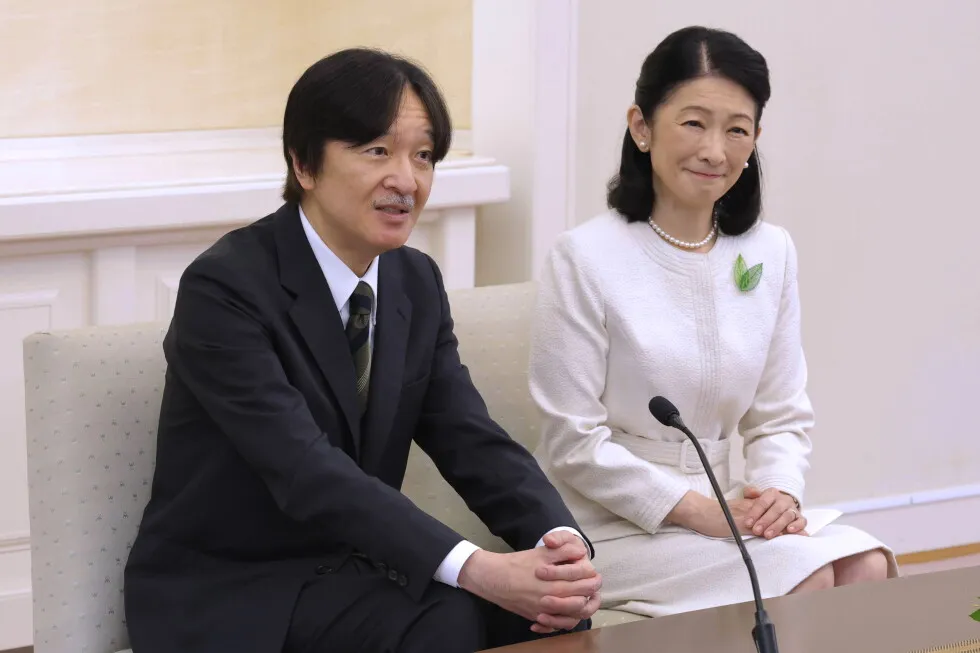
Japan’s Crown Prince Akishino has ‘mixed feelings’ about male-only imperial succession law 1 of 3 | Japan’s Crown Prince Akishino and Crown Princess Kiko attend a news conference in Tokyo, Thursday, Aug. 13, 2026, ahead of their visit to Paraguay. (Japan Pool/Kyodo News via AP) 2 of 3 | Japan’s Crown Prince Akishino and Crown Princess Kiko attend a news conference in Tokyo, Thursday, Aug. 13, 2026, ahead of their visit to Paraguay. (Japan Pool/Kyodo News via AP) 3 of 3 | Japan’s Crown Prince Akishino attends a news conference in Tokyo, Thursday, Aug. 13, 2026, ahead of his visit to Paraguay. (Japan Pool/Kyodo News via AP) By MARI YAMAGUCHI Updated 9:35 AM MESZ, August 13, 2026 Add AP News on Google Add AP News as your preferred source to see more of our stories on Google. Share Share Facebook Copy Link copied Print Email X LinkedIn Bluesky Flipboard Pinterest Reddit TOKYO (AP) — Japanese Crown Prince Akishino, the younger brother of Emperor Naruhito, on Thursday said he has “mixed feelings” about the government’s revision to the Imperial House Law that insists only men can become emperor. “I believe there is no difference between men and women” in serving the roles of the imperial family to respond to social needs, Akishino said at a news conference ahead of a trip to Paraguay later this month to mark the 90th anniversary of Japanese emigration to the South American country. The comments by Akishino, the next in line for the throne, come just weeks after a historic revision to the Imperial House Law by the conservative government of Prime Minister Sanae Takaichi that insists only paternal-lineage men can become emperor. The law has been criticized as anachronistic and sexist and the revision sparked outrage and concern that the measure could doom the already shrinking imperial family. Critics also say the government’s insistence on the male-only succession is an imposition of an inhumane system on the royals without taking into consideration their burden and feelings. As an imperial family member who is not supposed to make political statements, Akishino was nuanced in his comments. Japan enshrines male-only succession for the shrinking imperial family 2 MIN READ 47 Japan enacts law to punish national flag vandals. Opponents say it’s a threat to free speech 3 MIN READ 15 Parlamento de Japón consagra sucesión sólo masculina para la menguante familia imperial 3 MIN READ 15 “I have mixed feelings about it, and it’s rather strange if I don’t,” Akishino said when asked about the government’s decision. He added that it “is a difficult question, and the reality is that I can’t talk about it.” “The society needs to keep making progress, and I believe it is important for people with different views to keep thinking what’s best,” Akishino said. Male rule removes popular princess from succession Naruhito’s 24-year-old daughter, Princess Aiko, is hugely popular and many Japanese want her to be his successor, but as a woman she is ineligible. The male-only succession rule means the throne must go to Akishino, then to his 19-year-old nephew Prince Hisahito. Next in line after him is the emperor’s 90-year-old uncle. The revisions by Takaichi’s government to the antiquated law is meant to solidify the principle of the crucial imperial bloodline but pushes aside the emperor’s daughter. The revision allows princesses to keep their status and perform royal duties if they marry a commoner, but their husbands and children will remain non-royals. A more controversial change allows unmarried male descendants aged 15 or older of distant imperial relatives to be adopted into the immediate royal family to father heirs, but only those of paternal lineage can be chosen for adoption. The revisions have led to protests from Japanese who see the government efforts as an attempt to eliminate Princess Aiko from ruling and justify discrimination against women and a patriarchal system. There have been eight female monarchs in Japan. The last was Empress Gosakuramachi, who ruled from 1762 to 1770. The paternal-line male succession was stipulated for the first time in the 1890 Imperial House Law, when Japan promoted patriarchal systems. That law was largely carried over to the current 1947 version. There is also worry that the government’s push will upset the legacy of former Emperor Akihito, including making amends for the victims of World War II, which was fought in his father’s name. Akihito, who abdicated in 2019, tried to bring what was seen as an aloof monarchy closer to the people, an example followed by his son, Naruhito, and his family. MARI YAMAGUCHI Yamaguchi is based in Tokyo and covers Japanese politics, security, nuclear energy and social issues for The Associated Press. twitter mailto
SRCAssociated Press (AP)
LANGEN
LEANCenter
WORDS779
ENT9
THU · 2026-08-13 · 07:53 GMTBRIEF NSR-2026-0813-101845
NSR-2026-0813-101845News Report·EN·Human Interest
Japan’s Crown Prince Akishino has ‘mixed feelings’ about male-only imperial succession law
Japanese Crown Prince Akishino expressed "mixed feelings" regarding the government's recent revision to the Imperial House Law, which maintains a male-only succession to the Chrysanthemum Throne. Akishino stated that he believes there is no difference between men and women in fulfilling imperial roles.
Associated Press (AP)Filed 2026-08-13 · 07:53 GMTLean · CenterRead · 4 min
Associated Press (AP)FIG 01
Reading time
4min
Word count
779words
Sources cited
1cited
Entities identified
9entities
Quality score
100%
§ 01
Briefing Summary
AI-generatedNEWSAR · AI
Japanese Crown Prince Akishino expressed "mixed feelings" regarding the government's recent revision to the Imperial House Law, which maintains a male-only succession to the Chrysanthemum Throne. Akishino stated that he believes there is no difference between men and women in fulfilling imperial roles. This revision, enacted by Prime Minister Sanae Takaichi's conservative government, has drawn criticism for being anachronistic and sexist, with concerns raised about its impact on the shrinking imperial family and the potential exclusion of Emperor Naruhito's daughter, Princess Aiko. The law allows princesses to retain their status but their descendants will not be in the imperial line, and it also permits the adoption of male descendants from collateral branches of the imperial family to ensure male heirs. Historically, Japan has had female monarchs, with the last being Empress Gosakuramachi in the 18th century, but the paternal-line male succession was first codified in 1890.
Confidence 0.90Sources 1Claims 5Entities 9
§ 02
Article analysis
Model · rule-basedFraming
Human Interest
Social Justice
Tone
Mixed Tone
AI-assessed
CalmNeutralAlarmist
Factuality
0.70 / 1.00
Factual
LowHigh
Sources cited
1
Limited
FewMany
§ 03
Key claims
5 extracted01
Princess Aiko, Emperor Naruhito's daughter, is popular but ineligible for succession due to her gender.
factual
Confidence
1.00
02
The law revision has been criticized as anachronistic and sexist, sparking outrage.
factual
Confidence
1.00
03
The Japanese government revised the Imperial House Law, maintaining male-only succession.
factual
Confidence
1.00
04
Akishino believes there is no difference between men and women in serving the imperial family.
quoteCrown Prince Akishino
Confidence
1.00
05
Crown Prince Akishino stated he has 'mixed feelings' about the male-only imperial succession law.
quoteCrown Prince Akishino
Confidence
1.00
§ 04
Full report
4 min read · 779 words§ 05
Entities
9 identifiedKey playerOppositionContextPositiveNeutralNegative
People4
Organizations2
§ 06
Keywords & salience
9 termsmale-only succession
1.00
imperial house law
1.00
crown prince akishino
0.90
imperial family
0.80
japan
0.70
mixed feelings
0.60
shrinking imperial family
0.50
emperor naruhito
0.40
prime minister sanae takaichi
0.40
§ 07
Topic connections
Interactive graph No topic relationship data available yet. This graph will appear once topic relationships have been computed.