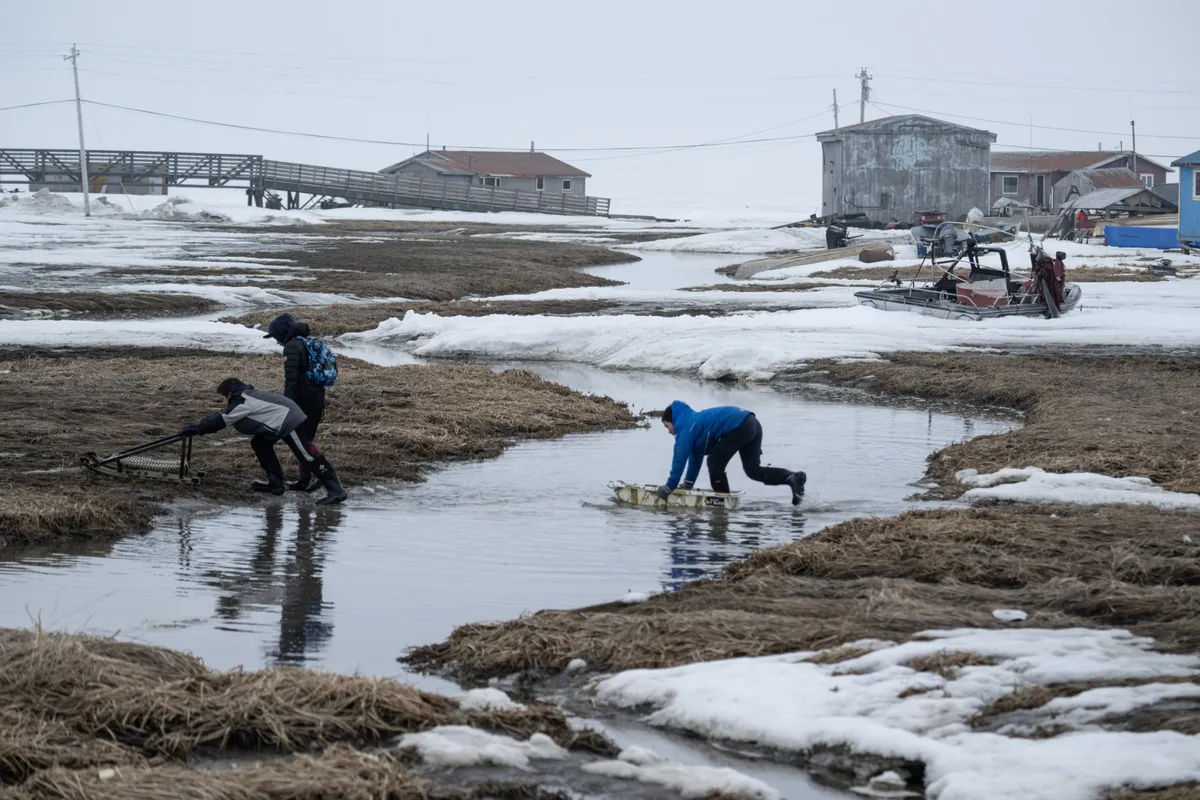
Joann Carl’s dog Rocky, a long-eared, short-legged mix the color of graham crackers, has become Alaska famous since I first met Carl in April. Over the past few months, she’s seen his photo all over Facebook, she said, rescued after Typhoon Halong wiped away more than half the homes in her coastal Alaska Native village of Kipnuk, population 700. At the Anchorage Daily News, we’re based in Alaska’s largest city but travel as often as we can to small communities like Kipnuk in an attempt to cover a state that’s twice the size of Texas. We try to report more than one story at a time to justify the expense of plane tickets. Flights to a remote village in a small plane cost the same as a trip to New York. But rarely do we have the chance to document a community just before the breaking news arrives. Maybe you didn’t hear much about the typhoon. It began as a tropical storm, dumping record rainfall in parts of Japan before swirling toward Alaska. By the time it reached our shores, the remnants of the storm still carried enough force to flood two villages, sweeping away homes and leaving as many as three people dead. I’m writing to you about the storm because photojournalist Marc Lester and I happened to visit Kipnuk shortly before the typhoon. Marc returned to cover the evacuation, providing a look at an Alaska village on the front lines of climate change just before and after the devastation. The story of destruction in Carl’s hometown, along with the nearby village of Kwigillingok, adds an exclamation point to long-simmering fears about the future of Alaska coastal villages. Which town will be wiped away next? Where will climate refugees live? Should their former homes be rebuilt? If not, what does it mean for the future of these communities? Emily Schwing, reporting for KYUK public radio in Bethel and ProPublica’s Local Reporting Network, wrote in May about climate refugees the government helped relocate from the Yup’ik village of Newtok. In November, while covering Alaska’s crumbling public school infrastructure, she wrote how the school in Kipnuk housed hundreds of residents as an emergency shelter during the storm surge from Halong. When Marc and I first visited that schoolhouse in April, we were reporting on a very different kind of story. Justine Paul, Carl’s son, spent seven years in jail charged with murder in Alaska’s glacially slow justice system, where serious cases can take a decade to resolve. Paul’s case was ultimately dismissed after the evidence against him turned out to be deeply flawed. After struggling with addiction on the streets of Anchorage upon his release, Paul returned to live with Carl in the little Kipnuk house where he grew up. Our visit to their village before the storm gave Marc a chance to document a version of Kipnuk that no longer exists and maybe never will again. Justine Paul leaves Joann Carl’s house after his lunch break from work in April. Marc Lester/ADN Carl, Paul’s mother, cries at her home in Kipnuk in April while describing her son’s situation. Marc Lester/ADN The people we met in the spring were subsequently airlifted to emergency shelter in an evacuation unlike any the state had experienced. They arrived in Bethel via helicopters and small planes. Some stayed in the regional hub. Others were packed shoulder-to-shoulder on the floor of a massive Alaska Air National Guard cargo plane bound for Anchorage. Many would end up staying for weeks in Anchorage at a convention center and a sports arena that had been transformed into emergency shelters. Five days after the storm, Marc toured Kipnuk on the back of an all-terrain vehicle with one of the village’s few holdouts. The floodwaters had devastated a community that’s been settling into melting permafrost like others on the coast. The central part of the village resembled a collapsed Jenga tower, rectangular homes scattered and strewn, Marc reported. Most were lifted from their pilings by the raging floodwater and deposited elsewhere. Some were surprisingly intact, but muddied, sodden, compromised and unlivable where they came to rest. Gone was the thrum and throttle of normal life we had seen earlier in the year, Marc found, replaced by an eerie vacancy. Zacharias John looks at the devastation left by Halong in Kipnuk on Oct. 17. John decided to stay back and help the few people who remain in the village. Marc Lester/ADN It had taken Carl’s family five hours to travel the three blocks from their house to the makeshift shelter at the school when the storm first hit. Carl’s son Raymond helped elders get over debris on the ground. Pieces of houses washed against the town’s boardwalk. She said the whole village smelled of diesel fuel — spilled stove oil. Villagers had to ration food that had been stored at the schoolhouse for students. “One cracker and a spoonful of hashbrowns” per person, Carl said. Eventually, volunteers salvaged dried Native foods from homes that were still standing: fish, berries, moose meat. “We fed the kids more and the mens that were doing all the work, the rescues,” Carl said. A volunteer pilot flew Rocky from Kipnuk to safety, she said. “Used her own gas.” One house floated 15 miles away, Carl said. Bodies from some of Kipnuk’s aboveground graves had been seen near the town’s airport. The storm, whose impacts the Alaska Climate Research Center later linked to global warming, killed 67-year-old Ella Mae Kashatok in Kwigillingok. The home she was in broke loose and floated toward the Bering Sea, state troopers said. Two members of her family, Vernon Pavil, 71, and Chester Kashatok, 41, have not been found. A home came to rest on a riverbank opposite Kipnuk during Halong. Marc Lester/ADN Paul flew to Bethel and then to Togiak, a coastal village 140 miles from Kipnuk that was less impacted by the storms. Carl, who has diabetes, said she evacuated Kipnuk on a Blackhawk helicopter. She sat next to a 2-year-old girl whose name she didn’t know and who was traveling without her parents. Carl made a show of looking out the window and appearing interested in the scenery, she said, to keep the toddler occupied and calm. Carl said Kipnuk’s subsistence culture made the villagers especially well-equipped to survive the aftermath of the storm. Hunters regularly face life-and-death decisions, she said. Starvation times weren’t so long ago. Elders taught everyone to dry and save food.Carl, however, is not likely to be around to experience that way of life in the village anymore.Although her home is one of the few that survived — it was built in the late 1970s or early ’80s on pilings moored deep in the tundra — she’s not optimistic about returning to the village full time. She burst into tears when asked if Kipnuk will exist in the future. “It’s probably the end,” she said over a recent lunch of Whoppers at an Anchorage Burger King. “It’s a ghost town.”
SRCProPublica
LANGEN
LEANCenter-Left
WORDS1 165
ENT5
SAT · 2026-01-24 · 10:00 GMTBRIEF NSR-2026-0124-10197
NSR-2026-0124-10197News Report·EN·Environmental
Documenting an Alaska Village, Before and After the Storm That Destroyed It
The Anchorage Daily News documented the Alaska Native village of Kipnuk before and after Typhoon Halong devastated it in late 2023. The storm, which originated as a tropical storm near Japan, flooded Kipnuk and the nearby village of Kwigillingok, destroying homes and causing fatalities.
Kyle HopkinsProPublicaFiled 2026-01-24 · 10:00 GMTLean · Center-LeftRead · 5 min
ProPublicaFIG 01
Reading time
5min
Word count
1 165words
Sources cited
2cited
Entities identified
5entities
Quality score
100%
§ 01
Briefing Summary
AI-generatedNEWSAR · AI
The Anchorage Daily News documented the Alaska Native village of Kipnuk before and after Typhoon Halong devastated it in late 2023. The storm, which originated as a tropical storm near Japan, flooded Kipnuk and the nearby village of Kwigillingok, destroying homes and causing fatalities. A reporter and photojournalist had visited Kipnuk prior to the storm to cover a separate story about a local man's murder case. The photojournalist returned to document the evacuation and aftermath, highlighting the vulnerability of Alaska's coastal villages to climate change. The event has reignited concerns about the future of these communities, including the potential for climate refugees and the question of whether to rebuild damaged villages.
Confidence 0.90Sources 2Claims 5Entities 5
§ 02
Article analysis
Model · rule-basedFraming
Environmental
Human Interest
Tone
Mixed Tone
AI-assessed
CalmNeutralAlarmist
Factuality
0.70 / 1.00
Factual
LowHigh
Sources cited
2
Limited
FewMany
§ 03
Key claims
5 extracted01
Justine Paul spent seven years in jail charged with murder in Alaska.
factualAnchorage Daily News
Confidence
1.00
02
The school in Kipnuk housed hundreds of residents as an emergency shelter during the storm surge from Halong.
factualEmily Schwing, KYUK/ProPublica
Confidence
0.90
03
Typhoon Halong wiped away more than half the homes in the coastal Alaska Native village of Kipnuk.
factualAnchorage Daily News
Confidence
0.90
04
Serious cases can take a decade to resolve in Alaska's justice system.
factualAnchorage Daily News
Confidence
0.80
05
The remnants of the storm still carried enough force to flood two villages, sweeping away homes and leaving as many as three people dead.
factualAnchorage Daily News
Confidence
0.80
§ 04
Full report
5 min read · 1 165 words§ 05
Entities
5 identifiedKey playerOppositionContextPositiveNeutralNegative
Organizations1
§ 06
Keywords & salience
9 termsalaska village
0.90
kipnuk
0.90
typhoon halong
0.80
climate change
0.70
climate refugees
0.60
coastal villages
0.60
storm surge
0.50
natural disaster
0.50
remote village
0.40
§ 07
Topic connections
Interactive graph Network visualization showing 41 related topics
View Full Graph Person Organization Location Event|Click node to navigate|Edge numbers = shared articles