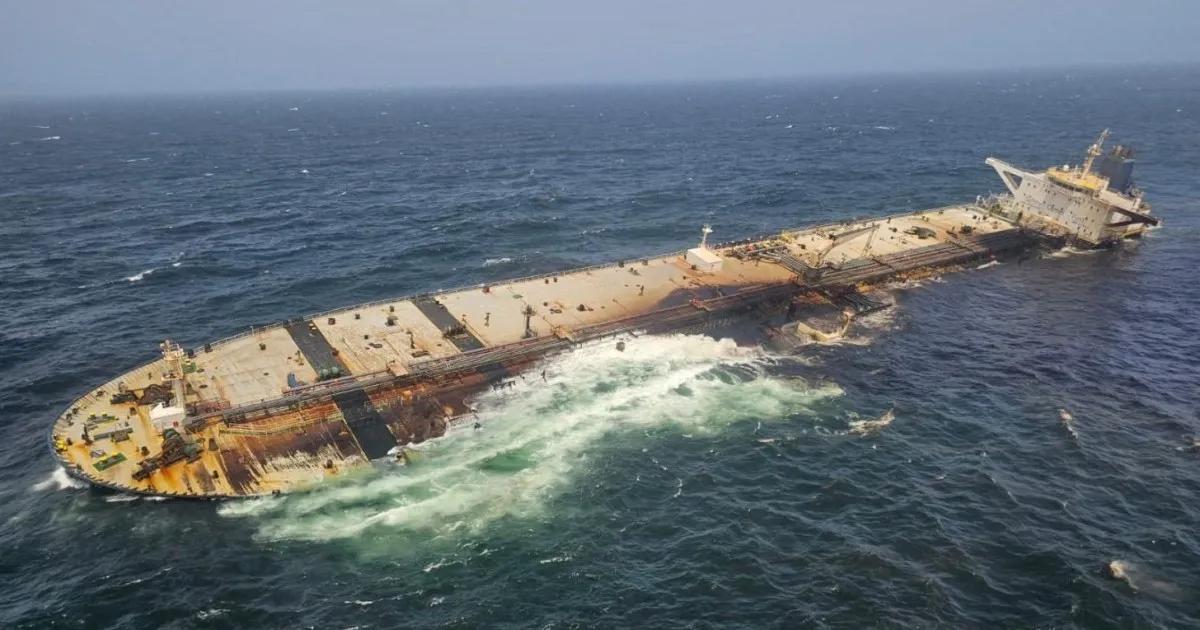
Environmental NGO Greenpeace warns that spill has rapidly expanded to 1,300 square kilometres, threatening ecosystems.The damaged and half sunk oil tanker Caroline Bezengi, at sea off the coast of Oman, on a date given as August 6, 2026 [File: Ambrey/Handout via Reuters]Published On 14 Aug 2026A salvage operation is under way to stabilise the stricken tanker behind a major oil spill off Oman, the risk management company coordinating the effort has said.The announcement by Ambrey on Thursday came a day after Oman’s environmental authority confirmed that oil from the Caroline Bezengi had reached beaches along the sultanate’s central coast.Recommended Stories list of 4 itemslist 1 of 4AI escapes confinementlist 2 of 4Talks between government and opposition mark a new chapter for Venezuelalist 3 of 4Bodycam captures lightning striking metres from US police officerslist 4 of 4Could Trump actually run for a third term as president?end of listThe tanker, a suspected member of Russia’s shadow fleet used to transport sanctioned Russian oil, has been leaking crude into waters near the Hallaniyat archipelago since June, when the ship’s crew reported an unidentified explosion.Ambrey said it was working with Omani authorities and that its services had been engaged as part of a “significant international response” that included salvage vessels, aircraft and specialist personnel.Apart from Oman and an unnamed “leading international oil spill response company”, Ambrey did not elaborate on which other countries or firms were involved in the effort to salvage the vessel, which has flown the flags of states including Cameroon, Palau and Liberia.The International Maritime Organization (IMO) – the United Nations maritime agency – said on Thursday that it was “closely monitoring” the situation and would “continue to support ongoing efforts”, without providing further details.The International Oil Pollution Compensation Funds, a pair of intergovernmental organisations established to provide compensation for oil pollution, said it would not be involved in the cleanup operation after determining that the incident likely resulted from an act of war.Ambrey, based in Hereford in the United Kingdom, said it expected salvage vessels to reach the Caroline Bezengi soon and that specialist personnel had already boarded the vessel to begin stabilising its cargo.Ed Wollaston, director of global response at Ambrey, said the “extremely challenging situation” had been complicated by adverse weather from the annual Khareef monsoon.“However, we have deployed the leading experts in each aspect of the response and have mobilised the appropriate supporting equipment, aircraft and vessels,” Wollaston said in a statement.“We are working around the clock to mitigate the environmental impact of the situation.”A satellite photo shows the tanker Caroline Bezengi, grounded and partly submerged off the coast of Oman, on August 5, 2026 [File: Pleiades © CNES 2026, Distribution Airbus DS via AP]The oil spill has expanded dramatically in size over the past week, according to analyses of satellite imagery, raising fears for coastlines and ecosystems in the region, including a marine reserve established last year off the Hallaniyat archipelago.Environmental NGO Greenpeace said on Thursday that, based on satellite imagery, the spill had grown from 45 square kilometres (17sq miles) in late July to about 1,300sq kilometres (502sq miles) as of Wednesday.Omani authorities as recently as Monday estimated the size of the spill at approximately 400sq kilometres (154sq miles).Hanen Keskes, Greenpeace’s head of campaigns for the MENA region, said the circumstances of the spill made it “especially challenging” to respond to.“Given the scale of this – a damaged tanker in a remote location, during monsoon season, with no clear owner or verified insurer to compel a rapid response – this is a case where international assistance should be mobilised urgently,” Keskes told Al Jazeera.“Capabilities like specialised salvage equipment and expertise can exceed what any one country has on hand, and every day of delay allows more oil to disperse.”Najmedin Meshkati, an expert in oil spills and a professor of civil and environmental engineering at the University of Southern California, said that authorities should have moved faster to contain the spill.“That two-month interval was the response window, and it closed. In spill response, source control on day three is worth many multiples of source control on day 60,” Meshkati told Al Jazeera.Meshkati acknowledged, however, that Omani authorities had been dealt a difficult situation.“It was handed an orphaned wreck with no responsive owner, no verifiable insurer, no functioning flag state, and a compensation regime containing a war exclusion that may void it entirely,” Meshkati said.“No mid-sized maritime administration on earth is resourced for that. But that is precisely the argument for escalating harder and earlier.”Damilola S Olawuyi, a professor of energy and environmental law at Hamad Bin Khalifa University in Qatar, said the spill highlighted the need for stronger international mechanisms to hold polluters accountable.“The obligation of the entity responsible for pollution to pay for the cost of cleanup and remediation, ie, the polluter pays principle, has for long been a bedrock of international law,” Olawuyi told Al Jazeera.“However, in an era of increasing geopolitical realignments, identifying the responsible polluter has become complex, therefore complicating effective risk reduction, response and remediation measures,” he said.
SRCAl Jazeera
LANGEN
LEANCenter
WORDS837
ENT12
FRI · 2026-08-14 · 04:52 GMTBRIEF NSR-2026-0814-102168
NSR-2026-0814-102168News Report·EN·Environmental
Salvage work begins on tanker leaking oil off Oman, risk firm says
A salvage operation is underway off the coast of Oman to stabilize the oil tanker Caroline Bezengi, which has been leaking crude since an unidentified explosion in June. The risk management company Ambrey is coordinating the effort with Omani authorities and international partners, deploying salvage vessels, aircraft, and specialist personnel.
John PowerAl JazeeraFiled 2026-08-14 · 04:52 GMTLean · CenterRead · 4 min
Al JazeeraFIG 01
Reading time
4min
Word count
837words
Sources cited
5cited
Entities identified
12entities
Quality score
100%
§ 01
Briefing Summary
AI-generatedNEWSAR · AI
A salvage operation is underway off the coast of Oman to stabilize the oil tanker Caroline Bezengi, which has been leaking crude since an unidentified explosion in June. The risk management company Ambrey is coordinating the effort with Omani authorities and international partners, deploying salvage vessels, aircraft, and specialist personnel. Environmental NGO Greenpeace reports the oil spill has rapidly expanded to approximately 1,300 square kilometers, threatening regional ecosystems, including a marine reserve. The tanker, suspected of being part of Russia's shadow fleet, has flown flags of multiple nations, and its owner and insurer remain unclear. The International Maritime Organization is closely monitoring the situation, while the International Oil Pollution Compensation Funds will not be involved due to a likely act of war exclusion. Adverse weather from the monsoon season is complicating the challenging salvage operation.
Confidence 0.90Sources 5Claims 5Entities 12
§ 02
Article analysis
Model · rule-basedFraming
Environmental
Conflict
Tone
Measured
AI-assessed
CalmNeutralAlarmist
Factuality
0.70 / 1.00
Factual
LowHigh
Sources cited
5
Well sourced
FewMany
§ 03
Key claims
5 extracted01
The International Oil Pollution Compensation Funds will not be involved in the cleanup as the incident likely resulted from an act of war.
factualInternational Oil Pollution Compensation Funds
Confidence
1.00
02
Oil from the Caroline Bezengi has reached beaches along Oman's central coast.
factualOman's environmental authority
Confidence
1.00
03
Salvage operation is underway to stabilize the stricken tanker Caroline Bezengi leaking oil off Oman.
factualAmbrey
Confidence
1.00
04
The spill has expanded to 1,300 square kilometers, threatening ecosystems.
statisticGreenpeace
Confidence
0.90
05
The tanker is suspected of being part of Russia's shadow fleet used to transport sanctioned Russian oil.
factualarticle
Confidence
0.80
§ 04
Full report
4 min read · 837 words§ 05
Entities
12 identifiedKey playerOppositionContextPositiveNeutralNegative
Organizations5
§ 06
Keywords & salience
9 termsoil spill
1.00
salvage operation
0.90
caroline bezengi
0.80
oman
0.70
environmental damage
0.60
ambrey
0.50
shadow fleet
0.50
sanctioned oil
0.40
international maritime organization
0.40
§ 07
Topic connections
Interactive graph Network visualization showing 5 related topics
View Full Graph Person Organization Location Event|Click node to navigate|Edge numbers = shared articles