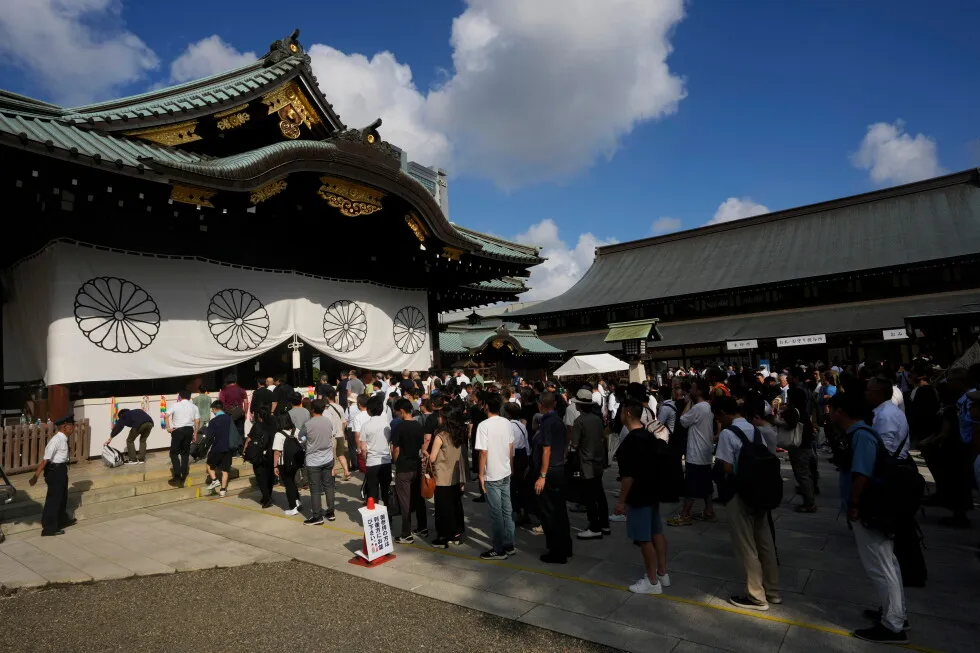
A look at the history and beliefs behind Japan’s controversial shrine to the war dead 1 of 4 | People wait to pray at the main hall at Yasukuni Shrine, which honors Japan’s war dead, in Tokyo on Aug. 15, 2024, as the country marks the 79th anniversary of its defeat in the World War II. (AP Photo/Hiro Komae, File) 2 of 4 | Doves are released in prayer of peace by worshippers at the Yasukuni Shrine in Tokyo, Japan, Tuesday, Aug. 15, 2023. (AP Photo/Eugene Hoshiko, File) 3 of 4 | Visitors line up to offer prayers at the Yasukuni Shrine on the 80th anniversary of Japan’s surrender in World War II in Tokyo, Aug. 15, 2025. (AP Photo/Louise Delmotte, File) 4 of 4 | Japanese Emperor Hirohito visits Yasukuni Shrine in Tokyo, on Nov. 21, 1975. (Kyodo News via AP) 1 of 4 | People wait to pray at the main hall at Yasukuni Shrine, which honors Japan’s war dead, in Tokyo on Aug. 15, 2024, as the country marks the 79th anniversary of its defeat in the World War II. (AP Photo/Hiro Komae, File) 1 of 4 People wait to pray at the main hall at Yasukuni Shrine, which honors Japan’s war dead, in Tokyo on Aug. 15, 2024, as the country marks the 79th anniversary of its defeat in the World War II. (AP Photo/Hiro Komae, File) Add AP News on Google Add AP News as your preferred source to see more of our stories on Google. Share 2 of 4 | Doves are released in prayer of peace by worshippers at the Yasukuni Shrine in Tokyo, Japan, Tuesday, Aug. 15, 2023. (AP Photo/Eugene Hoshiko, File) 2 of 4 Doves are released in prayer of peace by worshippers at the Yasukuni Shrine in Tokyo, Japan, Tuesday, Aug. 15, 2023. (AP Photo/Eugene Hoshiko, File) Add AP News on Google Add AP News as your preferred source to see more of our stories on Google. Share 3 of 4 | Visitors line up to offer prayers at the Yasukuni Shrine on the 80th anniversary of Japan’s surrender in World War II in Tokyo, Aug. 15, 2025. (AP Photo/Louise Delmotte, File) 3 of 4 Visitors line up to offer prayers at the Yasukuni Shrine on the 80th anniversary of Japan’s surrender in World War II in Tokyo, Aug. 15, 2025. (AP Photo/Louise Delmotte, File) Add AP News on Google Add AP News as your preferred source to see more of our stories on Google. Share 4 of 4 | Japanese Emperor Hirohito visits Yasukuni Shrine in Tokyo, on Nov. 21, 1975. (Kyodo News via AP) 4 of 4 Japanese Emperor Hirohito visits Yasukuni Shrine in Tokyo, on Nov. 21, 1975. (Kyodo News via AP) Add AP News on Google Add AP News as your preferred source to see more of our stories on Google. Share Updated [hour]:[minute] [AMPM] [timezone], [monthFull] [day], [year] Emperor Meiji first visited the site that would become one of Japan’s most controversial shrines in 1874. He vowed that the names of those who died for their country would live there forever.More than 2.4 million people are now honored at Yasukuni, a memorial and Shinto shrine in central Tokyo. Among them are 14 war criminals who are also commemorated each Aug. 15, when Japan’s surrender ended World War II.The shrine provides spiritual comfort for some who mourn relatives and others who visit to express gratitude. Yet for Asian countries that endured Japanese imperial rule and expansion, Yasukuni remains a symbol of Japan’s militarism.Visits by Japanese leaders frequently draw criticism from China and South Korea, which see them as a sign of insufficient remorse for Japan’s wartime aggression.Here’s a look at the history and religious background of a shrine that is both a sacred place of remembrance and a source of controversy. Yasukuni’s foundation followed a historic transformationImperial rule was restored in Japan in the 19th century after the fall of a military government that ruled for more than 250 years. A year into the new imperial era, in 1869, Emperor Meiji ordered the construction of the shrine that would later be renamed Yasukuni.The name derives from two Japanese characters that can be translated as “peaceful country,” and its purpose was to honor those who fell defending the imperial cause. 3 MIN READ 1 MIN READ 5 MIN READ “Yasukuni Shrine was initially conceived as a way to send a message to the Japanese people,” said Akiko Takenaka, a professor of history at the University of Kentucky. “The message was about the emperor; the message was about a new Japan.”In that Japan, Takenaka added, Meiji became the one who could bestow the highest honor on those who died fighting for the empire and men were expected to consider it an honor to sacrifice their lives for him. Religion and government became intertwinedJapan’s emperors have long been regarded as descendants of the sun goddess Amaterasu under Shinto beliefs. However, the notion of the emperor’s divine origins strengthened during the Meiji era, when the concept of State Shinto arose.On one hand, that meant the government exercised control over the shrine’s practices and finances. Beyond that, the line between patriotism and religion blurred. “The Meiji reformers believed that they were establishing an ideal nation in which the people and the sacred emperor maintained a spiritual union,” wrote Susumu Shimazono, a scholar specializing in religion and modern Japan, in the Japanese Journal of Religious Studies.The separation of religion and state came after Japan’s surrender in WWII. In December 1945, U.S. Gen. Douglas MacArthur issued an order that abolished State Shinto. The measure effectively cut off government funding for shrines and removed Shinto practices and teachings from public institutions.Yasukuni subsequently became a private religious corporation. Official visits have raised questions about the constitutional separation of religion and government. Enshrinement at Yasukuni has long stirred controversyYasukuni is not a cemetery. Rather than bodies or graves, those remembered there are enshrined as “kami” — divinities or sacred spirits in the Shinto tradition.They include soldiers, women who provided battlefield relief, students mobilized to support wartime production, and foreign nationals who died while serving Japan.Yasukuni’s most controversial kami are 14 Class-A war criminals, a designation applied to Japanese leaders accused of “crimes against peace” by planning and waging the war. Among them is wartime Prime Minister Hideki Tojo, one of the masterminds behind the attack on Pearl Harbor.Their enshrinement was carried out in secret by Yasukuni’s head priest in 1978, three years after Hirohito last prayed at the shrine.“Emperor Hirohito did not go again after he found out,” said Mark R. Mullins, professor of Japanese and religious studies at the University of Auckland. “He didn’t want to get caught up in criticism surrounding that.”Hirohito’s successors have sent emissaries to Yasukuni for its key annual rites, but neither has visited the shrine in person as emperor. Other controversial enshrinements include Buddhists, Christians, Koreans and Taiwanese whose families say they were included without their consent, Mullins said.Some have taken legal action, but Japanese courts have rejected efforts to have relatives removed from the shrine. Yasukuni means different things to different people“For some of those in the bereaved families’ association, the focus may be on the personal grief,” Mullins said. “But for those who are keen to restore what they feel was lost by the loss of the war and the foreign occupation, it means something more.”Adjacent to the shrine is the Yushukan Museum, which displays wartime artifacts. Scholars have underscored how its account of Japan’s military history leaves out the experiences of China and Korea under Japanese imperialism.“By eliminating the enemy, the Yushukan remembers a war that was only ever glorious,” wrote John Breen, a professor at the International Research Center for Japanese Studies, in a paper called “Yasukuni Shrine: Ritual and Memory.”Some visitors say paying respects at Yasukuni carries a spiritual meaning that should not be equated with endorsing war. Kana Shindo, a member of Tokyo’s Minato City Assembly, said she regards the shrine as a place where she purifies her mind, gives thanks to the kami and reflects on herself.“I have absolutely no intention of glorifying war,” said Shindo, who added that politicians also have freedom of religion and conscience. “I visit because I believe that the peaceful Japan in which we live today exists upon the lives and accumulated history of the people who lived before us.”Bereaved families maintain ties to YasukuniBefore leaving for war, Japanese soldiers were told that if they died, they would be enshrined at Yasukuni.“They told their families: ‘I want you to come see me at Yasukuni Shrine,’” said Toshiei Mizuochi, president of the Japan War-Bereaved Families Association.His father, who served in the Japanese navy, was killed in a bombing six days before the end of the war, on Aug. 9, 1945.More than 2.4 million Japanese soldiers died overseas during WWII. The remains of approximately 1 million have yet to be recovered.“For that reason, the vast majority of bereaved families who received neither remains nor personal belongings believe that the spirits of the war dead are at Yasukuni Shrine,” Mizuochi said.Relatives like him visit Yasukuni beyond Aug. 15. They attend major ceremonies, commemorate death anniversaries and report family milestones — entering school, starting a job, getting married or having a child.“I visit Yasukuni Shrine more times than I can count in a year,” Mizuochi said. “Every time I put my hands together in prayer, the face of my father in his portrait naturally comes to mind.”___Associated Press religion coverage receives support through the AP’s collaboration with The Conversation US, with funding from Lilly Endowment Inc. The AP is solely responsible for this content. Hernández is a multimedia reporter for AP’s Global Religion team. She is based in Beijing and covers the intersection of faith, culture and spirituality across Asia. Before moving to China, she was based in Mexico.
SRCAssociated Press (AP)
LANGEN
LEANCenter
WORDS1 637
ENT10
FRI · 2026-08-14 · 04:53 GMTBRIEF NSR-2026-0814-102194
NSR-2026-0814-102194News Report·EN·Conflict
A look at the history and beliefs behind Japan’s controversial shrine to the war dead
Yasukuni Shrine in Tokyo, established in 1869 by Emperor Meiji, honors over 2.4 million Japanese war dead, including 14 Class-A war criminals. While it offers spiritual comfort to some grieving families and those expressing gratitude, it remains a symbol of Japanese militarism for neighboring Asian countries, drawing criticism from China and South Korea.
By
MARÍA TERESA HERNÁNDEZAssociated Press (AP)Filed 2026-08-14 · 04:53 GMTLean · CenterRead · 7 min
Associated Press (AP)FIG 01
Reading time
7min
Word count
1 637words
Sources cited
0cited
Entities identified
10entities
Quality score
100%
§ 01
Briefing Summary
AI-generatedNEWSAR · AI
Yasukuni Shrine in Tokyo, established in 1869 by Emperor Meiji, honors over 2.4 million Japanese war dead, including 14 Class-A war criminals. While it offers spiritual comfort to some grieving families and those expressing gratitude, it remains a symbol of Japanese militarism for neighboring Asian countries, drawing criticism from China and South Korea. The shrine's history is tied to the Meiji era's State Shinto, which blurred the lines between patriotism and religion, though it became a private religious corporation after World War II. The enshrinement of war criminals, particularly in 1978, has been a significant source of controversy, with Emperor Hirohito ceasing personal visits after learning of it. For many bereaved families, Yasukuni represents a connection to lost loved ones whose remains were never recovered.
Confidence 0.90Claims 4Entities 10
§ 02
Article analysis
Model · rule-basedFraming
Conflict
Diplomatic
Tone
Measured
AI-assessed
CalmNeutralAlarmist
Factuality
0.80 / 1.00
Factual
LowHigh
Sources cited
0
No named sources
FewMany
§ 03
Key claims
4 extracted01
Japan marks the anniversary of its defeat in World War II on Aug. 15.
factual
Confidence
1.00
02
The shrine is a memorial and Shinto shrine in central Tokyo.
factual
Confidence
1.00
03
Emperor Meiji visited the site in 1874 and vowed that the names of those who died for their country would live there forever.
factual
Confidence
1.00
04
Yasukuni Shrine honors more than 2.4 million people, including 14 war criminals.
factual
Confidence
1.00
§ 04
Full report
7 min read · 1 637 words§ 05
Entities
10 identifiedKey playerOppositionContextPositiveNeutralNegative
People4
Organizations2
§ 06
Keywords & salience
9 termsyasukuni shrine
1.00
war dead
0.90
world war ii
0.80
controversial shrine
0.70
japan
0.60
beliefs
0.50
history
0.50
prayer
0.40
peace
0.40
§ 07
Topic connections
Interactive graph Network visualization showing 51 related topics
View Full Graph Person Organization Location Event|Click node to navigate|Edge numbers = shared articles