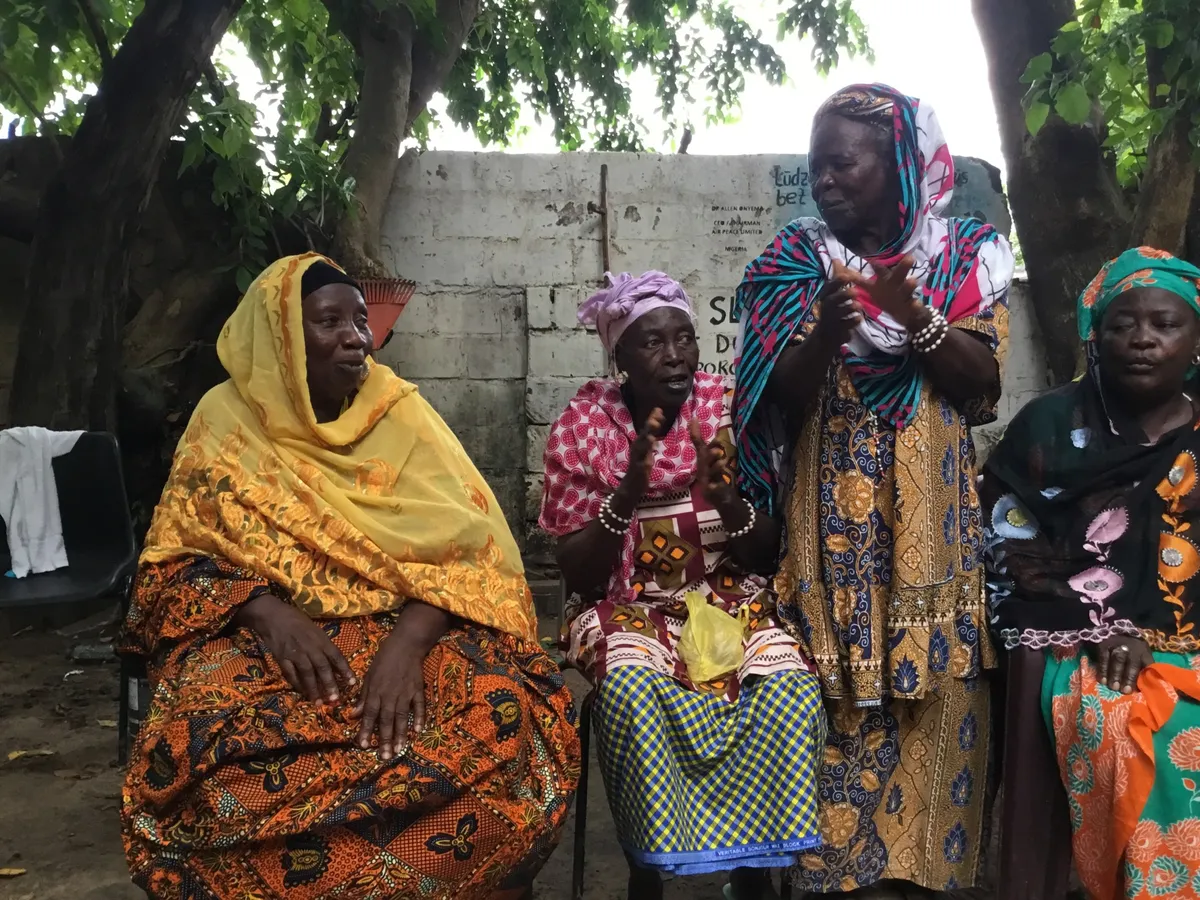
Banjul, The Gambia - The women arrive laughing before anyone hears them sing. More than a dozen of them are dressed in oversized men's shirts and loose trousers to show they are as strong as men. Upon their heads are brightly coloured headscarves of yellow, red and green.They tease one another as an empty plastic water bucket is turned upside down and beaten like a drum.The hollow beat fills the compound as voices rise in Mandinka, one woman leading a verse before the others answer in chorus.“Domori wo nteh'mang'na domorilan n'konobeh faring'neh sankuruwayang, nteh'mang'na domorila sankuruwayang. Meyeng naati wo tanbi'ta wola leh,” they sing.“I did not come here for food; my stomach is already full. I have come for something greater than that.”At weddings and naming ceremonies, they are entertainers, drawing crowds with jokes, dancing and song. The small donations they sometimes receive at these events can help support the group and their activities. But beneath the laughter is another story.At 84, Mentending Trawally is slight and stooped, her face lined by time. A yellow veil frames her face, covering her ears. She no longer sings as loudly as she once did.When the Kanyeleng, whose tradition offers solidarity to women who have experienced infertility and child loss, gather on a Sunday evening in July in the shade of a house in Bakau, a coastal town on the outskirts of Banjul, it is younger voices that now carry the songs she first learned as a teenager.Thirteen women sit shoulder to shoulder as the late afternoon heat begins to soften, some swaying gently to the rhythm, others clapping in time. Outside the compound gate, neighbourhood children stand on tiptoe, peering through the entrance as the singing spills into the street.Trawally sits among them, gently tapping her feet against the ground, smiling whenever someone forgets a verse she still knows by heart. Age has slowed her body, but it has not dimmed the songs that have stayed with her for more than seven decades.“I was born into Kanyeleng,” she says.At 84, Mentending Trawally no longer sings as loudly as she once did [Kaddy Jawo/Al Jazeera]Bakau is home to one of the largest concentrations of Kanyeleng with about 10 groups, but the tradition extends across The Gambia’s seven regions. Historian Hassoum Ceesay estimates there are more than 100 groups nationwide, and similar traditions are found in neighbouring Senegal, Guinea, Guinea-bissau" class="entity-link entity-location" data-entity-id="129" data-entity-type="location">Guinea-Bissau and Sierra Leone.The exact age of the tradition is difficult to determine, but Ceesay traces its roots back generations. Deeply associated with Mandinka culture, Kanyeleng is a cultural rather than religious practice and is not confined to one ethnic group. Related traditions have been adapted across communities. Among Fula people, for example, the term "geedereh", meaning "dumpsite", is used while the Wolof term "morrso" refers to a rag.The tradition shaped Trawally’s family long before she understood its meaning. Her maternal grandmother became a Kanyeleng after losing every child in infancy except Trawally’s mother. Years later, her mother would join too.Trawally remembers little of her grandmother herself. Instead, she remembers the songs, the clusters of women gathering in the family compound and the rhythm of dozens of dancing feet.In Mandinka, Mentending means tomato, a name her family connected to survival, like a plant that continues to grow despite hardship.Trawally smiles as she tells the story, her hands folded loosely in her lap. “My mother gave me that name because I survived,” she says.When she married as a young woman, she dreamed of a home filled with children, little feet running through the compound and the joy of watching them grow.Instead, five pregnancies ended, for reasons she doesn’t know, before she could carry a baby to term.“I cried until I had no tears left,” she tells Al Jazeera.In her community, motherhood shaped how women were viewed and valued. People saw the absence of a child, she says, but not the pain behind it.After marriage and the heartbreak of repeated miscarriages, Trawally returned to the Kanyeleng tradition she had grown up watching.The women welcomed her into a circle of others who knew the pain of losing pregnancies and losing children. Among them, she no longer had to explain her grief.Decades later, Trawally still remembers the verses she learned as a teenager. She remembers the women who came before her and the younger voices now carrying the songs forward.“Those songs are my life,” she says.For the Kanyeleng, song allows experiences that can be difficult to articulate in ordinary conversation to be expressed collectively. Through humour and shared rhythm, they turn experiences of loss into moments of connectionEvery Sunday as the sun sets, the women gather at Trawally’s home, a modest family compound with two corrugated iron-roofed houses arranged around a partly tiled courtyard. A small mango tree casts shade across the yard where the women sit in a circle, singing, clapping and punctuating the verses with laughter.Each member contributes 200 dalasis (about $2.70) to a shared fund that is set aside to help any woman facing hardship, whether through illness, bereavement or other unexpected difficulties.Contributions collected at a Kanyeleng gathering go into a shared fund used to help members in times of need [Kaddy Jawo/Al Jazeera]Neighbourhood children linger outside the compound gate, drawn by the rhythm of the singing and the hollow beat of the improvised drum. Dressed in T-shirts and shorts, they peek through the entrance.To a visitor, it looks like a celebration.Trawally smiles. "Outsiders see only the performance,” she says. “They do not see the grief that created it.”
SRCAl Jazeera
LANGEN
LEANCenter
WORDS913
ENT11
FRI · 2026-08-14 · 08:09 GMTBRIEF NSR-2026-0814-102239
NSR-2026-0814-102239News Report·EN·Human Interest
The Gambian women turning grief into song
In The Gambia, women known as the Kanyeleng transform experiences of child loss and infertility into music. These groups, with roots stretching back generations, gather to sing, dance, and share solidarity.
Kaddy JawoAl JazeeraFiled 2026-08-14 · 08:09 GMTLean · CenterRead · 4 min
Al JazeeraFIG 01
Reading time
4min
Word count
913words
Sources cited
2cited
Entities identified
11entities
Quality score
100%
§ 01
Briefing Summary
AI-generatedNEWSAR · AI
In The Gambia, women known as the Kanyeleng transform experiences of child loss and infertility into music. These groups, with roots stretching back generations, gather to sing, dance, and share solidarity. The tradition, deeply associated with Mandinka culture, provides a space for women to express grief collectively through song and humor, finding connection in shared hardship. For women like 84-year-old Mentending Trawally, who experienced multiple miscarriages, the Kanyeleng offered solace and a way to process pain that was often unseen by the community. The tradition continues across The Gambia, with numerous groups nationwide and similar practices in neighboring countries, ensuring that these songs of resilience and remembrance are passed on.
Confidence 0.90Sources 2Claims 5Entities 11
§ 02
Article analysis
Model · rule-basedFraming
Human Interest
Social Justice
Tone
Measured
AI-assessed
CalmNeutralAlarmist
Factuality
0.70 / 1.00
Factual
LowHigh
Sources cited
2
Limited
FewMany
§ 03
Key claims
5 extracted01
Mentending Trawally, 84, has been part of the Kanyeleng tradition since she was a teenager.
quoteMentending Trawally
Confidence
1.00
02
The Kanyeleng tradition offers solidarity to women who have experienced infertility and child loss.
factual
Confidence
1.00
03
The Kanyeleng tradition is a cultural practice, not religious, and is not confined to one ethnic group.
factual
Confidence
0.95
04
Similar traditions to Kanyeleng are found in neighboring Senegal, Guinea, Guinea-Bissau, and Sierra Leone.
factual
Confidence
0.95
05
Historian Hassoum Ceesay estimates there are over 100 Kanyeleng groups nationwide in The Gambia.
statisticHassoum Ceesay
Confidence
0.90
§ 04
Full report
4 min read · 913 words§ 05
Entities
11 identifiedKey playerOppositionContextPositiveNeutralNegative
Organizations1
Locations7
Topics1
§ 06
Keywords & salience
8 termskanyeleng tradition
1.00
women's solidarity
0.90
grief and song
0.80
infertility and child loss
0.70
cultural tradition
0.60
the gambia
0.50
mandinka
0.40
senegal
0.40
§ 07
Topic connections
Interactive graph No topic relationship data available yet. This graph will appear once topic relationships have been computed.