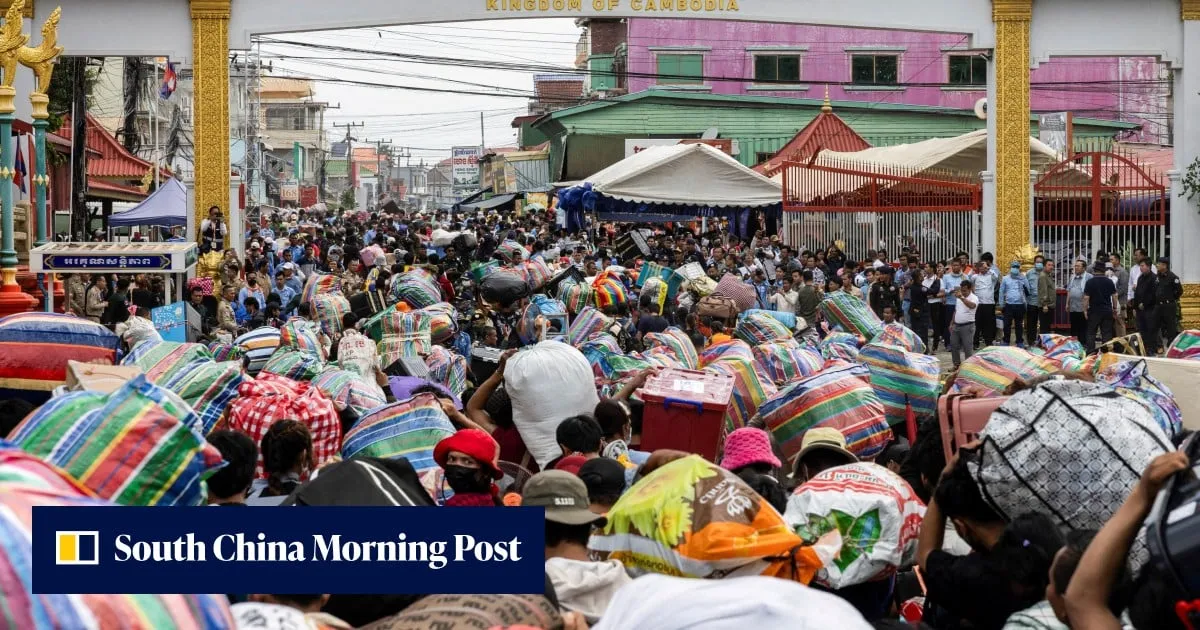
After last year’s conflict" class="entity-link entity-event" data-entity-id="186382" data-entity-type="event">border conflict with Cambodia, hundreds of thousands of migrant workers left Thailand, exposing how dependent parts of its economy had become on cross-border labour.Thailand has tried to ease the squeeze by holding on to workers already in the country, especially Myanmar nationals. But figures from the International Labour Organization (ILO) and warnings from employer groups point to a deeper problem: a workforce built around proximity, familiarity and low travel costs cannot be quickly recreated through permit extensions.Bringing in new labour legally is proving far more difficult, constrained by conflict, Myanmar’s exit controls and rising travel and brokerage costs.The exact size of the Cambodian exodus is contested because of the calculation methods.Last March, Thailand’s Department of Employment logged 495,271 authorised Cambodian workers – a figure dwarfed by Myanmar nationals, who made up 2.27 million of 3.14 million legal workers from nine Southeast Asian countries. A Labour Ministry analysis published six months later cited a Cambodian estimate of 780,000 returns, including undocumented migrants and family members.For Thai employers, however, it is not how many workers have left but who remain available.
SRCSouth China Morning Post
LANGEN
LEANCenter-Right
WORDS182
ENT12
SUN · 2026-08-16 · 04:00 GMTBRIEF NSR-2026-0816-102722
NSR-2026-0816-102722News Report·EN·Economic Impact
How Cambodian worker exodus exposes Thailand’s fragile labour model
A significant exodus of Cambodian migrant workers from Thailand following a border conflict last year has revealed the Thai economy's heavy reliance on cross-border labor. Thailand has attempted to mitigate this labor shortage by retaining existing migrant workers, particularly those from Myanmar.
Vincent TanSouth China Morning PostFiled 2026-08-16 · 04:00 GMTLean · Center-RightRead · 1 min
South China Morning PostFIG 01
Reading time
1min
Word count
182words
Sources cited
3cited
Entities identified
12entities
Quality score
100%
§ 01
Briefing Summary
AI-generatedNEWSAR · AI
A significant exodus of Cambodian migrant workers from Thailand following a border conflict last year has revealed the Thai economy's heavy reliance on cross-border labor. Thailand has attempted to mitigate this labor shortage by retaining existing migrant workers, particularly those from Myanmar. However, the International Labour Organization and employer groups indicate that extending permits is insufficient to replace the lost workforce, as legal recruitment is hindered by conflict, Myanmar's exit controls, and increased travel and brokerage fees. While the exact number of Cambodian workers who left is debated, the departure has created a critical labor gap for Thai employers.
Confidence 0.90Sources 3Claims 5Entities 12
§ 02
Article analysis
Model · rule-basedFraming
Economic Impact
Conflict
Tone
Measured
AI-assessed
CalmNeutralAlarmist
Factuality
0.70 / 1.00
Factual
LowHigh
Sources cited
3
Well sourced
FewMany
§ 03
Key claims
5 extracted01
Myanmar nationals constituted 2.27 million of 3.14 million legal workers from nine Southeast Asian countries in Thailand.
statisticThailand's Department of Employment
Confidence
0.90
02
Thailand's Department of Employment logged 495,271 authorized Cambodian workers in March, while a later analysis cited a Cambodian estimate of 780,000 returns including undocumented migrants.
statisticThailand's Department of Employment and Labour Ministry analysis
Confidence
0.90
03
Figures from the International Labour Organization (ILO) and employer groups indicate difficulties in legally bringing in new labor due to conflict, Myanmar's exit controls, and rising costs.
factualInternational Labour Organization (ILO) and employer groups
Confidence
0.90
04
Hundreds of thousands of migrant workers left Thailand after a border conflict with Cambodia, exposing economic dependence on cross-border labor.
factual
Confidence
0.90
05
Thailand has struggled to retain workers, with permit extensions proving insufficient to recreate a workforce based on proximity and low travel costs.
factual
Confidence
0.80
§ 04
Full report
1 min read · 182 words§ 05
Entities
12 identifiedKey playerOppositionContextPositiveNeutralNegative
Organizations3
§ 06
Keywords & salience
10 termsmigrant workers
1.00
labour model
0.90
cambodian exodus
0.80
thailand economy
0.70
cross-border labour
0.70
myanmar nationals
0.60
international labour organization
0.50
employer groups
0.40
travel costs
0.40
brokerage costs
0.40
§ 07
Topic connections
Interactive graph Network visualization showing 51 related topics
View Full Graph Person Organization Location Event|Click node to navigate|Edge numbers = shared articles