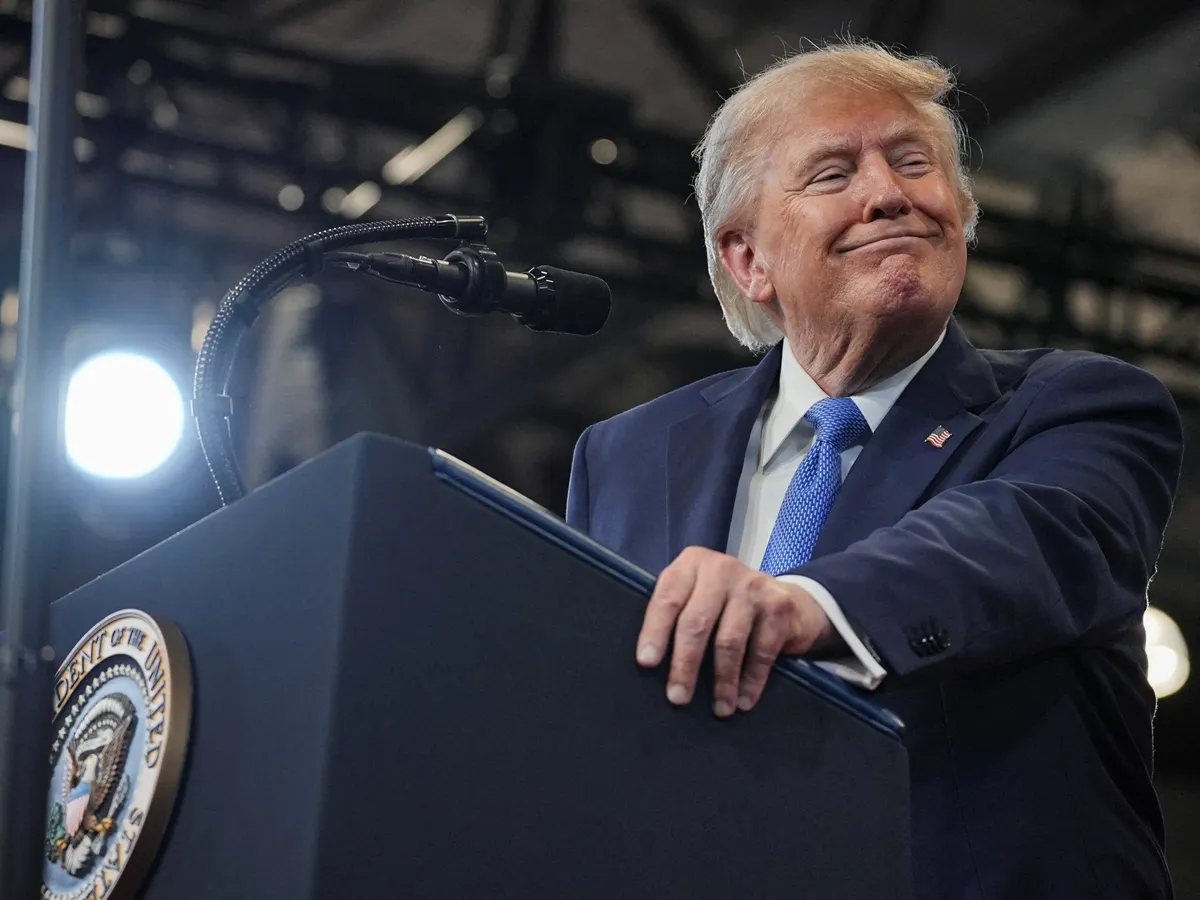
EXPLAINERTrump threatens to make the Strait of Hormuz a US territory: Can he?US president has yet another outlandish threat for Iran, with no end to war in sight.President Donald Trump delivers remarks at David S Mack Center for Training and Intelligence in Garden City, New York, US, August 14, 2026 [Ken Cedeno/Reuters]Published On 16 Aug 2026President Donald Trump on Friday said he would designate the Strait of Hormuz a territory of the United States “pretty soon” as the status of the waterway, a global chokepoint through which a fifth of global oil and gas passes, remains under a military and diplomatic deadlock.Iran has fired back, dubbing Trump’s threats as “nonsense” as the memorandum of understanding signed between the two in June expires on Sunday.Recommended Stories list of 4 itemslist 1 of 4Iran says no decision yet on a return to talks with the USlist 2 of 4Is China seeking to copy Iran’s Strait of Hormuz blockade around Taiwan?list 3 of 4US aircraft carrier expected to relieve USS Lincoln in Middle Eastlist 4 of 4Qatar denies Tehran’s claim it is detaining Iranian bomber pilotsend of listTehran has blocked the passage to leverage it as a global economy kill switch, while Washington has maintained a military naval blockade against Iran’s ports, choking its economy further.In the apparent game of who blinks first – though Trump says negotiation with Iran “is like chess” – the US president’s military rhetoric has also followed a pattern throughout the ongoing war, which began on February 28. On many occasions, he has threatened to attack Iran only to pull back at the eleventh hour.So, can the US actually make the Strait of Hormuz its territory? And what does that even mean?Children swim as ships are seen anchored in the Strait of Hormuz on August 10, 2026, off the coast of Bandar Abbas, Iran [File: Ali Saeedi/Getty Images]What has Trump said?“After we finish defeating Iran, which is being very badly defeated, pretty soon I’ll be declaring the Hormuz Strait a territory of the United States,” Trump said during a speech at a police academy in New York.Referring to the naval blockade, Trump went a step further to suggest that the Strait of Hormuz is already a US territory. “Essentially, that’s what it is,” he added.“We have the blockade. No ships get through unless we want them to,” he said.Iran maintains that it controls the waterway — and despite the US claims, some vessels have transited the passage despite the blockade, maritime navigation data shows.“It’s clear the US president, with a chuckle as he said that, even himself, is not taking this particularly seriously,” said Al Jazeera’s Kimberly Halkett, reporting from Washington, DC.“These are the territorial waters of Iran and Oman. But what the US president likes to do is get under the skin of adversaries, and, in this case, it’s Iran,” she said.“What we should point out, though, is what the US president is not backing down on is the fact that there is a naval blockade by the United States in effect in the Strait of Hormuz, and that is ongoing.Iran’s Foreign Minister Abbas Araghchi has blamed the US for a return to violence in the Strait of Hormuz [File: Elke Scholiers/Getty Images]How has Iran reacted to it?Several Iranian officials have sharply reacted to Trump’s remarks. The head of the judiciary came out with furious rhetoric, calling the US president criminal and feather-headed, his remarks “nonsense” and saying the Strait of Hormuz belongs to Iran.Kazem Gharibabadi, Iran’s deputy foreign minister, also responded, saying, “The Strait of Hormuz cannot be seized by tweet, nor by aircraft carrier, nor by issuing an order, nor by an election speech.”“The Strait of Hormuz has been Iranian, is Iranian, and will remain Iranian; this strait will only be closed and opened under Iran’s command, and as long as you do not accept the reality of defeat and cease your fanciful delusions, Iran will continue to enforce the blockade,” he added.Meanwhile, Iran has been holding talks with Oman, the only other coastal country in the strait, to reach a settlement on the management of maritime traffic in the strait. Foreign Minister Abbas Araghchi, in comments carried by the Iranian Students’ News Agency, said negotiations between Tehran and Muscat “may reach a conclusion soon”.The reopening of the waterway, however, is a separate issue, Araghchi said, where Washington has to adhere to promises made in the June memorandum of understanding, including removal of the naval blockade and sanctions on Iran.That is the new Iranian position on the ongoing war, where Tehran is now seeking these US concessions for mere reopening of the waterway, which were originally conditions for ending the war.Is Trump’s claim even practical?First, sovereignty does not exchange hands over a mere unilateral presidential proclamation.For instance, Trump had earlier threatened to send US boots to Iran’s Kharg Island to take over the key Iranian oil export hub in the Gulf. Tehran then responded by saying that its Islamic Revolutionary Guard Corps would be waiting for them, “with fingers on the trigger”. Trump had previously also threatened to take over Greenland, an autonomous territory of Denmark.Bruce Fein, associate deputy attorney general under President Ronald Reagan, says Trump is constitutionally powerless to annex on his own.“A treaty ratified by the Senate or statute is constitutionally required to annex territory, as with the Louisiana Purchase or annexation of Hawaii or Panama Canal or acquisition of Puerto Rico or the Philippines in ending the Spanish-American War.If he goes ahead with annexation, Fein says, it would “constitute the crime of aggressive war under international law, including the UN Charter”.Natalie Klein, a specialist in international law and associate dean at the University of New South Wales, Sydney, said, “Essentially the only way Trump’s claim could have any plausibility under international law would be if the US was asserting control over the Strait as an occupying power perhaps comparable to the authority the US exercised over Japan immediately after World War II.”“But in that scenario, the US would need to have military control over Iran or at least its coastal areas.”Trump’s war on Iran is also widely unpopular in the US, where the president and his fellow Republicans are seeking to defend their narrow congressional majorities in November’s midterm elections. Barely 35 percent of Americans approve of the war, according to a Reuters/Ipsos poll.Several US media publications have reported that Washington is running short on munitions, including the crucial Patriot antimissile interceptor. Petrol prices have also increased, and are now averaging more than $4 a gallon – a major issue for Americans.Last week, US Vice President JD Vance said the Trump administration’s top priority in the war was to control increasing petrol prices, while stopping Iran’s supposed race to a nuclear weapon now comes second.Tehran has also attacked its neighbours in the Gulf, which analysts say are aimed at forcing the regional countries to push Washington into a corner at the negotiating table.Even Iran does not enjoy unfettered sovereignty over the strait as a whole, under international laws, including the UN Convention on the Law of the Sea (UNCLOS), but only some coastal sites near its own borders.The UNCLOS recognises coastal-state sovereignty over territorial waters, but limits that territorial sea to 12 nautical miles (22km), and notes that ships enjoy a right of passage that “shall not be impeded”.The Strait of Hormuz is in international waters, sandwiched between the coasts of Iran and Oman. At its narrowest point, the strait is only about 21 nautical miles (39km) wide — and the two countries’ 12-nautical mile territorial seas overlap across it.While neither the US nor Iran has ratified UNCLOS, the convention’s rules on international straits are widely regarded as customary law.
SRCAl Jazeera
LANGEN
LEANCenter
WORDS1 279
ENT10
SUN · 2026-08-16 · 11:14 GMTBRIEF NSR-2026-0816-102766
NSR-2026-0816-102766Analysis·EN·Political Strategy
Trump threatens to make the Strait of Hormuz a US territory: Can he?
President Donald Trump has threatened to declare the Strait of Hormuz a United States territory "pretty soon," following Iran's blockade of the vital waterway. Iran has dismissed the threat as "nonsense," asserting its control over the strait.
Al Jazeera StaffAl JazeeraFiled 2026-08-16 · 11:14 GMTLean · CenterRead · 6 min
Al JazeeraFIG 01
Reading time
6min
Word count
1 279words
Sources cited
2cited
Entities identified
10entities
Quality score
100%
§ 01
Briefing Summary
AI-generatedNEWSAR · AI
President Donald Trump has threatened to declare the Strait of Hormuz a United States territory "pretty soon," following Iran's blockade of the vital waterway. Iran has dismissed the threat as "nonsense," asserting its control over the strait. The US has imposed a naval blockade against Iran's ports, impacting its economy. Trump's rhetoric is seen by some as a tactic to provoke adversaries, while Iran, in response, is negotiating with Oman for maritime traffic management. Iran's position is that the Strait of Hormuz belongs to Iran and will only be opened under its command, demanding US concessions for its reopening.
Confidence 0.90Sources 2Claims 5Entities 10
§ 02
Article analysis
Model · rule-basedFraming
Political Strategy
Conflict
Tone
Mixed Tone
AI-assessed
CalmNeutralAlarmist
Factuality
0.60 / 1.00
Mixed
LowHigh
Sources cited
2
Limited
FewMany
§ 03
Key claims
5 extracted01
Iran has dubbed Trump's threats as "nonsense."
quoteIran
Confidence
1.00
02
The Strait of Hormuz is a global chokepoint through which a fifth of global oil and gas passes.
factual
Confidence
1.00
03
President Donald Trump stated he would declare the Strait of Hormuz a US territory "pretty soon."
quoteDonald Trump
Confidence
1.00
04
The US has maintained a military naval blockade against Iran's ports.
factual
Confidence
0.90
05
The Strait of Hormuz are the territorial waters of Iran and Oman.
factualAl Jazeera's Kimberly Halkett
Confidence
0.80
§ 04
Full report
6 min read · 1 279 words§ 05
Entities
10 identifiedKey playerOppositionContextPositiveNeutralNegative
§ 06
Keywords & salience
8 termsstrait of hormuz
1.00
us territory
0.90
iran
0.90
donald trump
0.80
naval blockade
0.70
global oil and gas
0.60
military rhetoric
0.50
diplomatic deadlock
0.40
§ 07
Topic connections
Interactive graph Network visualization showing 51 related topics
View Full Graph Person Organization Location Event|Click node to navigate|Edge numbers = shared articles