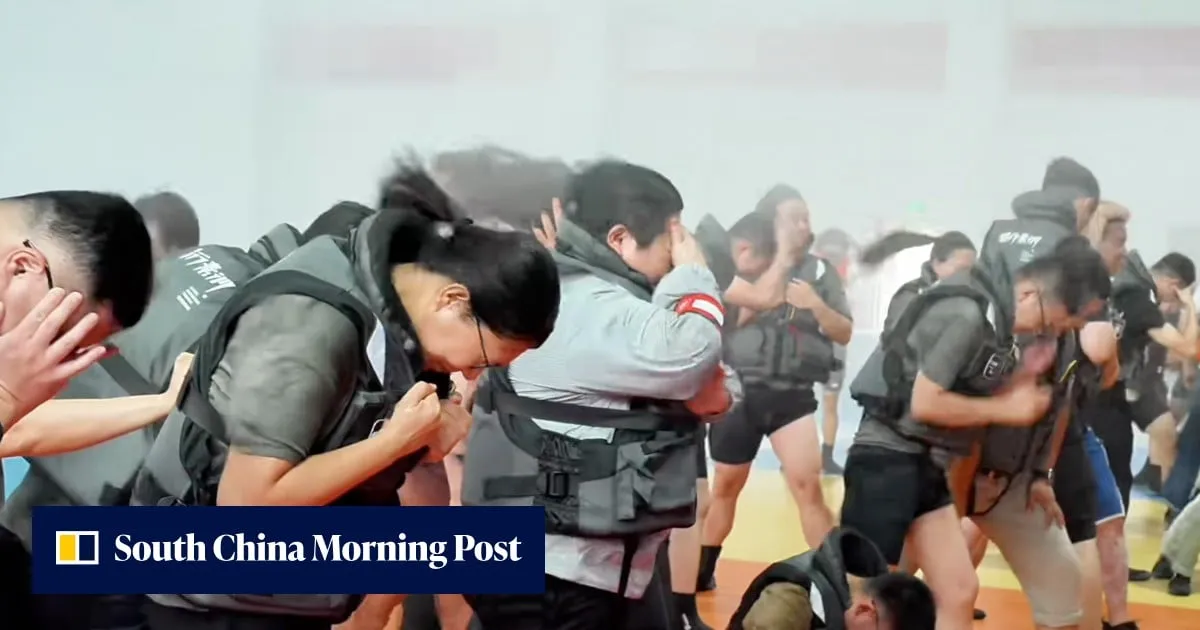
As dark tourism gains traction, some Chinese youth are embracing a related form of experiential travel, paying to confront simulated typhoons, floods, and other disasters while acquiring survival skills.Also referred to as grief tourism, dark tourism involves visiting sites linked to death, catastrophe, and human suffering. Its origins trace back centuries, including connections to 17th century Britain, where public executions often attracted large crowds.This phenomenon has surged across Asia in recent years, but its increasing popularity has sparked ethical debates regarding whether such experiences encourage remembrance and reflection or merely commodify tragedy for entertainment and profit.Many believe these sites serve a crucial role in death education, while research suggests that the authenticity of disaster relics deepens visitors’ understanding of mortality. Photo: QQ.comIn Hangzhou, eastern China, Lvxing Base, touted as the country’s first immersive natural disaster simulation centre, has become a sensation on social media since its opening in September 2024.For 899 yuan (US$135), adults can brave simulated typhoons, torrential rain, and flash floods, while a family package costing nearly 5,000 yuan includes wilderness survival and water rescue training. Children aged six to 14 can participate in selected activities.Mainland media reports indicate that the Lvxing Base can generate winds of up to 165km/hour.Participants don thermal suits and helmets before entering, while instructors provide training in rescue and disaster response skills, and trained safety staff are available to assist anyone who becomes distressed.Xiaofei, who grew up in a coastal city, shared that she had never experienced a typhoon or flood up close. During the urban flooding simulation, water surged into an underground car park, rising to her neck.One participant recounted her experience during an urban flooding simulation, where water surged into an underground car park and rose to her neck, just like the person pictured above. Photo: QQ.com“The suffocating fear made me forget I was merely ‘experiencing’ a disaster,” she told Vista Hydrogen Business.The flash flood drill was even more intense. A torrent swept her into a concrete bollard, leaving bruises on her leg, while her group, composed entirely of foreign tourists, instinctively helped one another, giving her a vivid sense of human solidarity.Since opening in late 2024, Lvxing Base has reportedly attracted over 160,000 visits for disaster simulations.Experts suggest that the appeal lies partly in confronting a crisis that feels dangerous yet remains controlled and surmountable.Further ReadingZhang Yong, a social work professor at Wuhan University of Science and Technology, noted that such immediate proof of one’s capabilities can be particularly compelling for individuals navigating intense competition and uncertain outcomes in daily life.Experience centres provide a safe space for individuals to face life-threatening disasters while simultaneously acquiring essential survival skills. Photo: QQ.comThe concept was inspired by the founders’ own adventures. Since 2012, Zhang Xinyu and Liang Hong, dubbed China’s “crazy couple,” have ventured inside volcanoes, entered Chernobyl’s radiation zone, traversed war zones in the Middle East, and sailed their own icebreaker to Antarctica, where they married.The couple hope to distil these experiences into a systematic survival education programme, teaching practical skills while fostering a deeper respect for nature.An online commenter noted: “Disaster experience centres are a valuable way to teach survival skills, especially as more young people are willing to pay to ‘suffer.’”Another questioned the trend: “For those who have actually lived through floods and lost their homes, does transforming disaster into an experience risk trivialising their suffering?”Similar disaster experience centres are emerging across Asia, including one in Japan, above, where visitors can feel the force of a super typhoon and heavy rainfall. Photo: QQ.comChina has also established dark tourism sites that are free to the public, including memorials linked to the 2008 Wenchuan earthquake in Sichuan and the Nanking Massacre.Unlike commercial simulators, these sites are grounded in real loss and collective memory.Professor Zhang highlighted that such sites hold far greater significance for death education, while research by Bai Kai and Chen Rufeng, who co-authored a published 2024–2025 study in the Journal of Travel Research, indicates that the authenticity of disaster relics can enhance visitors’ awareness of mortality, reinforcing self-esteem, family ties, and national identity.
SRCSouth China Morning Post
LANGEN
LEANCenter-Right
WORDS673
ENT8
MON · 2026-08-17 · 01:00 GMTBRIEF NSR-2026-0817-102921
NSR-2026-0817-102921News Report·EN·Human Interest
China dark tourism on the rise as adventurers brave simulated disasters at experience centres
A new trend of "dark tourism" is emerging in China, where young people are paying to experience simulated natural disasters like typhoons and floods at specialized centers. Lvxing Base in Hangzhou, China's first immersive natural disaster simulation center, opened in September 2024 and offers experiences ranging from simulated typhoons to wilderness survival training.
Zoey ZhangSouth China Morning PostFiled 2026-08-17 · 01:00 GMTLean · Center-RightRead · 3 min
South China Morning PostFIG 01
Reading time
3min
Word count
673words
Sources cited
2cited
Entities identified
8entities
Quality score
100%
§ 01
Briefing Summary
AI-generatedNEWSAR · AI
A new trend of "dark tourism" is emerging in China, where young people are paying to experience simulated natural disasters like typhoons and floods at specialized centers. Lvxing Base in Hangzhou, China's first immersive natural disaster simulation center, opened in September 2024 and offers experiences ranging from simulated typhoons to wilderness survival training. Participants pay to confront controlled, yet intense, disaster scenarios, gaining survival skills and a sense of accomplishment. This trend is part of a broader surge in dark tourism across Asia, which involves visiting sites of death and catastrophe. While some see these centers as valuable for death education and skill acquisition, ethical debates arise about commodifying tragedy. This contrasts with free public dark tourism sites in China, like earthquake memorials, which are grounded in real loss and collective memory.
Confidence 0.90Sources 2Claims 5Entities 8
§ 02
Article analysis
Model · rule-basedFraming
Human Interest
Social Justice
Tone
Mixed Tone
AI-assessed
CalmNeutralAlarmist
Factuality
0.70 / 1.00
Factual
LowHigh
Sources cited
2
Limited
FewMany
§ 03
Key claims
5 extracted01
Zhang Yong suggests the appeal lies in confronting a controlled crisis, offering compelling proof of capabilities for individuals facing life's uncertainties.
quoteZhang Yong
Confidence
1.00
02
Adults can experience simulated typhoons and floods at Lvxing Base for 899 yuan (US$135), with packages including survival training.
factual
Confidence
1.00
03
Lvxing Base, China's first immersive natural disaster simulation centre, opened in September 2024 and has become a social media sensation.
factual
Confidence
1.00
04
Dark tourism, also referred to as grief tourism, involves visiting sites linked to death, catastrophe, and human suffering.
factual
Confidence
1.00
05
Lvxing Base can generate winds up to 165km/hour and has reportedly attracted over 160,000 visits since opening in late 2024.
factual
Confidence
0.90
§ 04
Full report
3 min read · 673 words§ 05
Entities
8 identifiedKey playerOppositionContextPositiveNeutralNegative
Organizations3
Locations4
§ 06
Keywords & salience
10 termsdark tourism
1.00
simulated disasters
0.90
experiential travel
0.80
disaster preparedness
0.70
survival skills
0.70
death education
0.60
china
0.50
lvxing base
0.50
ethical debates
0.40
human solidarity
0.40
§ 07
Topic connections
Interactive graph Network visualization showing 51 related topics
View Full Graph Person Organization Location Event|Click node to navigate|Edge numbers = shared articles