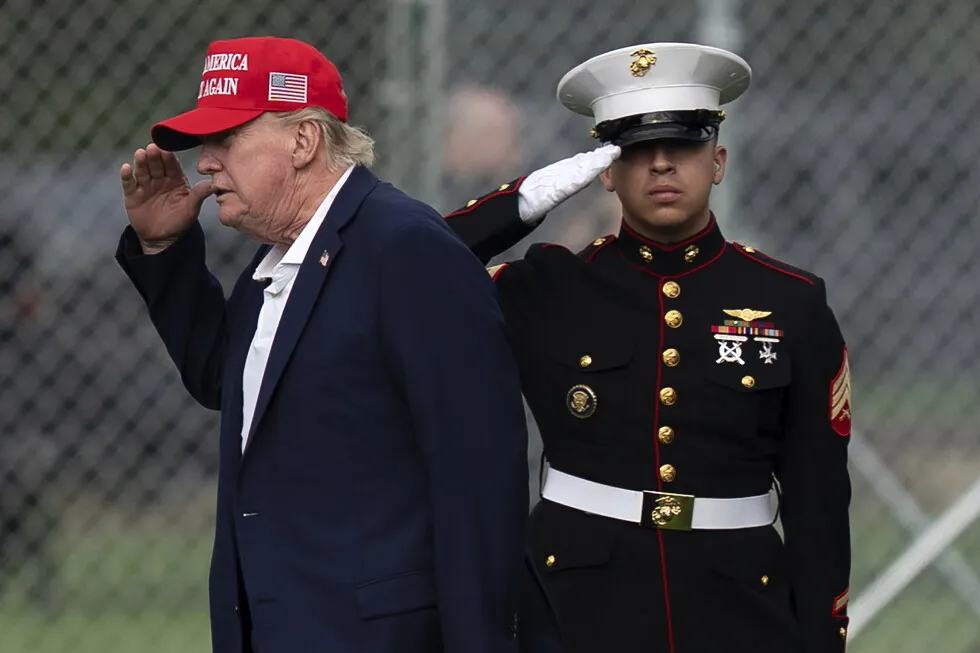
Trump’s slight of South Korea in favor of the North raises broader US security concerns 1 of 3 | President Donald Trump said Monday that North Korean leader Kim Jong Un treats him with “great respect,” a day after ordering the Pentagon to scale back annual joint military exercises with South Korea, which he criticized for not joining the U.S. war in Iran. 2 of 3 | President Donald Trump returns a salute as he walks from Marine One to his limousine upon his arrival at the Ellipse just outside of the White House, Sunday, Aug. 16, 2026, in Washington. (AP Photo/Jose Luis Magana) 3 of 3 | President Donald Trump boards Air Force One at Morristown Airport, Sunday, Aug. 16, 2026, in Morristown, N.J. (AP Photo/Julia Demaree Nikhinson) 1 of 3 President Donald Trump said Monday that North Korean leader Kim Jong Un treats him with “great respect,” a day after ordering the Pentagon to scale back annual joint military exercises with South Korea, which he criticized for not joining the U.S. war in Iran. Add AP News on Google Add AP News as your preferred source to see more of our stories on Google. Share 2 of 3 | President Donald Trump returns a salute as he walks from Marine One to his limousine upon his arrival at the Ellipse just outside of the White House, Sunday, Aug. 16, 2026, in Washington. (AP Photo/Jose Luis Magana) 2 of 3 President Donald Trump returns a salute as he walks from Marine One to his limousine upon his arrival at the Ellipse just outside of the White House, Sunday, Aug. 16, 2026, in Washington. (AP Photo/Jose Luis Magana) Add AP News on Google Add AP News as your preferred source to see more of our stories on Google. Share 3 of 3 | President Donald Trump boards Air Force One at Morristown Airport, Sunday, Aug. 16, 2026, in Morristown, N.J. (AP Photo/Julia Demaree Nikhinson) 3 of 3 President Donald Trump boards Air Force One at Morristown Airport, Sunday, Aug. 16, 2026, in Morristown, N.J. (AP Photo/Julia Demaree Nikhinson) Add AP News on Google Add AP News as your preferred source to see more of our stories on Google. Share Updated [hour]:[minute] [AMPM] [timezone], [monthFull] [day], [year] WASHINGTON (AP) — President Donald Trump’s decision to scale back joint military exercises with South Korea does not just slight a longtime ally but raises broader concerns about the security interests of the United States in Asia and elsewhere.Trump explained his decision by citing South Korea’s refusal to join his war against Iran and pointing to what he said was his good relationship with North Korea’s reclusive dictator, a transactional and personal approach to foreign policy that has defined the Republican’s presidency.“There is no American interest that I can see in this,” said Dan Fried, an assistant secretary of state for European affairs in the George W. Bush administration. “On all levels it makes no sense. It undermines the South Koreans, undermines the Japanese, frightens the Taiwanese, unnerves NATO and emboldens the Chinese, not to mention the North Koreans.”Danny Russel, former assistant secretary of state for East Asia and the Pacific in the Obama administration, said Trump’s decision to side with North Korea, which strongly objects to the annual joint military exercises, is “firmly in the ‘hard-to see-how-it-could-be-worse’ category.”“It is tragically upside-down. Trump is punishing an ally while encouraging an adversary,” said Russel, now a scholar at the Asia Society Policy Institute in New York. “He is protecting Kim Jong Un’s sensitive feelings from an unfriendly signal at the expense of U.S.-South Korean security.” The message it sends to South KoreansTrump on Sunday ordered the U.S. military to downsize the 11-day Ulchi Freedom Shield exercises, which began Monday as scheduled. It wasn’t known which parts of the training were being scaled back. His announcement baffled many in South Korea, which has been closely allied with the U.S. for decades and where national security is a top priority due to threats from nuclear-armed North Korea. 3 MIN READ 5 MIN READ 5 MIN READ It also drew instant criticism from many Democrats in Congress. “Treating one of America’s closest allies like an adversary weakens our alliances and benefits China and North Korea,” said Rep. Greg Meeks of New York, the top Democrat on the House Foreign Affairs Committee, in a statement. Trump on Monday doubled down, posting a photo of North Korea’s leader speaking on a phone. The caption read: “HEY DONALD ... WE COOL, RIGHT?” Retired U.S. Ambassador Robert Wood, who served under Republican and Democratic presidents, said the joint military exercises are critical to deterring North Korea, which has shunned any talks with the U.S. over its nuclear program and has accelerated weapons testing. “We also don’t want South Korea to draw the conclusion that a nuclear weapons capability is the only guarantee it has to ensure its security,” Wood said. Matthew Kroenig, who previously served in defense and intelligence positions in Republican and Democratic administrations, said polls show that South Koreans have increasingly supported the idea of pursuing their own nuclear weapons. “The United States has been working really hard to try to persuade South Korea that they are protected,” said Kroenig, who is now with the Atlantic Council, a Washington think tank. Scaling back the exercises “potentially undermines that message,” he said. Seoul tried to flatter Trump Trump’s turnabout came even after the South Koreans worked to flatter the American president, eager to gain favor on critical issues such as trade and defense.As soon as he sat down in the gilded Oval Office for his meeting with Trump last year, new President Lee Jae Myung praised the room’s elaborate decor. Laying it on thick, Lee affirmed Trump’s assertion that Kim would not have pursued his nuclear ambitions had Trump won a second consecutive term in 2020, while dangling the prospect of an eventual Trump Tower in North Korea.Trump just hours earlier had appeared to show sympathy for Lee’s predecessor, Yoon Suk Yeol, who had been ousted from office after imposing martial law in December 2024.Charles Kupchan, a senior fellow at the Council on Foreign Relations, said Trump’s scaling back of the exercises may prompt longtime allies to think more about their own security without U.S. help. “They are hoping that the American umbrella is there for the future,” said Kupchan, who worked on the National Security Council under Democratic Presidents Bill Clinton and Barack Obama, “but they have to at least contemplate the idea that Uncle Sam won’t be there for them.” ‘It’s like he wants to burn it all down’ Kupchan said Trump is not mistaken in wanting to have South Korea, as well as the Europeans, contribute more to their defense. But, he said, the president’s unpredictable approach cuts through the solidarity that undergirds those alliances “because he ends up insulting allies.”Fried said Trump seems unwilling to “take a win” after brow-beating NATO members and Asian allies into increasing their defense spending. “NATO is building up, South Korea is building up, Japan is building up. Trump has a problem with taking the win,” said Fried, who is currently at the Atlantic Council. “It’s like he wants to burn it all down.”John Herbst, a former ambassador to Ukraine under President George W. Bush, said the Korea decision shows how inconsistent the Trump administration can be in its policy pronouncements. But in general, he said, the U.S. has maintained long-term alliances. “If these things grow in frequency and in importance, obviously we will be in the process of taking apart the alliance system, which has served us so well since the end of World War II,” said Herbst, who also is with the Atlantic Council. “But despite some statements which seem to head in that direction, we have not headed there in a consistent, strong way.”Kupchan agreed. While the president’s language could be taken as “we’re done with you,” Kupchan said, “the reality is that, at least as of today, Trump has left intact America’s forward bases and its core alliance relationships.”Whether Trump’s message to South Korea will amount to a meaningful policy change or a fleeting social media post is up in the air. “He’s an unpredictable president,” Kroenig said. “If we move on and the exercises go as planned and we never hear anything about this again, I wouldn’t be surprised.”——Associated Press reporters Collin Binkley, Jesse Bedayn, Lisa Mascaro and Seung Min Kim in Washington and Farnoush Amiri in New York contributed to this report.
SRCAssociated Press (AP)
LANGEN
LEANCenter
WORDS1 416
ENT10
TUE · 2026-08-18 · 00:23 GMTBRIEF NSR-2026-0818-103245
NSR-2026-0818-103245News Report·EN·National Security
Trump’s slight of South Korea in favor of the North raises broader US security concerns
President Donald Trump has ordered a reduction in joint military exercises with South Korea, citing the ally's refusal to join the U.S. war in Iran and his positive relationship with North Korea's leader.
By
MATTHEW LEE and BEN FINLEYAssociated Press (AP)Filed 2026-08-18 · 00:23 GMTLean · CenterRead · 6 min
Associated Press (AP)FIG 01
Reading time
6min
Word count
1 416words
Sources cited
1cited
Entities identified
10entities
Quality score
100%
§ 01
Briefing Summary
AI-generatedNEWSAR · AI
President Donald Trump has ordered a reduction in joint military exercises with South Korea, citing the ally's refusal to join the U.S. war in Iran and his positive relationship with North Korea's leader. This decision has raised broader concerns about U.S. security interests in Asia, with critics arguing it undermines allies like South Korea and Japan, unnerves Taiwan, and emboldens China. Former officials described the move as "tragically upside-down," punishing an ally while encouraging an adversary at the expense of U.S.-South Korean security. The scaling back of the Ulchi Freedom Shield exercises baffled many in South Korea and drew criticism from Democrats in Congress. Trump has defended his approach, emphasizing his personal relationship with North Korea's leader.
Confidence 0.90Sources 1Claims 5Entities 10
§ 02
Article analysis
Model · rule-basedFraming
National Security
Diplomatic
Tone
Mixed Tone
AI-assessed
CalmNeutralAlarmist
Factuality
0.60 / 1.00
Mixed
LowHigh
Sources cited
1
Limited
FewMany
§ 03
Key claims
5 extracted01
The decision 'makes no sense' and 'undermines the South Koreans, undermines the Japanese, frightens the Taiwanese, unnerves NATO and emboldens the Chinese'.
quoteDan Fried
Confidence
1.00
02
North Korean leader Kim Jong Un treats President Trump with 'great respect'.
quotePresident Donald Trump
Confidence
1.00
03
Trump criticized South Korea for not joining the U.S. war in Iran.
factualPresident Donald Trump
Confidence
1.00
04
President Donald Trump ordered the Pentagon to scale back annual joint military exercises with South Korea.
factualPresident Donald Trump
Confidence
1.00
05
Scaling back exercises with South Korea raises broader concerns about U.S. security interests in Asia and elsewhere.
factual
Confidence
0.80
§ 04
Full report
6 min read · 1 416 words§ 05
Entities
10 identifiedKey playerOppositionContextPositiveNeutralNegative
Organizations1
Locations6
§ 06
Keywords & salience
8 termsus security concerns
1.00
joint military exercises
0.90
south korea
0.80
north korea
0.70
donald trump
0.70
kim jong un
0.60
us war in iran
0.50
pentagon
0.40
§ 07
Topic connections
Interactive graph Network visualization showing 51 related topics
View Full Graph Person Organization Location Event|Click node to navigate|Edge numbers = shared articles