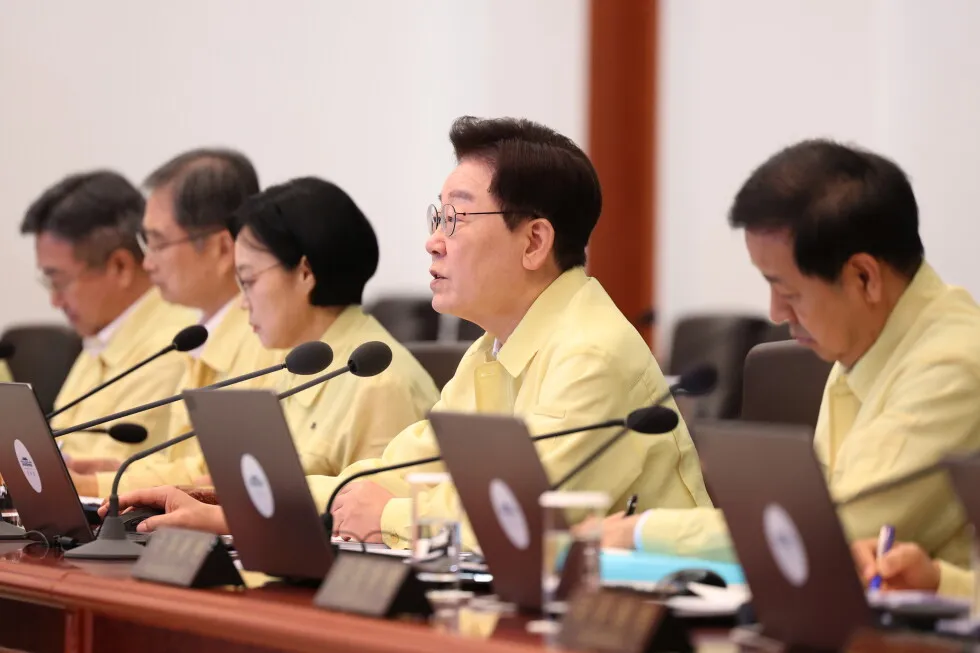
South Korea president stresses US alliance as many baffled by Trump order to cut exercises 1 of 3 | South Korean President Lee Jae Myung, second from right, speaks during a cabinet meeting at the presidential office in Seoul, South Korea, Tuesday, Aug. 18, 2026. (Yonhap via AP) 2 of 3 | South Korean President Lee Jae Myung, center, speaks during a cabinet meeting at the presidential office in Seoul, South Korea, Tuesday, Aug. 18, 2026. (Yonhap via AP) 3 of 3 | South Korean President Lee Jae Myung speaks during a cabinet meeting at the presidential office in Seoul, South Korea, Tuesday, Aug. 18, 2026. (Yonhap via AP) By HYUNG-JIN KIM Updated 9:23 AM MESZ, August 18, 2026 Leer en español Add AP News on Google Add AP News as your preferred source to see more of our stories on Google. Share Share Facebook Copy Link copied Print Email X LinkedIn Bluesky Flipboard Pinterest Reddit SEOUL, South Korea (AP) — South Korea’s president said Tuesday a solid alliance with the U.S. strengthens the foundation of national security, as many South Koreans were baffled and concerned about U.S. President Donald Trump’s abrupt order to “substantially reduce” joint military exercises. Trump made the surprise announcement in a social media post just before U.S. and South Korean soldiers began Monday’s annual Ulchi Freedom Shield exercises, which are largely designed to sharpen readiness against North Korean threats. Trump cited what he said was a good relationship with North Korean leader Kim Jong Un and South Korea’s refusal to join the U.S. war against Iran. Trump’s move was apparently taken without consultations with South Korea and meant to reach out to Kim, deepening concerns about the reliability of the U.S.-South Korean alliance forged in the turmoil of the 1950-53 Korean War. Confidence in the U.S. has already eroded among many South Koreans because of Trump’s tariff war and last year’s immigration raid in the U.S. state of Georgia that led to the detainment of hundreds of South Korean workers. Trump’s announcement “reveals the stark reality of a faltering Korea-U.S. alliance, fueling public anxiety,” South Korea’s Hankook Ilbo newspaper said in an editorial Tuesday. “It’s absurd that the U.S. appears to treat North Korea more respectfully than its ally South Korea.” In a regular Cabinet meeting, South Korean President Lee Jae Myung stressed the importance of a firm military alliance with the U.S., saying that “national security will be further strengthened when the alliance is solid.” “When we build up our strengths, our value and importance as an ally will further grow,” said Lee, a liberal who has called for a stronger, self-reliant defense posture. South Korea hopes for talks between US and North Korea after Trump downsizes military drills 5 MIN READ 312 Trump’s slight of South Korea in favor of the North raises broader US security concerns 5 MIN READ 31 Trump orders Pentagon to scale back joint exercises with South Korea 5 MIN READ 31 It was unclear which parts of the 11-day South Korea-U.S. exercises were being downsized. The South Korean and U.S. militaries earlier said their drills this year would be similar in scale to previous years and incorporate lessons from recent conflicts such as North Korea’s battlefield experiences in the Russia-Ukraine front. They also said the drills are defensive in nature. North Korea’s Foreign Ministry accused South Korea and the U.S. of plotting more provocative drills this year and vowed to respond with “a new level of a deterrent.” Prospects unclear for reengagement between Trump and Kim Kim has shunned any talks with the U.S. and South Korea since his earlier high-profile diplomacy with Trump fell apart in 2019. Experts say Kim won’t likely embrace Trump’s overture and return to talks anytime soon unless he is promised bigger U.S. concessions. Kim has boosted his military and diplomatic credentials in recent years by enlarging his nuclear arsenal and aligning with Russia over its war against Ukraine. Lee’s presidential office on Monday expressed hopes that a “friendly relationship” between Trump and Kim would lead to “meaningful dialogue” between their countries to promote peace on the Korean Peninsula. That invited a backlash from conservatives, who criticized Lee’s government for allegedly prioritizing resumption of Kim-Trump diplomacy over security concerns. “South Korea’s security bulwark is being shaken to its very foundations,” Park Chung-kwon, a spokesperson for the main conservative opposition People Power Party, said in a statement. A weakening of the U.S. defense commitment could shake South Korea’s national security as it has no nuclear weapons and is under the so-called U.S. “nuclear umbrella” protection, which guarantees a devastating American response in the event of an attack on its ally by nuclear-armed North Korea. The U.S. has about 28,500 troops in South Korea. In his social media post, Trump said the military exercises with South Korea are not only costly but “send a signal that is totally inappropriate and hostile” to North Korea, which he said “has been unthreatening and respectful” during his time in the White House. Trump said he asked Lee if South Korea would join the U.S. in the “denuclearization” of Iran, “and they said, ‘No thanks!’” Lee’s office said South Korea and the U.S. are closely discussing practical and military contributions that South Korea can make to help restore freedom of navigation in the Strait of Hormuz. “Trump thinks of an alliance as an investment that should pay regular dividends, or a rainy-day fund he can withdraw from when another project isn’t going well,” said Leif-Eric Easley, a professor at Ewha University in Seoul. “South Korean leaders understand that relations with the Trump administration will be a constant renegotiation linking economic and security issues. Seoul is thus cautiously responding to recent developments within that framework,” Easley said. A recent survey jointly conducted by South Korea’s JoongAng Ilbo newspaper and the East Asia Institute, a Seoul-based research group, showed 46.4% of respondents in South Korea viewed the U.S. as “not a trustworthy partner” while 45.4% called it “trustworthy.” It was the first time that more Koreans said they could not trust the U.S. than said they could since the East Asia Institute began asking the question in 2017, JoongAng Ilbo reported. HYUNG-JIN KIM Kim is an Associated Press reporter in Seoul, South Korea. He reports on security, political and other general news on the Korean Peninsula. twitter mailto
SRCAssociated Press (AP)
LANGEN
LEANCenter
WORDS1 057
ENT10
TUE · 2026-08-18 · 06:53 GMTBRIEF NSR-2026-0818-103343
NSR-2026-0818-103343News Report·EN·National Security
South Korea president stresses US alliance as many baffled by Trump order to cut exercises
South Korean President Lee Jae-myung emphasized the importance of a strong alliance with the U.S. for national security following U.S.
Associated Press (AP)Filed 2026-08-18 · 06:53 GMTLean · CenterRead · 5 min
Associated Press (AP)FIG 01
Reading time
5min
Word count
1 057words
Sources cited
2cited
Entities identified
10entities
Quality score
100%
§ 01
Briefing Summary
AI-generatedNEWSAR · AI
South Korean President Lee Jae-myung emphasized the importance of a strong alliance with the U.S. for national security following U.S. President Donald Trump's abrupt order to significantly reduce joint military exercises. Trump cited his relationship with North Korean leader Kim Jong Un and South Korea's refusal to join the U.S. action against Iran as reasons for the decision, which was reportedly made without consulting Seoul. This move has caused concern and bafflement in South Korea, with some media outlets questioning the reliability of the U.S.-South Korean alliance. President Lee stressed that a solid alliance strengthens national security and increases South Korea's value as a partner. North Korea, meanwhile, accused the U.S. and South Korea of plotting provocative drills and vowed a strong response.
Confidence 0.90Sources 2Claims 5Entities 10
§ 02
Article analysis
Model · rule-basedFraming
National Security
Diplomatic
Tone
Mixed Tone
AI-assessed
CalmNeutralAlarmist
Factuality
0.70 / 1.00
Factual
LowHigh
Sources cited
2
Limited
FewMany
§ 03
Key claims
5 extracted01
South Korea's Hankook Ilbo newspaper editorial stated the U.S. appears to treat North Korea more respectfully than South Korea.
quoteHankook Ilbo
Confidence
1.00
02
U.S. President Donald Trump ordered a substantial reduction in joint military exercises with South Korea.
factualDonald Trump
Confidence
1.00
03
South Korean President Lee Jae Myung stated that a solid alliance with the U.S. strengthens national security.
quoteLee Jae Myung
Confidence
1.00
04
Trump cited his good relationship with Kim Jong Un and South Korea's refusal to join the U.S. war against Iran as reasons for the order.
factualDonald Trump
Confidence
0.90
05
Many South Koreans were baffled and concerned by Trump's order to reduce military exercises.
factual
Confidence
0.90
§ 04
Full report
5 min read · 1 057 words§ 05
Entities
10 identifiedKey playerOppositionContextPositiveNeutralNegative
People3
Organizations1
Locations5
§ 06
Keywords & salience
8 termsus-south korea alliance
1.00
military exercises
0.90
national security
0.80
donald trump
0.70
north korea
0.70
kim jong un
0.60
public anxiety
0.50
diplomatic relations
0.40
§ 07
Topic connections
Interactive graph Network visualization showing 51 related topics
View Full Graph Person Organization Location Event|Click node to navigate|Edge numbers = shared articles