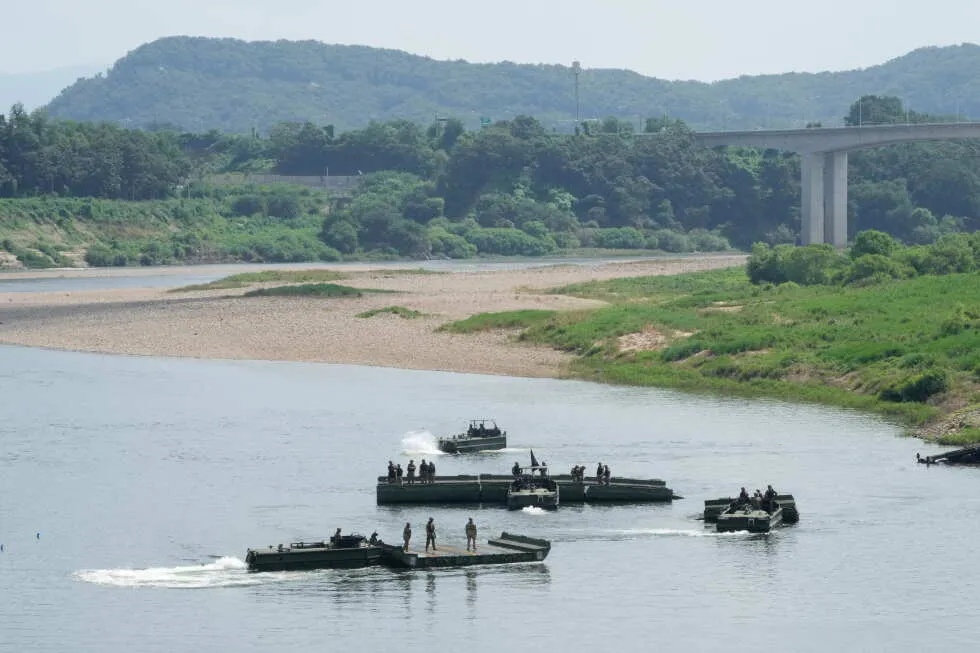
South Korean and US militaries shorten drills by about half after Trump ordered a reduction 1 of 3 | U.S. Army’s soldiers conduct a training exercise on a river in Yeoncheon, South Korea, near the border with North Korea, Tuesday, Aug. 18, 2026. (AP Photo/Ahn Young-joon) 2 of 3 | The U.S. Army’s soldiers conduct a training exercise on a river in Yeoncheon, South Korea, near the border with North Korea, Tuesday, Aug. 18, 2026. (AP Photo/Ahn Young-joon) 3 of 3 | U.S. President Donald Trump, right, meets with North Korean leader Kim Jong Un on Sentosa Island in Singapore, on June 12, 2018. (AP Photo/Evan Vucci, File) By HYUNG-JIN KIM Updated 3:52 AM MESZ, August 19, 2026 Leer en español Add AP News on Google Add AP News as your preferred source to see more of our stories on Google. Share Share Facebook Copy Link copied Print Email X LinkedIn Bluesky Flipboard Pinterest Reddit SEOUL, South Korea (AP) — The South Korean and U.S. militaries have agreed to shorten their drills at the U.S.'s request, South Korean officials said Wednesday, a move that likely reflected President Donald Trump’s hopes to reengage with North Korean leader Kim Jong Un but could undermine a U.S.-South Korean defense readiness. Trump had ordered his Pentagon chief to “substantially reduce” the allies’ summertime Ulchi Freedom Shield exercises, just before they began Monday for an 11-day run. Trump cited what he said was a good relationship with Kim and South Korea’s refusal to join the U.S. war against Iran. South Korea’s military said in a statement the ongoing drills with the U.S. would end Friday, not Aug. 27 as initially planned. It said the allies also agreed to downsize some joint field training exercises. Many experts say Trump’s move threatens to hurt combined U.S.-South Korean defense posture and eventually weaken their decades-long alliance. Ulchi Freedom Shield is largely a computer-simulated command post exercise meant to hone the allies’ ability to deal with potential regional security threats like North Korean aggression. The two countries usually hold field training exercises during the command post exercise period. The drills and a similar springtime exercise are a central pillar of the U.S. -South Korea alliance, which dates to the 1950-53 Korean War. But it’s also a long-running source of tensions with North Korea, which has denounced the exercises as a rehearsal for war and responded with provocative missile tests. Drills cut by Trump are central to the US-South Korea alliance, observers say 2 MIN READ 18 South Korea hopes for talks between US and North Korea after Trump downsizes military drills 2 MIN READ 736 South Korea president stresses US alliance as many baffled by Trump order to cut exercises 2 MIN READ 736 This month’s drills were reportedly supposed to be held in two phases — the first part until this Friday with a focus on defensive operations in simulation of North Korean attacks and the second part until Aug. 27 to practice counteroffensive operations. North Korea is typically extremely sensitive to counteroffensive drills. North Korea hasn’t responded to Trump’s overture. But earlier Wednesday, its state news agency, KCNA, published commentary slamming the U.S.-South Korean military drills as “frantic” and “extremely dangerous” and vowing to completely frustrate its rivals’ hostilities. “The dangerous escalation of the war drills staged by the U.S. and its vassal forces is posing a more serious threat to the security rights” of North Korea, the commentary said. “Our exercise of its right to self-defense will continue to completely neutralize the enemies’ military threat.” Many experts said Kim, now emboldened by his advancing nuclear program and expanding military cooperation, won’t likely embrace Trump’s overture anytime soon unless he’s promised bigger concessions. In response to Trump’s previous outreach, Kim suggested last year that he can return to talks only after the U.S. drops its demand of a North Korean denuclearization as a precondition for diplomacy. Trump and Kim met three times from 2018-2019 but their high-stakes diplomacy eventually fell apart over wrangling over a North Korean demand for extensive sanctions relief in return for limited denuclearization steps. HYUNG-JIN KIM Kim is an Associated Press reporter in Seoul, South Korea. He reports on security, political and other general news on the Korean Peninsula. twitter mailto
SRCAssociated Press (AP)
LANGEN
LEANCenter
WORDS708
ENT10
WED · 2026-08-19 · 01:23 GMTBRIEF NSR-2026-0819-103643
NSR-2026-0819-103643News Report·EN·National Security
South Korea says the South Korean and US militaries have agreed to shorten their drills
South Korean and U.S. militaries have agreed to shorten their Ulchi Freedom Shield drills at the U.S.'s request, according to South Korean officials.
Associated Press (AP)Filed 2026-08-19 · 01:23 GMTLean · CenterRead · 3 min
Associated Press (AP)FIG 01
Reading time
3min
Word count
708words
Sources cited
3cited
Entities identified
10entities
Quality score
100%
§ 01
Briefing Summary
AI-generatedNEWSAR · AI
South Korean and U.S. militaries have agreed to shorten their Ulchi Freedom Shield drills at the U.S.'s request, according to South Korean officials. President Donald Trump ordered the reduction, citing his relationship with North Korean leader Kim Jong Un and South Korea's stance on Iran. The drills, which began Monday for an 11-day run, will now conclude Friday, and some joint field training exercises will be downsized. Experts suggest this move could weaken combined U.S.-South Korean readiness and their alliance. North Korea has criticized the drills as dangerous, though it has not yet responded to Trump's overture.
Confidence 0.90Sources 3Claims 5Entities 10
§ 02
Article analysis
Model · rule-basedFraming
National Security
Diplomatic
Tone
Measured
AI-assessed
CalmNeutralAlarmist
Factuality
0.70 / 1.00
Factual
LowHigh
Sources cited
3
Well sourced
FewMany
§ 03
Key claims
5 extracted01
South Korea's military said the ongoing drills would end Friday, not Aug. 27 as initially planned.
factualSouth Korea's military
Confidence
0.95
02
President Donald Trump ordered his Pentagon chief to 'substantially reduce' the allies’ summertime Ulchi Freedom Shield exercises.
factualArticle
Confidence
0.95
03
Trump cited a good relationship with Kim Jong Un and South Korea’s refusal to join the U.S. war against Iran as reasons for the reduction.
factualArticle
Confidence
0.90
04
South Korean and U.S. militaries agreed to shorten their drills at the U.S.'s request.
factualSouth Korean officials
Confidence
0.90
05
Many experts say Trump’s move threatens to hurt combined U.S.-South Korean defense posture and weaken their alliance.
factualExperts
Confidence
0.70
§ 04
Full report
3 min read · 708 words§ 05
Entities
10 identifiedKey playerOppositionContextPositiveNeutralNegative
Organizations2
Locations5
§ 06
Keywords & salience
10 termsus military
1.00
south korea
1.00
military drills
1.00
donald trump
0.90
north korea
0.80
us-south korea alliance
0.70
defense readiness
0.70
ulchi freedom shield
0.60
kim jong un
0.50
regional security
0.40
§ 07
Topic connections
Interactive graph Network visualization showing 51 related topics
View Full Graph Person Organization Location Event|Click node to navigate|Edge numbers = shared articles