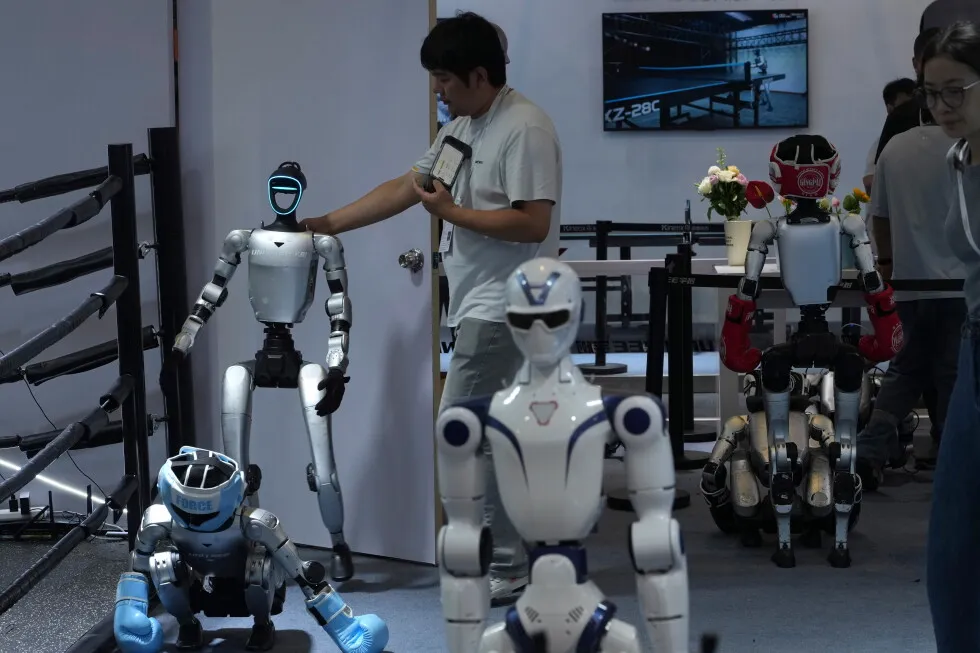
Shares in Chinese humanoid robot maker Unitree soar in Shanghai trading debut 1 of 5 | A worker gets a robot ready for demonstration at a booth for leading Chinese commercial humanoid robotics firm Unitree Robotics during the World AI Conference in Shanghai, China, on July 18, 2026. (AP Photo/Ng Han Guan) 2 of 5 | Visitors stand near for leading Chinese commercial humanoid robotics firm Unitree Robotics during the World AI Conference in Shanghai, China, on July 18, 2026. (AP Photo/Ng Han Guan) 3 of 5 | A humanoid and four legged robot from Unitree waits to demonstrate at the 137th Canton Fair in Guangzhou in southern China’s Guangdong province on April 16, 2025. (AP Photo/Ng Han Guan, File) 4 of 5 | Visitors watch robots box at a booth for leading Chinese commercial humanoid robotics firm Unitree Robotics during the World AI Conference in Shanghai, China, on July 17, 2026. (AP Photo/Ng Han Guan) 5 of 5 | A wide range of robots are displayed at a booth for leading Chinese commercial humanoid robotics firm Unitree Robotics during the World AI Conference in Shanghai, China, on July 17, 2026. (AP Photo/Ng Han Guan) By CHAN HO-HIM Updated 7:01 AM MESZ, August 19, 2026 Add AP News on Google Add AP News as your preferred source to see more of our stories on Google. Share Share Facebook Copy Link copied Print Email X LinkedIn Bluesky Flipboard Pinterest Reddit HONG KONG (AP) — Shares of Unitree, one of China’s largest humanoid robot makers, initially soared as much as 629% in its public stock trading debut Wednesday in Shanghai, in the latest highlight of investor optimism over China’s technological advances. The company, founded in 2016 by entrepreneur Wang Xingxing in the eastern Chinese technology hub of Hangzhou, raised around 6.1 billion yuan ($904 million) in its listing on the Shanghai-stock-exchange" class="entity-link entity-organization" data-entity-id="17136" data-entity-type="organization">Shanghai Stock Exchange’s Nasdaq-style STAR market. The shares were priced at 150.80 yuan ($22.36) a share. Shares were still up nearly 500% as of midday. Advanced robotics, often referred to as “embodied” Artificial Intelligence, is a key sector in the heated technology rivalry between China and the U.S. China leads the U.S. in terms of production capacity of humanoid robots and the ability to scale up manufacturing. Last year, of the roughly 15,000 humanoid robots shipped globally, Unitree and AGIBOT, another major Chinese humanoid robot maker, each shipped more than 5,000, according to technology research and advisory group Omdia, way ahead of their U.S. counterparts. But analysts say for now, many of these humanoid robots are still mainly used for demonstrations, performances and research rather than real-world applications. Unitree’s humanoid robots, for example, dazzled audiences at China’s annual Spring Festival gala by performing backflips and martial arts. US bans foreign-made humanoid robots, targeting China over national security 3 MIN READ 28 Cheaper, open and intelligent: Chinese AI models gain ground, as they make inroads in the US 4 MIN READ 125 “The real competitive test will be whether companies – Chinese or American – can achieve reliable performance and attractive returns on investment in large-scale industrial and commercial deployments,” analyst Kangyuxiao Li at investment research firm Morningstar said in a commentary. Unitree said proceeds from the IPO will be used for advanced robot research and development and development of its robot manufacturing base. The company is the first publicly traded humanoid robotics maker in mainland China. Analysts believe the IPO could set a precedent for valuations of other robotic company stock offerings. It “gives mainland investors direct exposure to one of the sector’s leading companies,” said Li at Morningstar. UBTech, another major Chinese humanoid robot maker, has shares traded in Hong Kong. Its shares fell 10.6% on Wednesday. Unitree reported about 1.7 billion yuan (about $250 million) in revenue in 2025, mainly from sales of its humanoid robots and quadruped robots, often referring to four-legged robot dogs. More than 40% of that revenue was from overseas. Last year, the U.S. accounted for roughly 13% of Unitree’s revenue, the company said. But that was before the U.S. Federal Communications Commission banned imports of new foreign-made humanoid and quadruped robots in July on national security grounds. Unitree cautioned that the U.S. ban, which it said applies to its new models, could affect its future sales in the U.S. market. Existing models of its advanced robots can still be sold, but Unitree faces the risk that the U.S. could further expand its restrictions. CHAN HO-HIM Chan writes about business and economy in China for The Associated Press, reporting on key sectors of the world’s second-largest economy from trade and technology to autos. He is based in Hong Kong. mailto
SRCAssociated Press (AP)
LANGEN
LEANCenter
WORDS774
ENT12
WED · 2026-08-19 · 05:23 GMTBRIEF NSR-2026-0819-103681
NSR-2026-0819-103681News Report·EN·Technology
Shares in Chinese humanoid robot maker Unitree soar in Shanghai trading debut
Shares in Chinese humanoid robot maker Unitree surged significantly on their Shanghai trading debut, with an initial jump of up to 629% and remaining up nearly 500% by midday. The company, founded in 2016, raised approximately $904 million in its listing on the Shanghai Stock Exchange's STAR market.
Associated Press (AP)Filed 2026-08-19 · 05:23 GMTLean · CenterRead · 4 min
Associated Press (AP)FIG 01
Reading time
4min
Word count
774words
Sources cited
1cited
Entities identified
12entities
Quality score
100%
§ 01
Briefing Summary
AI-generatedNEWSAR · AI
Shares in Chinese humanoid robot maker Unitree surged significantly on their Shanghai trading debut, with an initial jump of up to 629% and remaining up nearly 500% by midday. The company, founded in 2016, raised approximately $904 million in its listing on the Shanghai Stock Exchange's STAR market. This event highlights investor optimism in China's technological advancements, particularly in the competitive advanced robotics sector where China leads in production capacity. Unitree and another Chinese firm, AGIBOT, shipped over 5,000 humanoid robots each last year, outpacing U.S. counterparts, though current applications are largely for demonstrations and research. Unitree's IPO proceeds will fund further R&D and manufacturing expansion. However, a recent U.S. ban on new foreign-made humanoid and quadruped robots on national security grounds could impact Unitree's future U.S. sales.
Confidence 0.90Sources 1Claims 5Entities 12
§ 02
Article analysis
Model · rule-basedFraming
Technology
Economic Impact
Tone
Measured
AI-assessed
CalmNeutralAlarmist
Factuality
0.80 / 1.00
Factual
LowHigh
Sources cited
1
Limited
FewMany
§ 03
Key claims
5 extracted01
Unitree raised around 6.1 billion yuan ($904 million) in its listing on the Shanghai Stock Exchange's STAR market.
statistic
Confidence
1.00
02
Shares of Unitree, a Chinese humanoid robot maker, soared as much as 629% in its Shanghai trading debut.
statistic
Confidence
1.00
03
Last year, Unitree and AGIBOT each shipped more than 5,000 humanoid robots globally, out of roughly 15,000 total.
statisticOmdia
Confidence
0.90
04
China leads the U.S. in terms of production capacity of humanoid robots and the ability to scale up manufacturing.
factual
Confidence
0.90
05
Analysts state that many humanoid robots are currently mainly used for demonstrations, performances, and research, not real-world applications.
factualanalysts
Confidence
0.80
§ 04
Full report
4 min read · 774 words§ 05
Entities
12 identifiedKey playerOppositionContextPositiveNeutralNegative
Locations5
§ 06
Keywords & salience
8 termsunitree
1.00
humanoid robots
1.00
stock debut
0.90
artificial intelligence
0.80
china technology
0.70
robotics manufacturing
0.60
shanghai stock exchange
0.50
investor optimism
0.40
§ 07
Topic connections
Interactive graph Network visualization showing 16 related topics
View Full Graph Person Organization Location Event|Click node to navigate|Edge numbers = shared articles