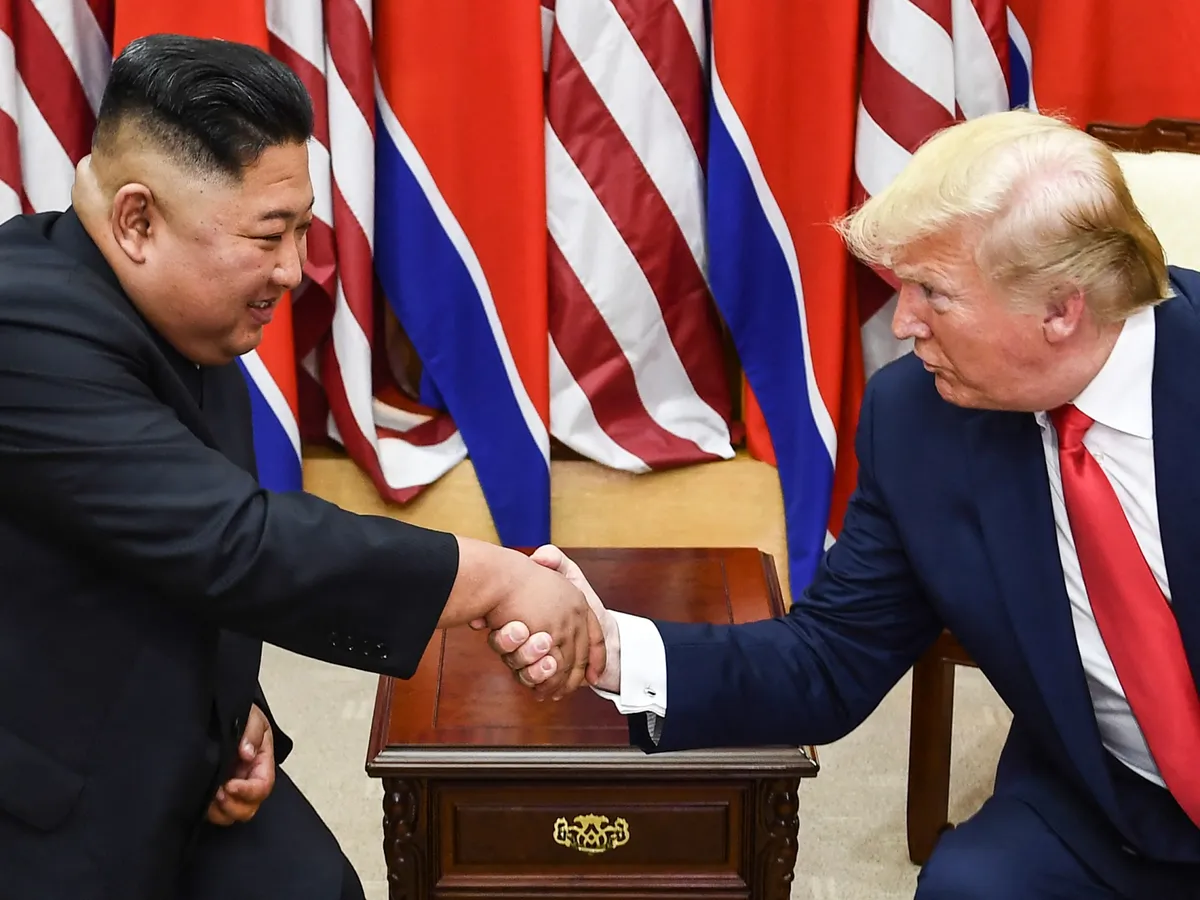
EXPLAINERAnalysts say Trump’s attempted rapprochement with Kim Jong Un is driven by political signals to both Pyongyang and Seoul.North Korea's leader Kim Jong Un and US President Donald Trump meet on the south side of the Military Demarcation Line that divides North and South Korea in June 2019 [AFP]Published On 19 Aug 2026US President Donald Trump has again praised the leader of nuclear-armed North Korea while rebuking key ally Seoul for failing to help Washington fight Iran, reigniting one of the most contentious diplomatic issues from his first term.Trump said on Monday that North Korea leader Kim Jong Un had responded to his recent overtures with a “very positive” exchange, a day after he ordered the Pentagon to scale back military drills with South Korea designed to prepare for a possible war with Pyongyang.Recommended Stories list of 3 itemslist 1 of 3Why did Trump scale back war games with South Korea?list 2 of 3Trump says talking to North Korea’s Kim makes the south saferlist 3 of 3‘Very positive’: Trump says Kim Jong Un has responded to his overturesend of listThe US president said his ties with Kim, whom he met three times during his first term, made the Korean Peninsula “much safer”. The Wall Street Journal reported on Tuesday that Trump was pushing aides to arrange a meeting with Kim as soon as this autumn, ahead of the midterm elections on November 3.Analysts say a summit with Kim, irrespective of its outcome, would be a useful feather on Trump’s cap, particularly as Washington’s unpopular war on Iran stands unresolved and his electoral pledge to end the Ukraine war remains unfulfilled.Yet, Trump’s effort to cozy up to Kim may also have to do with exercising leverage vis-a-vis South Korea, in a typical example of the US president’s transactional approach to diplomacy.“Trump may want to put pressure on South Korea … following [Seoul]’s reluctance to cooperate with the US in the Iran war and the slow progress in South Korean investment in the United States,” Yong-Chool Ha, director of the Center for Korean Studies at the Henry Jackson School of International Studies in Washington, told Al Jazeera.“This could be seen as a form of tit-for-tat diplomacy, despite the ongoing alliance between the two countries.”How has the US-North Korea relationship evolved under Trump?Trump threatened North Korea with “fire and fury” in 2017 after reports that Pyongyang had produced a nuclear warhead small enough to fit inside its missiles.The US president held a first, historic face-to-face meeting with Kim in Singapore in 2018, where they agreed to the “complete denuclearisation” of the Korean Peninsula. But subsequent meetings in 2019, in Hanoi and in the Korean Demilitarized Zone (DMZ), failed to build on the initial agreement — even though Trump became the first and only US president to briefly cross over into North Korea.Since then, North Korea has expanded its missile and nuclear capabilities, continued missile testing and developed close military ties with Russia. Nevertheless, Trump says his relationship with Kim remains “unthreatening and respectful”.Yong-Chool Ha, who also lectures at the University of Washington, said Trump may believe that the Hanoi summit failed because of pressure from critics, including his own former national security adviser John Bolton, who had urged the US government to pursue denuclearisation or think about the possibility of pushing for regime change in Pyongyang.“Trump may now think that, without such constraints, he can make a deal with Kim this time,” Ha said.Why would Trump opt to exercise leverage against ally South Korea?Trump took aim at South Korea on his Truth Social network on Sunday night, abruptly announcing that he had ordered the Pentagon to scale back “inappropriate and hostile” military drills with Seoul.He later linked the decision to South Korea’s refusal to help with the US-Israel war on Iran. “We can’t go around and protect all of these countries, especially when they’re not there to help us,” Trump said in the Oval Office.The 11-day Ulchi Freedom Shield exercises are designed to prepare for a possible war with North Korea. The United States stations about 28,500 troops in South Korea to bolster the country’s defences, a legacy of the 1950-53 Korean War that ended with an armistice rather than a peace treaty.Scaling back these drills creates tensions for Seoul, which depends on Washington to deter North Korea. Pyongyang decries the drills as dress rehearsals for an invasion.Eugene Park, a historian of East Asia at the University of Nevada in the US, said Trump’s decision reflected Washington’s shifting strategic priorities. “The United States today faces greater demands on its military resources than it did during Trump’s first term, including ongoing commitments in the Middle East and mounting concerns about force readiness and defence-industrial capacity,” he told Al Jazeera.According to Park, the conflict involving Iran has altered the broader geopolitical environment in which Korean Peninsula diplomacy must now take place, as Washington now has a strong incentive to avoid the emergence of another major crisis beyond the Middle East.Money is also likely to have been at the forefront in the US president’s decision.Rachel Minyoung Lee, senior fellow for the Stimson Center’s Korea Program and 38 North, said Trump may have used the drills as leverage “to expedite South Korea’s investment and possibly to lay the groundwork for increasing South Korea’s defence cost-sharing”.Trump has been pushing for the alliance to evolve towards a more symmetrical structure, where Seoul has greater responsibility for regional security. During his first term, Trump demanded a sharp increase in South Korea’s contribution to hosting US troops, arguing South Korea pays too little.Economic tensions could also be a factor, Lee suggested.Trump’s first administration renegotiated a bilateral free trade agreement and imposed tariffs affecting South Korean steel. Washington initially threatened 25-percent tariffs before agreeing to a 15-percent rate in return for South Korean investment and other commitments, including favourable regulation for American technology companies.The president later threatened higher tariffs again, accusing Seoul of moving too slowly to implement the agreement.“The lack of any concrete steps on South Korea’s part to invest in the US, which was the condition for keeping tariffs to 15 percent, appears to be a huge frustration for Trump,” Minyoung Lee said.Does this mark a new chapter in US-North Korea relations?Not yet, at least. According to Minyoung Lee, North Korea does not trust the US. Additionally, following the US-Israeli attack on Iran in February, Pyongyang has consistently portrayed Washington as an “untrustworthy actor and a disturber of the international order”.Kim earlier this year made clear that a precondition for friendly ties was for Washington to recognise North Korea’s “constitutional status” — a reference to North Korea’s nuclear-armed status. “Even for President Trump, who is eager to engage Kim Jong Un again, recognising North Korea’s nuclear status seems like a very tall order,” Minyoung Lee said.Overall, the analyst said, Trump appears to have used the scaling back of joint military exercises with South Korea to “kill two birds with one stone: exercise leverage against South Korea and to remind the world, including [Kim], that he remains interested in reengaging North Korea”.
SRCAl Jazeera
LANGEN
LEANCenter
WORDS1 171
ENT12
WED · 2026-08-19 · 10:57 GMTBRIEF NSR-2026-0819-103799
NSR-2026-0819-103799Analysis·EN·Diplomatic
‘Tit for tat’: Why is Trump cozying up to North Korea’s Kim Jong Un again?
Donald Trump is again praising North Korean leader Kim Jong Un and has ordered a scaling back of military drills with South Korea. Analysts suggest this rapprochement is driven by political signals to both Pyongyang and Seoul, potentially to exert leverage over South Korea's reluctance to assist in the US-Iran conflict and slow investment in the US.
Federica MarsiAl JazeeraFiled 2026-08-19 · 10:57 GMTLean · CenterRead · 5 min
Al JazeeraFIG 01
Reading time
5min
Word count
1 171words
Sources cited
1cited
Entities identified
12entities
Quality score
100%
§ 01
Briefing Summary
AI-generatedNEWSAR · AI
Donald Trump is again praising North Korean leader Kim Jong Un and has ordered a scaling back of military drills with South Korea. Analysts suggest this rapprochement is driven by political signals to both Pyongyang and Seoul, potentially to exert leverage over South Korea's reluctance to assist in the US-Iran conflict and slow investment in the US. Trump has previously met Kim multiple times, aiming for denuclearization, though subsequent summits yielded limited progress. Despite North Korea's continued weapons development, Trump views his relationship with Kim as positive. This move also comes as Trump seeks diplomatic wins ahead of midterm elections, with reports indicating he is pushing for a new meeting with Kim.
Confidence 0.90Sources 1Claims 5Entities 12
§ 02
Article analysis
Model · rule-basedFraming
Diplomatic
Political Strategy
Tone
Mixed Tone
AI-assessed
CalmNeutralAlarmist
Factuality
0.60 / 1.00
Mixed
LowHigh
Sources cited
1
Limited
FewMany
§ 03
Key claims
5 extracted01
Trump's ties with Kim made the Korean Peninsula 'much safer'.
quoteDonald Trump
Confidence
1.00
02
Trump said North Korea leader Kim Jong Un responded to his recent overtures with a 'very positive' exchange.
quoteDonald Trump
Confidence
1.00
03
Trump is pushing aides to arrange a meeting with Kim as soon as this autumn, ahead of the midterm elections on November 3.
factualThe Wall Street Journal
Confidence
0.90
04
Trump may want to put pressure on South Korea following their reluctance to cooperate with the US in the Iran war.
factualYong-Chool Ha
Confidence
0.80
05
Trump's rapprochement with Kim Jong Un is driven by political signals to both Pyongyang and Seoul.
factualAnalysts
Confidence
0.80
§ 04
Full report
5 min read · 1 171 words§ 05
Entities
12 identifiedKey playerOppositionContextPositiveNeutralNegative
People3
Organizations2
§ 06
Keywords & salience
10 termsnorth korea
1.00
trump-kim diplomacy
1.00
south korea
0.90
nuclear-armed north korea
0.80
transactional diplomacy
0.70
military drills
0.60
korean peninsula
0.50
iran war
0.50
midterm elections
0.40
tit-for-tat diplomacy
0.40
§ 07
Topic connections
Interactive graph Network visualization showing 51 related topics
View Full Graph Person Organization Location Event|Click node to navigate|Edge numbers = shared articles