close Video Cuba is a ‘massive national security threat’ just 90 miles from US, report author warns America First Policy Institute’s Melissa Ford Maldonado says Cuba’s strategic location has made it valuable to Russia and China, warning that intelligence activity and Moscow’s ties to Havana pose risks close to the US homeland. NEWYou can now listen to Fox News articles! Hören Sie sich diesen Artikel an 7 Min A new report warns that Cuba’s relationships with Russia, China and Iran could provide America’s adversaries with a strategic foothold just 90 miles from Florida, arguing that the island’s deepening economic crisis does not necessarily make it less dangerous to the United States. The America First Policy Institute report, The Dictatorship Next Door: Cuba and the Fight for the Western Hemisphere, argues that Washington has too often viewed Cuba primarily as a human rights, migration or economic problem while overlooking the national security implications of Havana’s relationships with U.S. adversaries. The report says those partnerships create opportunities for intelligence collection, military cooperation, cyber operations and political influence close to the U.S. homeland. "Cuba is a massive national security threat to the U.S.," report author Melissa Ford Maldonado, director of AFPI’s Western Hemisphere Initiative, told Fox News Digital in an interview ahead of the report’s release. RUBIO WARNS Cuba HAS INFILTRATED US WITH SPIES, CALLS COMMUNIST REGIME AN 'ESPIONAGE SUPERPOWER' Xi Jinping meets with Miguel Diaz-Canel at the Great Hall of the People in Beijing on Sept. 4, 2025. Diaz-Canel is in China for commemorations marking the 80th anniversary of the victory in the Chinese People's War of Resistance against Japanese Aggression and the World Anti-Fascist War. (Xinhua News Agency via Getty Ima) "They are a hostile communist regime that is only 90 miles from Florida," Ford Maldonado said, arguing that Cuba has a decades-long history of working against American interests and supporting U.S. adversaries. The report’s most concrete current concern centers on China and suspected intelligence facilities on the island. A June 18, 2026, analysis by the Center for Strategic and International Studies found continued activity at Cuban sites capable of supporting signals intelligence collection. CSIS said it had previously identified four such sites, several with possible links to China. Ford Maldonado said she believes the broader evidence of Chinese intelligence activity on Cuba is compelling. "There is a lot of credible evidence that there are Chinese bases and that there is spying going on in Cuba," she said, claiming that China has taken advantage of Cuba’s geographic position to monitor U.S. activity. Cuba BUILT COVERT NETWORK INSIDE AMERICA THROUGH SPIES, ACTIVISTS AND UNIVERSITIES, STATE DEPT ALLEGES In this pool photograph distributed by the Russian state agency Sputnik, Russia's President Vladimir Putin meets with Cuba's President Miguel Diaz-Canel at the Kremlin in Moscow on May 7, 2025. (Mikhail Metzel/ POOL / AFP via Getty Images) Russia’s relationship with Havana is older and more extensive. Ford Maldonado described Moscow and Havana as increasingly "intimate, reliable partners," pointing to diplomatic and military cooperation as well as Cuban nationals joining Russian forces fighting in Ukraine. The number of Cubans fighting for Russia is contested. A U.S. State Department cable obtained by Reuters on Oct. 5, 2025 estimated that 1,000 to 5,000 Cubans were fighting in Ukraine alongside Russian forces. Reuters reported that Ukrainian officials had also raised concerns with U.S. lawmakers about Russia’s recruitment of Cuban nationals. Cuba has denied sending troops to Ukraine. In an Oct. 11 statement reported by Reuters, the Cuban Foreign Ministry said Cuba was not participating in the conflict with military personnel and said it had prosecuted Cubans for mercenary activity. Havana said 40 defendants had faced criminal proceedings between 2023 and 2025, with 26 convicted. Ukraine nevertheless closed its embassy in Havana in October 2025 and downgraded relations, with Foreign Minister Andrii Sybiha accusing Cuban authorities of failing to act against what Kyiv described as large-scale Russian recruitment of Cuban citizens, according to The Kyiv Independent. The public evidence regarding Iran is considerably less developed — something Ford Maldonado acknowledged when pressed by Fox News Digital. "Iran was a little bit trickier," she said. "There wasn’t that much substance that I could find to include it in the report," Ford Maldonado said, adding that she believes Iran has used Cuba primarily as a platform for influence operations. "The evidence was not as substantive as we saw with China and Russia and Venezuela," she said. The Trump administration has nevertheless grouped Iran with Russia and China in its own assessment of Cuba. US SANCTIONS FIVE CUBAN ENTITIES, CASTRO FAMILY MEMBER IN LATEST PRESSURE CAMPAIGN, RUBIO SAYS Cuban special forces carrying assault rifles equipped with scopes and silencers take part in a military parade 02 December 2006 at Revolution Square celebrating the 50th Anniversary of the Cuban Army and the 80th birthday of President Fidel Castro. (Rodrigo Arangua/AFP via Getty Images) In a Jan. 29, 2026, executive order, President Donald Trump declared Cuba’s policies an "unusual and extraordinary threat" to U.S. national security and said Havana aligns itself with Russia, China, Iran and Iran proxies – Hezbollah and Hamas. The order also accused Cuba of hosting foreign military and intelligence capabilities and specifically alleged deep intelligence and defense cooperation with China and Russian signals-intelligence activity. AFPI’s report calls for a substantially tougher U.S. response. "We are not advocating for new American bases," she clarified. Instead, she said Washington could pursue expanded access agreements, overflight rights, cooperative security locations and stronger regional partnerships. "The objective is just permanent and persistent ... American capability," Ford Maldonado said. The call for even greater pressure, however, comes as ordinary Cubans are enduring a severe humanitarian crisis. Power outages were exceeding 20 hours a day in most provinces, Reuters reported Aug. 13, 2026, crippling food production, transportation and tourism and pushing Cuba’s electrical system toward technical collapse. Reuters described the situation as one of the most severe economic and political crises in Cuba’s modern history and said it had been exacerbated by the Trump administration’s oil restrictions and hardened sanctions. A July 7 investigation by Human Rights Watch described severe shortages of food and medicine, prolonged blackouts, water shortages and deteriorating living conditions. WALTZ WARNS OF CHINESE, RUSSIAN-FUELED ‘national security threat’ LOOMING CLOSE TO US SHORES Cuba's National Electric System (SEN) suffered another disconnection on Monday while efforts were still underway to restore the grid following the previous night's total blackout in Havana, Cuba on August 5, 2026. The Electric Union (UNE) attributed this new setback to weather conditions that struck an unstable grid, knocking out part of the generation capacity that had already been brought back online. (Angelo Mastrascusa/Anadolu via Getty Images) HRW attributed Cuba’s crisis to multiple factors, including longstanding structural inefficiencies in its highly state-controlled economy, decades of U.S. restrictions on trade and financing, the collapse of tourism during the COVID-19 pandemic and subsequent tightening of U.S. sanctions. HRW said the 2026 restrictions on oil supplies further deepened the energy crisis. Critics of the Trump administration’s maximum-pressure strategy argue that further squeezing an already collapsing economy risks worsening civilian suffering and triggering additional instability and migration. On June 8, UN-appointed independent human rights experts called for the sanctions to be lifted, arguing that they were putting Cubans’ access to essential goods and services at risk. Asked about that broader criticism, Ford Maldonado said the blame belongs with Havana rather than Washington. "Maximum pressure isn’t harming the Cuban people, it’s harming their regime," she said, arguing that the Cuban government and Cuban people should be treated as distinct. The latest blackout marks Cuba's sixth nationwide electrical grid failure of 2026, with three such outages occurring during July. (Yamil Lage / AFP via Getty Images) "One has brutalized and repressed the other for 67 years now," Ford Maldonado said. "So maximum pressure is what’s necessary from the United States and from the rest of the world in order to be able to help the Cuban people." Fox News Digital reached out to the Russian, Chinese and Iranian embassies but did not receive a response in time for publication. Reuters and the Associated Press contributed to this report. Efrat (Effie) Lachter is a reporter for Fox News Digital with more than 15 years of experience covering conflict, global affairs, human rights and political accountability. She has directed and produced more than 200 documentary segments across more than 40 countries, documenting conflicts, humanitarian crises, corruption, human trafficking, gender-based violence and the human stories behind major world events. Lachter’s reporting has taken her into conflict zones and crisis areas across the Middle East, Europe, Asia and Africa. Her work has included uncovering human trafficking networks, revealing an ISIS underground torture prison in Syria, documenting the war in Ukraine and interviewing senior political figures and world leaders. She was also among the Western journalists who entered Russia after the war began to bring testimonies from Putin’s opposition. Lachter is the recipient of the 2022 Peres Center for Peace Award and was a 2023–2024 Knight-Wallace Journalism Fellow at the University of Michigan. She also won two Rockower Awards for Excellence in Reporting. She holds a bachelor's degree in communication and a master's degree in political science.
SRCFox News - World
LANGEN
LEANCenter-Right
WORDS1 526
ENT12
WED · 2026-08-19 · 15:23 GMTBRIEF NSR-2026-0819-103852
NSR-2026-0819-103852News Report·EN·National Security
Cuba’s economic freefall is hiding a national security threat just miles from Florida: report
A report by the America First Policy Institute argues that Cuba's relationships with Russia, China, and Iran pose a national security threat to the United States due to its proximity to Florida. The report highlights concerns about potential intelligence collection, military cooperation, and political influence from these adversaries operating on the island.
Fox News - WorldFiled 2026-08-19 · 15:23 GMTLean · Center-RightRead · 7 min
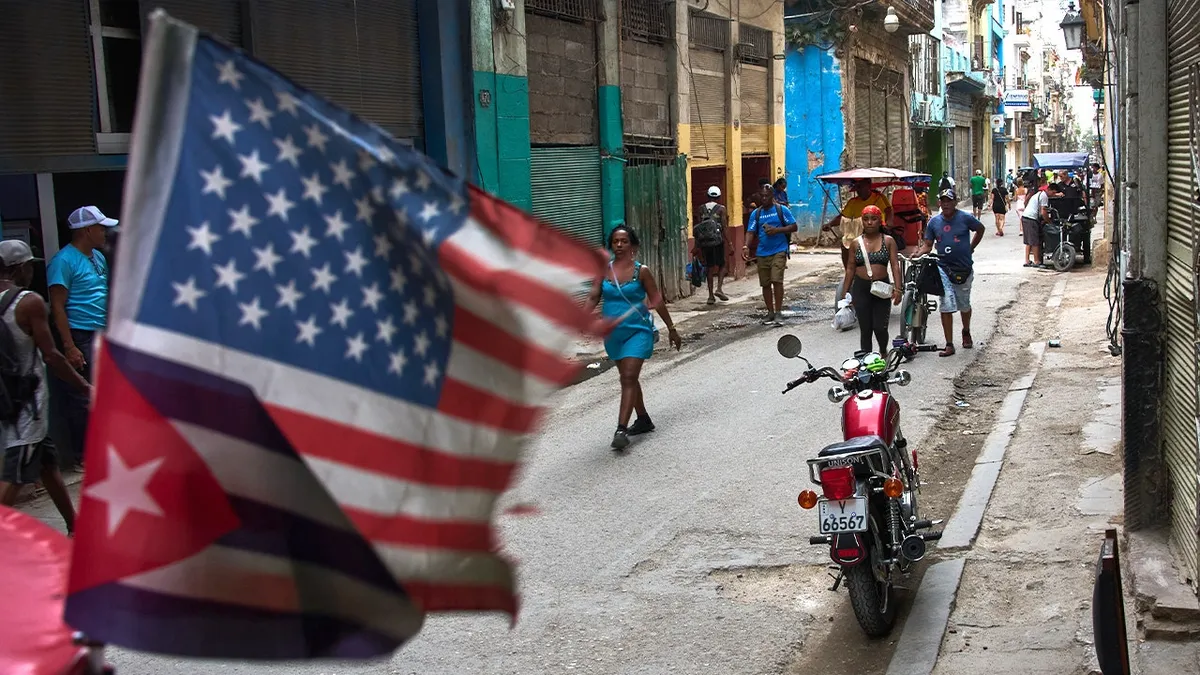
Fox News - WorldFIG 01
Reading time
7min
Word count
1 526words
Sources cited
4cited
Entities identified
12entities
Quality score
100%
§ 01
Briefing Summary
AI-generatedNEWSAR · AI
A report by the America First Policy Institute argues that Cuba's relationships with Russia, China, and Iran pose a national security threat to the United States due to its proximity to Florida. The report highlights concerns about potential intelligence collection, military cooperation, and political influence from these adversaries operating on the island. Specifically, the report cites evidence of Chinese intelligence facilities and ongoing cooperation between Cuba and Russia, including Cuban nationals reportedly fighting alongside Russian forces in Ukraine. While less developed, Iran is also mentioned as potentially using Cuba for influence operations. The report advocates for a tougher U.S. response, despite Cuba facing a severe economic and humanitarian crisis exacerbated by U.S. sanctions.
Confidence 0.90Sources 4Claims 4Entities 12
§ 02
Article analysis
Model · rule-basedFraming
National Security
Political Strategy
Tone
Sensational
AI-assessed
CalmNeutralAlarmist
Factuality
0.40 / 1.00
Mixed
LowHigh
Sources cited
4
Well sourced
FewMany
§ 03
Key claims
4 extracted01
Continued activity at Cuban sites capable of supporting signals intelligence collection has been identified.
factualCenter for Strategic and International Studies
Confidence
0.90
02
Cuba is a massive national security threat to the U.S.
quoteMelissa Ford Maldonado
Confidence
0.90
03
Cuba's relationships with Russia, China, and Iran could provide America’s adversaries with a strategic foothold 90 miles from Florida.
factualAmerica First Policy Institute report
Confidence
0.80
04
There is a lot of credible evidence that there are Chinese bases and that there is spying going on in Cuba.
quoteMelissa Ford Maldonado
Confidence
0.70
§ 04
Full report
7 min read · 1 526 words§ 05
Entities
12 identifiedKey playerOppositionContextPositiveNeutralNegative
People3
Organizations2
Locations5
§ 06
Keywords & salience
10 termscuba
1.00
national security threat
1.00
strategic location
0.90
russia
0.80
china
0.80
intelligence activity
0.70
economic crisis
0.60
us adversaries
0.50
florida
0.40
signals intelligence
0.40
§ 07
Topic connections
Interactive graph Network visualization showing 51 related topics
View Full Graph Person Organization Location Event|Click node to navigate|Edge numbers = shared articles