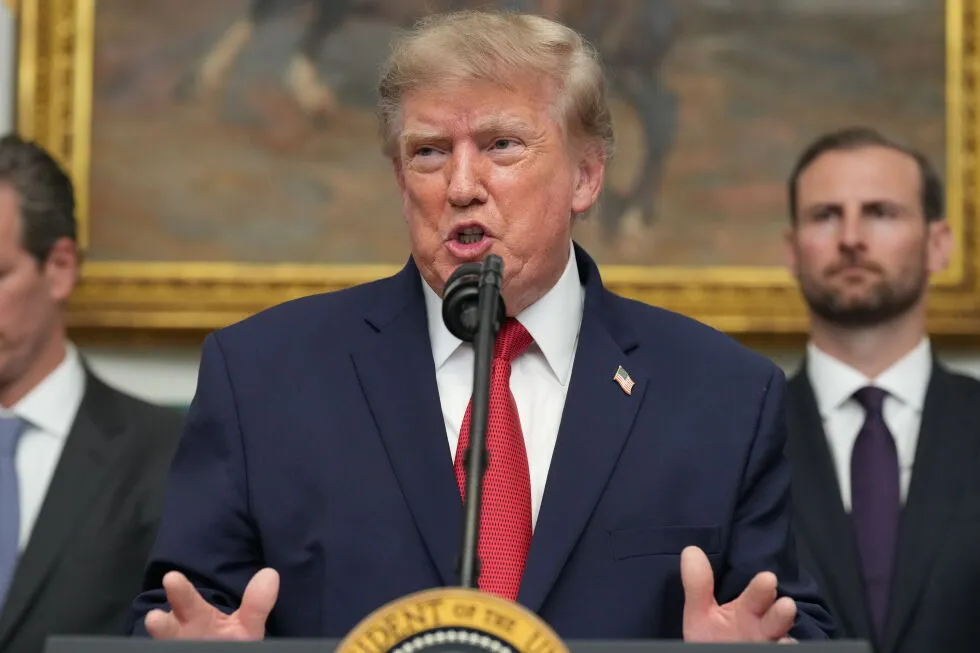
Trump keeps embracing data centers even as they become toxic in midterm races 1 of 5 | President Donald Trump speaks during a meeting with technology leaders in the Roosevelt Room of the White House, Wednesday, Aug. 19, 2026, in Washington. (AP Photo/Jacquelyn Martin) 2 of 5 | Sen. Jon Husted, R-Ohio, speaks during an event in the Indian Treaty Room of the Eisenhower Executive Office Building on the White House complex on March 4, 2026, in Washington. (AP Photo/Jacquelyn Martin, File) 3 of 5 | Gubernatorial candidate Aaron Ford, attorney general of Nevada, reacts during a primary election night watch party after winning the Democratic nomination, June 9, 2026, in Las Vegas. (AP Photo/Jae C. Hong, File) 4 of 5 | Texas Gov. Greg Abbott speaks at a press conference addressing foreign influence in public education at the Texas Public Policy Foundation in Austin, Tuesday, Aug. 18, 2026. (Sara Diggins/The San Antonio Express-News via AP) 5 of 5 | Democratic gubernatorial nominee David Crowley speaks to the press Wednesday, Aug. 12, 2026, in Middleton, Wis. (AP Photo/Kayla Wolf) 1 of 5 | President Donald Trump speaks during a meeting with technology leaders in the Roosevelt Room of the White House, Wednesday, Aug. 19, 2026, in Washington. (AP Photo/Jacquelyn Martin) 1 of 5 President Donald Trump speaks during a meeting with technology leaders in the Roosevelt Room of the White House, Wednesday, Aug. 19, 2026, in Washington. (AP Photo/Jacquelyn Martin) Add AP News on Google Add AP News as your preferred source to see more of our stories on Google. Share 2 of 5 | Sen. Jon Husted, R-Ohio, speaks during an event in the Indian Treaty Room of the Eisenhower Executive Office Building on the White House complex on March 4, 2026, in Washington. (AP Photo/Jacquelyn Martin, File) 2 of 5 Sen. Jon Husted, R-Ohio, speaks during an event in the Indian Treaty Room of the Eisenhower Executive Office Building on the White House complex on March 4, 2026, in Washington. (AP Photo/Jacquelyn Martin, File) Add AP News on Google Add AP News as your preferred source to see more of our stories on Google. Share 3 of 5 | Gubernatorial candidate Aaron Ford, attorney general of Nevada, reacts during a primary election night watch party after winning the Democratic nomination, June 9, 2026, in Las Vegas. (AP Photo/Jae C. Hong, File) 3 of 5 Gubernatorial candidate Aaron Ford, attorney general of Nevada, reacts during a primary election night watch party after winning the Democratic nomination, June 9, 2026, in Las Vegas. (AP Photo/Jae C. Hong, File) Add AP News on Google Add AP News as your preferred source to see more of our stories on Google. Share 4 of 5 | Texas Gov. Greg Abbott speaks at a press conference addressing foreign influence in public education at the Texas Public Policy Foundation in Austin, Tuesday, Aug. 18, 2026. (Sara Diggins/The San Antonio Express-News via AP) 4 of 5 Texas Gov. Greg Abbott speaks at a press conference addressing foreign influence in public education at the Texas Public Policy Foundation in Austin, Tuesday, Aug. 18, 2026. (Sara Diggins/The San Antonio Express-News via AP) Add AP News on Google Add AP News as your preferred source to see more of our stories on Google. Share 5 of 5 | Democratic gubernatorial nominee David Crowley speaks to the press Wednesday, Aug. 12, 2026, in Middleton, Wis. (AP Photo/Kayla Wolf) 5 of 5 Democratic gubernatorial nominee David Crowley speaks to the press Wednesday, Aug. 12, 2026, in Middleton, Wis. (AP Photo/Kayla Wolf) Add AP News on Google Add AP News as your preferred source to see more of our stories on Google. Share Updated [hour]:[minute] [AMPM] [timezone], [monthFull] [day], [year] WASHINGTON (AP) — President Donald Trump, speaking alongside cryptocurrency leaders at the White House this week, made a statement that Republican and Democratic candidates alike wouldn’t touch with a 10-foot pole.“If I were the mayor of a town or the governor of a state, and I had a chance to get a big plant in, an AI plant or a data center,” Trump said, “I would absolutely want it because the jobs are enormous and the money paid, the taxes paid, are just enormous.”It’s not the kind of message anyone is using in competitive midterm races. The race to build data centers, which power artificial intelligence and cloud computing, has run aground amid frustration from voters who don’t want to live near the massive warehouse campuses. Even the Senate Republicans’ campaign arm warned that anger over data centers — some of which dwarf football stadiums and use more energy than small cities — could cost them a seat. Opposition stretches across the political spectrum because of fears that the behemoths will jack up electricity bills, drain people’s water wells, create unhealthy amounts of air and noise pollution and forever change a community’s character — all while getting lucrative tax breaks from states competing for their business.Trump has framed data centers as a necessary component of a top national and economic security priority: winning the AI race against China. However, he also has acknowledged concern over rising electricity bills, previously saying “it’s only fair” for the companies to shoulder their costs. 2 MIN READ 6 MIN READ 4 MIN READ He also suggested this week that data centers need “a little public relations help.” In recent months, he has gotten tech giants to sign a voluntary pledge to shield U.S. consumers from higher utility bills from data centers, even as he pushes to streamline the process for companies and utilities to build their own power plants. But building power plants doesn’t happen overnight, and the immediate political reality for candidates across the country is far different.“It is yet another dimension in which the White House appears tone deaf — tone deaf at best and indifferent to the interest of other Republican candidates at worst,” said James Henson, the director of the Texas Politics Project at the University of Texas, Austin, a nonpartisan research organization. Republican committee issues warning over data centers in OhioStatewide candidates from Nevada to Pennsylvania, both Republican and Democratic, are weaponizing data centers against their opponents, and candidates who absorb those attacks are subsequently trying to distance themselves from them.In Ohio, a data center hot spot with closely contested races for governor and U.S. Senate, the National Republican Senatorial Committee warned in a memo Tuesday that Sen. Jon Husted is vulnerable to losing his seat because of the centers.Democratic nominee Sherrod Brown is airing attack ads against Husted that call him the “face of data centers in Ohio” as people gather signatures for a statewide referendum to ban their construction.The Republican memo said it’s been a “sleeper issue for the entire election cycle.”“Brown is using it because it works,” the NRSC said. “More than any other thing in this race, data centers are the anchor hanging around Husted’s neck. If he loses and data centers get the blame, politicians across the country will take notice — and they will not go near the next one.” The memo suggested voters may balk at Democratic candidates who want to stop data center construction altogether in favor of a Republican candidate who only wants data centers built if a community approves it in a local vote and it pays for its own power, water and other utilities.Most registered voters oppose building a data center in their area, according to a July Fox News poll. Still, the issue falls behind other voter concerns, such as cost of living, as November looms. A Quinnipiac Poll conducted in June asked voters what issues were important in deciding who to vote for in U.S. House elections, and about 4 in 10 mentioned AI data centers. Trump’s statement already put to use in Nevada raceIn Nevada, Democrat Aaron Ford quickly tied Trump’s statement to Republican Gov. Joe Lombardo, characterizing them as being in “lockstep on data centers.”In a statement, Ford said Trump and Lombardo are “Nevada data centers’ biggest cheerleaders” who “only care about catering to their ‘billionaire friends’ while Nevadans pay the price.”Ford this week unveiled a policy platform in which he said he would halt new state tax breaks for data centers — he estimated them at $200 million currently — while auditing existing projects to ensure they are delivering on promises. He also said he would ensure data centers pay for their electricity needs, do not deplete Nevada’s water supply and help local governments negotiate strong benefits agreements with developers. Texas’ governor changed course and got a jab from TrumpTexas Gov. Greg Abbott, who last November celebrated Google’s announcement of a $40 billion investment there by calling the state “the epicenter of AI development,” is under attack from his Democratic challenger, Gina Hinojosa, over his pursuit of data center development.Abbott has since changed course by promising tougher action, such as removing the state’s sales tax exemption and holding up projects to review their energy usage.Trump criticized the shift, saying “I think it’s a mistake” in a recent interview with Punchbowl News. Asked about Trump’s support for data centers, Abbott’s office said the governor’s “top priority is to protect Texans’ safety and quality of life and ensure the integrity of our power grid and water supply.”“Simply put, Texans must come first,” Abbott’s office said.data centers complicated Wisconsin governor raceWhile Trump embraces data centers, even some of his allies are using them for political attacks. U.S. Rep. Tom Tiffany, running for Wisconsin governor, released a TV ad this week branding his Democratic opponent as “Data Center David Crowley.”The ad includes a clip of Crowley saying Wisconsin could become the “AI and data hub not only for the entire country, but for the entire globe.”Crowley has said local communities must have veto authority while also calling data centers a part of the modern economy that could bring significant economic benefits to the state.Tiffany, who Trump has endorsed, has also said positive things about data centers. In January, Tiffany called data centers “exciting new technology,” in an interview with PBS Wisconsin. And last December, he voted for a bipartisan bill known as the SPEED Act, which is designed to accelerate construction of new AI infrastructure projects like data centers. It hasn’t passed the Senate.Neither Tiffany nor Crowley support a moratorium on new data center construction.Tiffany has called for repealing the state tax incentive for data centers, while Crowley has not. They both have called for stricter regulation.Crowley, at an event Wednesday where he received the endorsement of the environmental group Clean Wisconsin, downplayed the attacks Tiffany has made against his data center position.“He’s getting very good at saying one thing and doing something different,” Crowley said, pointing to Tiffany’s votes in support of the SPEED Act.“What Congressman Tom Tiffany’s doing is lying because he’s trying to run away from his record in Congress,” Crowley said.___Bauer reported from Madison, Wisconsin, and Levy from Harrisburg, Pennsylvania. Linley Sanders contributed from Washington. Bedayn is a national politics reporter based in Austin, Texas. Levy covers politics and state government for The Associated Press. He is based in Pennsylvania. Bauer is the AP’s Statehouse reporter covering politics and state government in Madison, Wisconsin. He also writes music reviews.
SRCAssociated Press (AP)
LANGEN
LEANCenter
WORDS1 864
ENT12
THU · 2026-08-20 · 17:53 GMTBRIEF NSR-2026-0820-104246
NSR-2026-0820-104246News Report·EN·Political Strategy
Trump keeps embracing data centers even as they become toxic in midterm races
President Donald Trump continues to advocate for data centers, despite their growing unpopularity among voters in competitive midterm races. Candidates from both parties are avoiding the issue due to public concerns about increased electricity bills, water depletion, pollution, and community character changes, often exacerbated by lucrative tax breaks.
By
JESSE BEDAYN, MARC LEVY and SCOTT BAUERAssociated Press (AP)Filed 2026-08-20 · 17:53 GMTLean · CenterRead · 8 min
Associated Press (AP)FIG 01
Reading time
8min
Word count
1 864words
Sources cited
0cited
Entities identified
12entities
Quality score
100%
§ 01
Briefing Summary
AI-generatedNEWSAR · AI
President Donald Trump continues to advocate for data centers, despite their growing unpopularity among voters in competitive midterm races. Candidates from both parties are avoiding the issue due to public concerns about increased electricity bills, water depletion, pollution, and community character changes, often exacerbated by lucrative tax breaks. The Senate Republicans' campaign arm has warned that data center anger could cost them seats. Trump views data centers as crucial for national security and winning the AI race against China, though he has acknowledged rising electricity costs and suggested companies should bear more of the burden. In states like Ohio and Nevada, data centers have become a significant campaign issue, with candidates using them to attack opponents. Some politicians, like Nevada's Aaron Ford, are proposing policy changes to address these concerns.
Confidence 0.90Claims 5Entities 12
§ 02
Article analysis
Model · rule-basedFraming
Political Strategy
Technology
Tone
Mixed Tone
AI-assessed
CalmNeutralAlarmist
Factuality
0.60 / 1.00
Mixed
LowHigh
Sources cited
0
No named sources
FewMany
§ 03
Key claims
5 extracted01
Aaron Ford won the Democratic nomination for Nevada Attorney General on June 9, 2026.
factualAP Photo/Jae C. Hong, File
Confidence
1.00
02
Sen. Jon Husted spoke at an event in Washington on March 4, 2026.
factualAP Photo/Jacquelyn Martin, File
Confidence
1.00
03
President Donald Trump met with technology leaders in the White House on August 19, 2026.
factualAP Photo/Jacquelyn Martin
Confidence
1.00
04
Donald Trump continues to support data centers despite their negative impact on midterm election races.
factual
Confidence
0.80
05
Data centers have become a 'toxic' issue in midterm election races.
factual
Confidence
0.70
§ 04
Full report
8 min read · 1 864 words§ 05
Entities
12 identifiedKey playerOppositionContextPositiveNeutralNegative
People5
Locations5
§ 06
Keywords & salience
8 termsdata centers
1.00
midterm races
0.90
donald trump
0.80
technology leaders
0.70
political races
0.60
foreign influence
0.50
public education
0.40
democratic nomination
0.40
§ 07
Topic connections
Interactive graph Network visualization showing 51 related topics
View Full Graph Person Organization Location Event|Click node to navigate|Edge numbers = shared articles