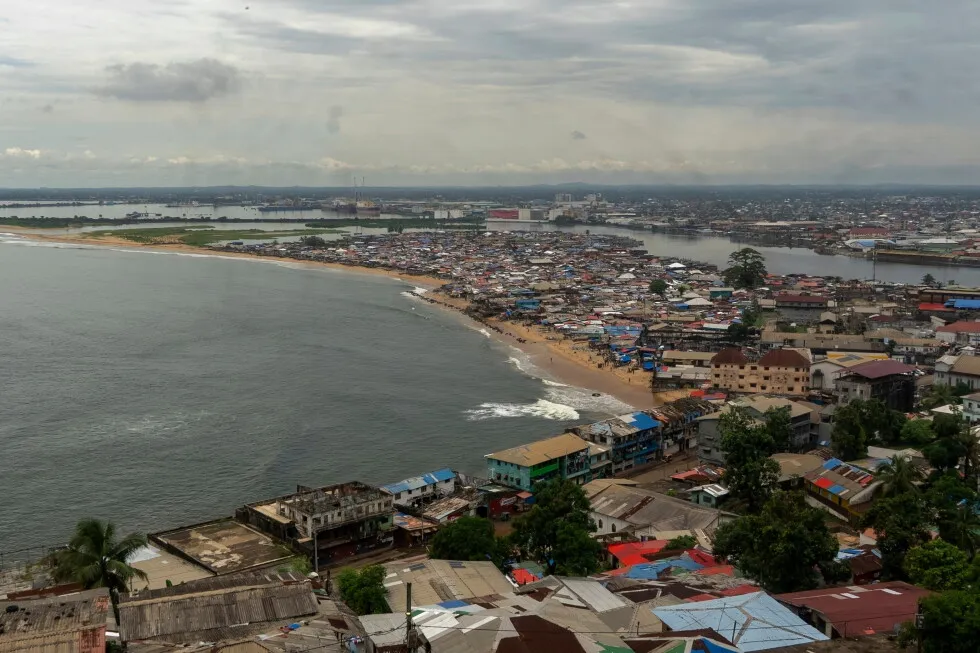
US has sent deportees to many African countries, the latest one being Liberia. Here’s why 1 of 3 | Wide view of Monrovia, Liberia, from the top of the Ducor Hotel, Sunday, June 15, 2025. (AP Photo/Annie Risemberg, File) 2 of 3 | FILE -Liberia’s President Joseph Boakai addresses the 80th session of the UN General Assembly at United Nations headquarters, Sept. 22, 2025. (AP Photo/Angelina Katsanis, File) 3 of 3 | Plane carrying the deportees from the US arrives at the Roberts International Airport outside of Monrovia, Liberia, Thursday, Aug. 20, 2026. (AP Photo/Alexander Wiaplah) By MARK BANCHEREAU Updated 9:39 PM MESZ, August 20, 2026 Add AP News on Google Add AP News as your preferred source to see more of our stories on Google. Share Share Facebook Copy Link copied Print Email X LinkedIn Bluesky Flipboard Pinterest Reddit DAKAR, Senegal (AP) — Twenty migrants deported from the United States arrived in Liberia on Thursday, the first group of an eventual 1,200 deportees that the West African country says it will receive from the U.S. under a new deal. Under a series of often-secret agreements, the Trump administration has deported thousands of people to two dozen countries that aren’t their own, as it pushes ahead with its immigration crackdown, advocates say. An estimated 11 of those agreements, nearly half the total, are with African countries and the Liberia-U.S. agreement involves one of the largest numbers of such third-country deportations Immigration lawyers say the practice is being used as a legal loophole to indirectly return some asylum-seekers to countries they fled. Authorities in Liberia have said the deportees being welcomed in their country can seek asylum there or leave if they choose. Other African countries that have received or agreed to receive third-country deportees from the U.S. include South Sudan, Eswatini, Rwanda, Ghana, Equatorial Guinea, Cameroon, Congo, Uganda, Sierra Leone and the Central African Republic. Some, like Ghana and Sierra Leone, are accepting deportees from their regions — in this case West Africa. Liberia agrees to take 1,200 third-country deportees from the US 4 MIN READ US carries out its first deportations under pact for Liberia to accept 1,200 non-Liberians 2 MIN READ 37 More than 178,000 immigrants have suddenly fled or been deported from South Africa. Here’s why 2 MIN READ 37 Many of the African countries approving the deals are among the worst hit by the Trump administration’s policies, including on trade, aid and migration. A good number of them also have authoritarian governments, raising questions about the lack of accountability and due process to ensure the protection of the deportees’ rights. Details of most of the deals are never made public and some of the African nations, like Ghana’s government, have defended their actions as having been taken on humanitarian grounds. The Trump administration had spent at least $40 million to deport about 300 migrants to countries other than their own, according to a February report by the Democratic staff of the U.S. Senate Foreign Relations Committee. More countries have entered the deal since then. Congolese President Félix Tshisekedi has described his country’s agreement as an “act of goodwill between partners,” without financial compensation. The deal came as Washington increased pressure on neighboring Rwanda over its support for M23 rebels, a dynamic analysts say may help explain Congo’s willingness to cooperate. Early flights to Africa included people that the U.S. said had convictions for serious crimes. But later transfers have included asylum-seekers with U.S. court orders protecting them from being returned to their home countries because they could face persecution or torture. Many say they’ve been sent to countries with which they have no ties and where they were not told about until hours into the deportation journey. For instance, a gay Moroccan woman deported to Cameroon, where homosexuality is illegal, and an Iranian woman with U.S. court protection from returning to Iran who was sent to the Central African Republic. Immigration lawyer Alma David called that an effective legal “loophole,” saying deportees can be left with “impossible choices” — remain in an unfamiliar country with little support or return to a country a U.S. judge found unsafe. U.S. policy says that when a receiving government gives blanket diplomatic assurances that deportees won’t face persecution there, they can be removed without additional procedures, David told The Associated Press. Some of the deportees have recounted being shackled while some were held in full-body restraint straitjackets called the WRAP during flights that can sometimes last more than 16 hours. Their conditions in the different countries vary. In Sierra Leone, the government hired private contractor Kenvah Solutions to provide housing, food and healthcare. In Congo, the International Organization for Migration has provided humanitarian assistance and offered assisted voluntary return. In Equatorial Guinea, the AP found deportees confined in a hotel owned by the family of President Teodoro Obiang Nguema Mbasogo. Migrants said they were barred from leaving, had uneven access to medical care and faced repeated pressure to return home. Twenty-five of at least 32 people held there had been sent to their home countries by May. Deportations have led to lawsuits and human rights concerns Rights advocates say the third-country deportation program risks violating non-refoulement, the principle barring governments from sending people to places where they face persecution or torture. An international coalition sued Ghana in June on behalf of 27 deportees, alleging most were quickly sent to their home countries, despite U.S. protection orders, and that some were held under armed guard in military camps, hotels and airport cells. Rights lawyers have also brought a case against Equatorial Guinea before the African Commission on Human and Peoples’ Rights, alleging deportees were returned to countries where they faced persecution despite U.S. court protections. MARK BANCHEREAU Banchereau covers 22 countries across West and Central Africa for The Associated Press. He is based in Dakar, Senegal. twitter mailto
SRCAssociated Press (AP)
LANGEN
LEANCenter
WORDS977
ENT12
THU · 2026-08-20 · 19:53 GMTBRIEF NSR-2026-0820-104270
NSR-2026-0820-104270News Report·EN·Legal & Judicial
US has sent deportees to many African countries, the latest one being Liberia. Here’s why
The United States has deported thousands of migrants to numerous African countries under a series of often secret agreements, with Liberia recently agreeing to receive 1,200 deportees. This practice, which has involved at least 11 agreements with African nations, is viewed by immigration lawyers as a legal loophole to return asylum-seekers to countries they fled.
Associated Press (AP)Filed 2026-08-20 · 19:53 GMTLean · CenterRead · 4 min
Associated Press (AP)FIG 01
Reading time
4min
Word count
977words
Sources cited
3cited
Entities identified
12entities
Quality score
100%
§ 01
Briefing Summary
AI-generatedNEWSAR · AI
The United States has deported thousands of migrants to numerous African countries under a series of often secret agreements, with Liberia recently agreeing to receive 1,200 deportees. This practice, which has involved at least 11 agreements with African nations, is viewed by immigration lawyers as a legal loophole to return asylum-seekers to countries they fled. Some African nations accept these deportees, with governments citing humanitarian grounds, though details of the deals are rarely public. These deportations have raised human rights concerns, as some asylum-seekers with U.S. court protections have been sent to countries where they may face persecution, and conditions for deportees vary significantly across the continent.
Confidence 0.90Sources 3Claims 5Entities 12
§ 02
Article analysis
Model · rule-basedFraming
Legal & Judicial
Diplomatic
Tone
Measured
AI-assessed
CalmNeutralAlarmist
Factuality
0.70 / 1.00
Factual
LowHigh
Sources cited
3
Well sourced
FewMany
§ 03
Key claims
5 extracted01
Liberia agrees to receive 1,200 third-country deportees from the US.
factualLiberia
Confidence
1.00
02
The US has sent deportees to many African countries, with Liberia being the latest recipient.
factual
Confidence
1.00
03
The Liberia-US agreement involves one of the largest numbers of third-country deportations.
factualadvocates
Confidence
0.90
04
The Trump administration has spent at least $40 million to deport about 300 migrants to countries other than their own.
statistic
Confidence
0.80
05
Immigration lawyers suggest the practice is a legal loophole to return asylum-seekers to countries they fled.
factualImmigration lawyers
Confidence
0.80
§ 04
Full report
4 min read · 977 words§ 05
Entities
12 identifiedKey playerOppositionContextPositiveNeutralNegative
Organizations1
§ 06
Keywords & salience
10 termsthird-country deportations
1.00
deportees
1.00
liberia
0.90
us immigration policy
0.80
african countries
0.70
asylum-seekers
0.60
immigration crackdown
0.50
trump administration
0.50
legal loophole
0.40
secret agreements
0.40
§ 07
Topic connections
Interactive graph Network visualization showing 21 related topics
View Full Graph Person Organization Location Event|Click node to navigate|Edge numbers = shared articles