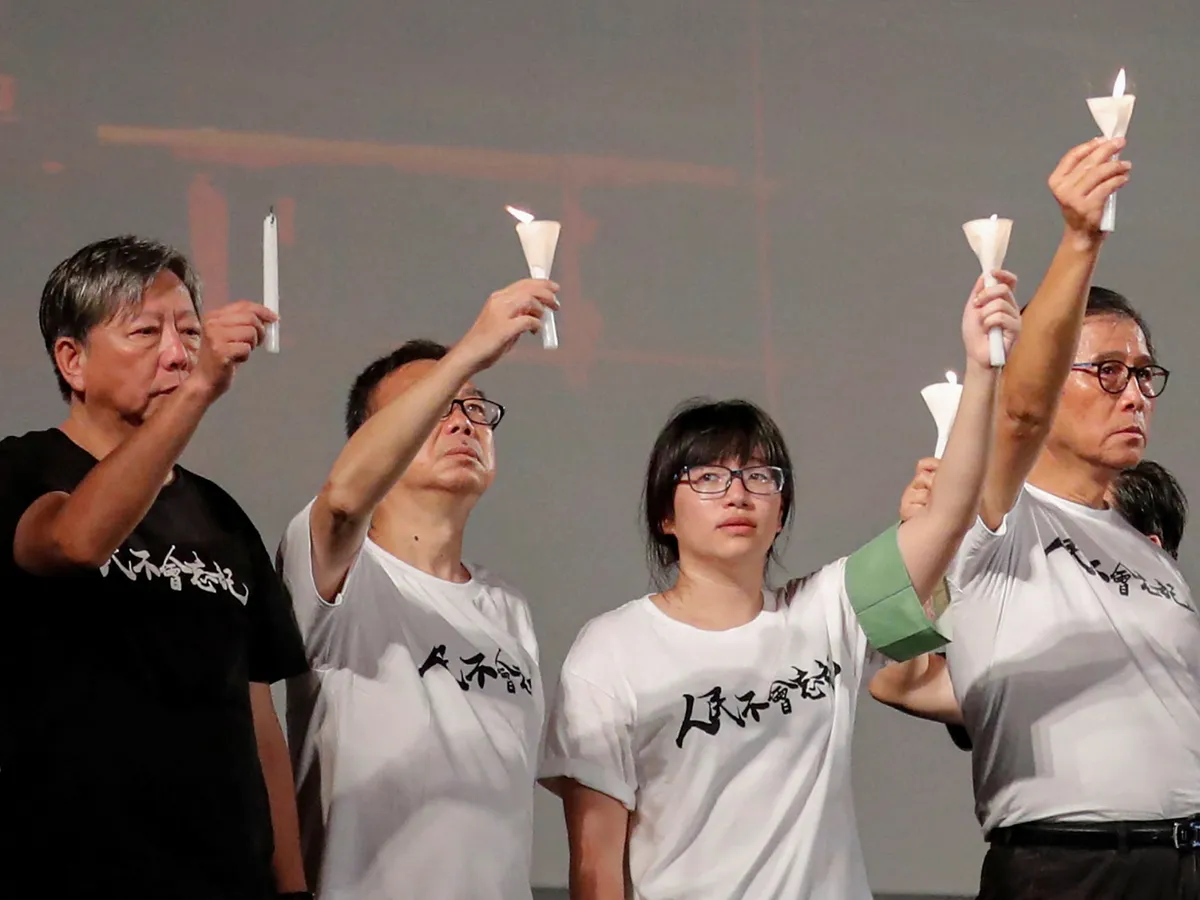
EXPLAINERAmnesty International said they ‘must be released immediately and unconditionally’.Pro-democracy activists Lee Cheuk-yan, left, Cheung Man-kwong and Chow Hang-tung, centre right, at a 2019 vigil for the victims of the Tiananmen Square massacre [Tyrone Siu/Reuters]Published On 21 Aug 2026Two prominent Hong Kong activists who helped organise annual vigils commemorating China’s deadly 1989 Tiananmen Square crackdown have been convicted of inciting subversion under the city’s national security law.On Friday, Hong Kong’s High Court found former legislator Lee Cheuk-yan, 69, and lawyer Chow Hang-tung, 41, guilty of what is one of the most serious offences under the sweeping security law imposed by Beijing in 2020.Recommended Stories list of 4 itemslist 1 of 4Pakistan’s Imran Khan back to prison after evaluation at hospitallist 2 of 4Philippines floods fuel anger over alleged corruptionlist 3 of 4Nord Stream bombing suspect to Hollywood fixer: Who is Volodymyr Zhuravlev?list 4 of 4Northern Italy seeks to keep the pressure on the south as Serie A returnsend of listThe pair, who pleaded not guilty to inciting subversion, have been held in detention since they were charged in September 2021. They face up to 10 years in prison, with sentencing to take place at a later date. A third defendant, veteran activist Albert Ho, 74, pleaded guilty before the trial began.The case is among Hong Kong’s highest-profile prosecutions under the national security law and has renewed scrutiny of the erosion of political freedoms in the territory as Beijing expands its influence there. Here is what we know.Who are Lee Cheuk-yan and Chow Hang-tung?Lee and Chow were leading members of the now-disbanded, pro-democracy action group China" class="entity-link entity-organization" data-entity-id="16309" data-entity-type="organization">Hong Kong Alliance in Support of Patriotic Democratic Movements of China, which for decades organised Hong Kong’s annual candlelight vigil commemorating those killed in the Tiananmen crackdown.The alliance was established in May 1989 as protests calling for political reform in China gathered momentum in Beijing and other cities. Over the following three decades, it campaigned for accountability over the brutal crackdown on protests, the release of political dissidents and democratic reform in China.Lee, a former Hong Kong politician and veteran labour activist, served as the alliance’s chairman, while Chow, a barrister, was its vice chairwoman.Prosecutors accused the alliance and its leaders of inciting others to subvert state power. Central to the case was the organisation’s longstanding slogan calling to “end one-party” system in China.The court ruled that the slogan sought to instigate hostility towards the Chinese Communist Party and undermine the political system established under China’s constitution. Lee and Chow maintained that their political advocacy was peaceful and protected by Hong Kong’s guarantees of freedom of expression.Both were convicted on Friday. Ho, another former alliance leader, had already pleaded guilty to the same charge.What happened to Hong Kong’s Tiananmen vigils?Hong Kong was previously one of the few places under Chinese sovereignty where large public commemorations of the Tiananmen crackdown were permitted.On June 4, 1989, Chinese troops opened fire on demonstrators after weeks of largely peaceful protests centred around Beijing’s Tiananmen Square, calling for political reform. Hundreds – possibly thousands – of people were killed, while thousands more were arrested.Public discussion and commemoration of the crackdown have long been heavily censored in mainland China.Hong Kong was different. Under the “one country, two systems” arrangement established when Britain handed the territory back to China in 1997, Hong Kong retained some of the freedoms unavailable on the mainland.Every June 4, crowds gathered in the city’s Victoria Park for a candlelight vigil commemorating those killed and demanding accountability from Beijing. At their height, the commemorations drew crowds numbering in the tens of thousands.The last major vigil organised by the alliance was held in 2019, the 30th anniversary of the crackdown. The authorities banned the gatherings in 2020 and 2021, initially citing COVID-19 restrictions. They have not resumed.What is Hong Kong’s national security law?The vigils ceased just as Hong Kong was undergoing a much broader political transformation following months of mass antigovernment and pro-democracy protests in 2019.In June 2020, Beijing imposed a new national security law in Hong Kong, criminalising secession, subversion, terrorism and collusion with foreign forces.Chinese and Hong Kong authorities said the legislation was necessary to restore stability following the 2019 unrest and to ensure rights and freedoms remained protected.Human rights groups say, however, its broad provisions have been used to dismantle much of Hong Kong’s organised political opposition and restrict some individual freedoms that once distinguished the territory from mainland China.Since the law was introduced, leading opposition figures have been prosecuted, political organisations and civil society groups have disbanded, and independent media outlets have closed.Rights groups say the prosecution of Lee and Chow in effect criminalises peaceful political advocacy and the commemoration of one of the most difficult episodes in modern Chinese history.Responding to Friday’s verdict, Amnesty International Hong Kong Overseas spokesperson Fernando Cheung said it showed how the national security law was being used to “punish people for peacefully remembering” the Tiananmen crackdown.“For decades, Hong Kong was the only place on Chinese soil where large-scale public remembrance of the Tiananmen crackdown could take place,” Cheung said, describing the convictions as another step in what Amnesty says is a campaign to erase its legacy and silence demands for accountability.Amnesty International Deputy Regional Director Sarah Brooks called Lee and Chow “prisoners of conscience” and said they “should never have been prosecuted in the first place”, calling for their immediate and unconditional release.
SRCAl Jazeera
LANGEN
LEANCenter
WORDS893
ENT10
FRI · 2026-08-21 · 12:54 GMTBRIEF NSR-2026-0821-104556
NSR-2026-0821-104556News Report·EN·Human Rights
Why are Hong Kong’s Tiananmen vigil organisers facing prison?
Two prominent Hong Kong activists, Lee Cheuk-yan and Chow Hang-tung, have been convicted of inciting subversion under the city's national security law for their roles in organizing annual Tiananmen Square massacre vigils. They were leading members of the Hong Kong Alliance in Support of Patriotic Democratic Movements of China, which for decades commemorated the 1989 crackdown and campaigned for democratic reform in China.
Caolán MageeAl JazeeraFiled 2026-08-21 · 12:54 GMTLean · CenterRead · 4 min
Al JazeeraFIG 01
Reading time
4min
Word count
893words
Sources cited
1cited
Entities identified
10entities
Quality score
100%
§ 01
Briefing Summary
AI-generatedNEWSAR · AI
Two prominent Hong Kong activists, Lee Cheuk-yan and Chow Hang-tung, have been convicted of inciting subversion under the city's national security law for their roles in organizing annual Tiananmen Square massacre vigils. They were leading members of the Hong Kong Alliance in Support of Patriotic Democratic Movements of China, which for decades commemorated the 1989 crackdown and campaigned for democratic reform in China. Prosecutors argued the alliance's slogan calling to "end one-party" rule incited hostility towards the Chinese Communist Party. Lee and Chow, who maintained their advocacy was peaceful, face up to 10 years in prison. A third leader, Albert Ho, pleaded guilty to the same charge. The convictions mark a significant prosecution under the national security law, which has been used to restrict political freedoms in Hong Kong.
Confidence 0.90Sources 1Claims 5Entities 10
§ 02
Article analysis
Model · rule-basedFraming
Human Rights
Legal & Judicial
Tone
Measured
AI-assessed
CalmNeutralAlarmist
Factuality
0.80 / 1.00
Factual
LowHigh
Sources cited
1
Limited
FewMany
§ 03
Key claims
5 extracted01
Amnesty International stated that the activists 'must be released immediately and unconditionally'.
quoteAmnesty International
Confidence
1.00
02
Lee and Chow maintained that their political advocacy was peaceful and protected by Hong Kong's guarantees of freedom of expression.
quoteLee Cheuk-yan, Chow Hang-tung
Confidence
1.00
03
Prosecutors accused the alliance and its leaders of inciting others to subvert state power, citing the slogan 'end one-party' system in China.
factual
Confidence
1.00
04
The Hong Kong Alliance in Support of Patriotic Democratic Movements of China organized annual vigils commemorating the Tiananmen Square crackdown.
factual
Confidence
1.00
05
Two Hong Kong activists, Lee Cheuk-yan and Chow Hang-tung, were convicted of inciting subversion under the national security law.
factual
Confidence
1.00
§ 04
Full report
4 min read · 893 words§ 05
Entities
10 identifiedKey playerOppositionContextPositiveNeutralNegative
People3
Organizations2
§ 06
Keywords & salience
9 termshong kong national security law
1.00
tiananmen square massacre
1.00
inciting subversion
0.90
pro-democracy activists
0.80
hong kong alliance
0.70
political freedoms
0.60
lee cheuk-yan
0.50
chow hang-tung
0.50
beijing
0.40
§ 07
Topic connections
Interactive graph Network visualization showing 15 related topics
View Full Graph Person Organization Location Event|Click node to navigate|Edge numbers = shared articles