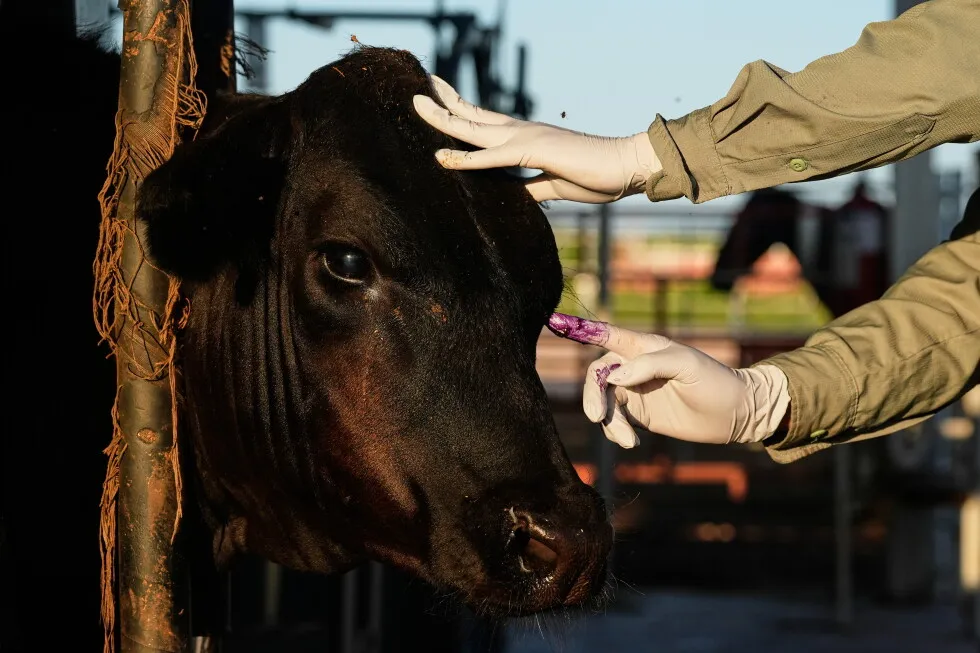
Mexico resumes livestock sales to US under tight controls over screwworm risk 0 seconds of 59 secondsVolume 0% Press shift question mark to access a list of keyboard shortcuts Keyboard ShortcutsEnabledDisabled Shortcuts Open/Close/ or ? Play/PauseSPACE Increase Volume↑ Decrease Volume↓ Seek Forward→ Seek Backward← Captions On/Offc Fullscreen/Exit Fullscreenf Mute/Unmutem Decrease Caption Size- Increase Caption Size+ or = Seek %0-9 Next Up Republican U.S. Sen. Dan Sullivan encourages voters to turn out on election day 01:15 00:00 00:59 00:59 More Videos 01:15 Republican U.S. Sen. Dan Sullivan encourages voters to turn out on election day 00:25 Stampede at Hindu temple in India's Bihar state leaves 7 dead and over a dozen injured 00:40 US sends 20 deportees to Liberia, part of 1,200 migrants the country will receive under new deal 01:33 Cuban Amb. question for Sec. Rubio: "What are you afraid of?" 01:09 AP Explains: Byron Donalds celebrates Republican nomination for Florida Governor 00:45 Vessels remain stranded at the Strait of Hormuz with tensions high between US and Iran 00:50 Charter boat hauls in 1,260-pound blue marlin believed to be East Coast's largest catch 01:13 Trump threatens Oman as it works with Iran on a Strait of Hormuz deal Close 1 of 6 | cattle ranchers in Mexico’s northern state of Sonora are preparing to resume exports to the United States after more than a year of disruptions caused by the spread of the New World screwworm, but they say the initial flow of cattle will be too small to quickly clear a backlog. (AP Video: Fernanda Pesce) 2 of 6 | A veterinarian applies antibiotics to a calf’s injured eye during an inspection for export to the United States at a regional cattle ranchers’ association in Hermosillo, Mexico, on Tuesday, Aug. 18, 2026. (AP Photo/Fernando Llano) 3 of 6 | A rancher unloads calves at the pens of the regional cattle ranchers association ahead of the announced reopening of the U.S. border to Mexican cattle imports, in Hermosillo, Mexico, Monday, Aug. 17, 2026. (AP Photo/Fernando Llano) 4 of 6 | Calves feed prior to inspection for export to the United States at a regional cattle ranchers association in Hermosillo, Mexico, Tuesday, Aug. 18, 2026, ahead of the reopening of the U.S. border to Mexican cattle imports. (AP Photo/Fernando Llano) 5 of 6 | A cattle handler moves calves during an auction at a livestock market in Hermosillo, Mexico, Tuesday, Aug. 18, 2026, ahead of the reopening of the U.S. border to Mexican cattle imports.(AP Photo/Fernando Llano) 6 of 6 | Calves stand in pens before an inspection for export to the United States at a regional cattle ranchers association in Hermosillo, Mexico, Tuesday, Aug. 18, 2026, ahead of the reopening of the U.S. border to Mexican cattle imports. (AP Photo/Fernando Llano) By FABIOLA SÁNCHEZ Updated 11:59 AM MESZ, August 22, 2026 Add AP News on Google Add AP News as your preferred source to see more of our stories on Google. Share Share Facebook Copy Link copied Print Email X LinkedIn Bluesky Flipboard Pinterest Reddit Hermosillo, Mexico (AP) — At daybreak, rancher Martín Alfonso Ibarra takes advantage of the cooler hours in northern Mexico’s desert to oversee the milking of his cows and tend to 16 prized calves. Soon, he hopes, they will be headed north to the United States as a yearlong ban on Mexican cattle imports comes to an end. The ban, imposed over concerns about a flesh-eating parasite known as the New World screwworm fly, dealt a blow to cattle and beef industries on both sides of the border, exacerbating a livestock shortage in the U.S. and hurting a Mexican ranching sector already weakened by drought and a cattle export business that generated $1.2 billion for Mexico last year. Now, the U.S. is set to resume livestock imports from Mexico beginning Aug. 24 at the Douglas, Arizona, border crossing, which borders Agua Prieta in Mexico’s Sonora state. If the reopening goes smoothly, the U.S. Department of Agriculture could allow imports through additional ports, though shipments will initially be subject to restrictions aimed at preventing the spread of the parasite — which has already crossed the border, with authorities battling cases in Texas and New Mexico. The screwworm gets its name from the maggots’ habit of burrowing — or screwing — into a wound, according to the USDA Animal and Plant Health Inspection Service. Any warm-blooded animal, including wildlife, pets and occasionally even humans, can be infested. In Mexico, the screwworm outbreak was detected in November 2024 and has spread to 30 of the 32 states — most recently in Sonora, where the first case was reported Wednesday in the community of Munihuasa, near the borders with Chihuahua and Sinaloa, states where infections have also proliferated. To date, Mexico has 1,969 active screwworm cases, which represent less than half of the infections reported a year ago, a decline that authorities say shows progress in containing the outbreak. Still, they acknowledge eradication will take time. US says it will begin lifting a suspension of Mexican cattle imports starting in August 2 MIN READ 98 Why Mexican avocado exports to the US have been stopped again 5 MIN READ México reanuda venta de ganado a EEUU bajo fuerte control y riesgo de la plaga del gusano barrenador 5 MIN READ New US controls are expected to slow shipments Against that backdrop, Ibarra and thousands of other ranchers in the northern state of Sonora are preparing to resume live cattle exports. But optimism is tempered by new U.S. controls expected to slow shipments across the border. “This is not over yet,” said the 58-year-old rancher, adding that the export halt cut his income by 40% last year. According to the protocol defined by U.S. authorities, in the first week of reopening, only 700 cattle per day will be allowed through; this will rise to 900 in the second week and will gradually increase until reaching 1,300 cattle per day, veterinarian Arturo Ruiz, responsible for animal health for the state of Sonora, told The Associated Press. The new rules also require cattle to be fitted with radio-frequency identification tags in their ears and screened by electronic readers and trained dogs. Officials from the U.S. Department of Agriculture will conduct the inspections before allowing the Mexican cattle to cross into Arizona, Ruiz explained. Mexico accepted the U.S. protocols, but the restrictions have frustrated some local ranchers. “We are at a complicated moment when we need authorities to think less politically and more technically and reasonably,” said Juan Carlos Ochoa, president of the Regional Livestock Union of Sonora, referring to tensions between the Mexican and U.S. governments when the ban was first imposed in May 2025. Ochoa said the new U.S. restrictions would limit shipments and argued that a greater flow of cattle across the border is needed to address supply shortages in both countries. Although both countries felt the effects of Washington’s decision, the impact was greater in the U.S., particularly for consumers facing record-high beef prices that led some to cut back on meat. Juan Carlos Anaya, general director of agricultural consulting firm Grupo Consultor de Mercados Agrícolas, said U.S. ranchers were unable to make up the supply shortfall, contributing to closures at some meat-processing plants and hurting feedlot operations. Before the border closure, Mexico exported about 1.2 million head of cattle to the United States each year, mainly from its northern states. When exports were suspended, Mexican ranchers turned to the domestic market, where they sold their cattle for nearly 40% less than they had received in the U.S. — a loss of income that forced many to sell some of their cattle or cut spending and investment. Back in Sonora, in the stifling August heat of the capital, Hermosillo, Ibarra was cautiously optimistic about finally sending his 16 calves to the U.S. But he said he would temper his expectations until October, when the cattle have gained enough weight and the sale could be finalized. Follow AP’s coverage of Latin America and the Caribbean at https://apnews.com/hub/latin-america
SRCAssociated Press (AP)
LANGEN
LEANCenter
WORDS1 336
ENT10
SAT · 2026-08-22 · 10:23 GMTBRIEF NSR-2026-0822-104832
NSR-2026-0822-104832News Report·EN·Economic Impact
Mexico resumes livestock sales to US under tight controls over screwworm risk
Mexico is resuming livestock sales to the United States on August 24th, ending a yearlong ban imposed due to concerns over the New World screwworm fly. The ban significantly impacted both countries' cattle industries, contributing to a U.S.
Associated Press (AP)Filed 2026-08-22 · 10:23 GMTLean · CenterRead · 6 min
Associated Press (AP)FIG 01
Reading time
6min
Word count
1 336words
Sources cited
0cited
Entities identified
10entities
Quality score
100%
§ 01
Briefing Summary
AI-generatedNEWSAR · AI
Mexico is resuming livestock sales to the United States on August 24th, ending a yearlong ban imposed due to concerns over the New World screwworm fly. The ban significantly impacted both countries' cattle industries, contributing to a U.S. livestock shortage and hurting Mexico's ranching sector. Imports will initially be limited and subject to strict controls, including RFID tagging and electronic screening, to prevent the parasite's spread, which has already been detected in Texas and New Mexico. While Mexico has seen a decline in screwworm cases, eradication is ongoing. Ranchers are cautiously optimistic but express concern that the new restrictions will slow shipments and limit the immediate impact on supply backlogs.
Confidence 0.90Claims 4Entities 10
§ 02
Article analysis
Model · rule-basedFraming
Economic Impact
Public Health
Tone
Measured
AI-assessed
CalmNeutralAlarmist
Factuality
0.80 / 1.00
Factual
LowHigh
Sources cited
0
No named sources
FewMany
§ 03
Key claims
4 extracted01
Veterinarians are inspecting cattle for export to the US.
factual
Confidence
1.00
02
The New World screwworm outbreak caused disruptions to livestock sales.
factual
Confidence
1.00
03
Mexico resumes livestock sales to the US after over a year of disruption due to New World screwworm.
factual
Confidence
1.00
04
The initial flow of cattle will be too small to quickly clear a backlog.
quotecattle ranchers in Mexico
Confidence
0.90
§ 04
Full report
6 min read · 1 336 words§ 05
Entities
10 identifiedKey playerOppositionContextPositiveNeutralNegative
Organizations1
Locations4
§ 06
Keywords & salience
10 termsscrewworm risk
1.00
livestock sales
1.00
mexico
0.90
united states
0.90
cattle exports
0.80
tight controls
0.70
new world screwworm
0.60
sonora
0.50
hermosillo
0.50
veterinarian inspection
0.40
§ 07
Topic connections
Interactive graph Network visualization showing 51 related topics
View Full Graph Person Organization Location Event|Click node to navigate|Edge numbers = shared articles