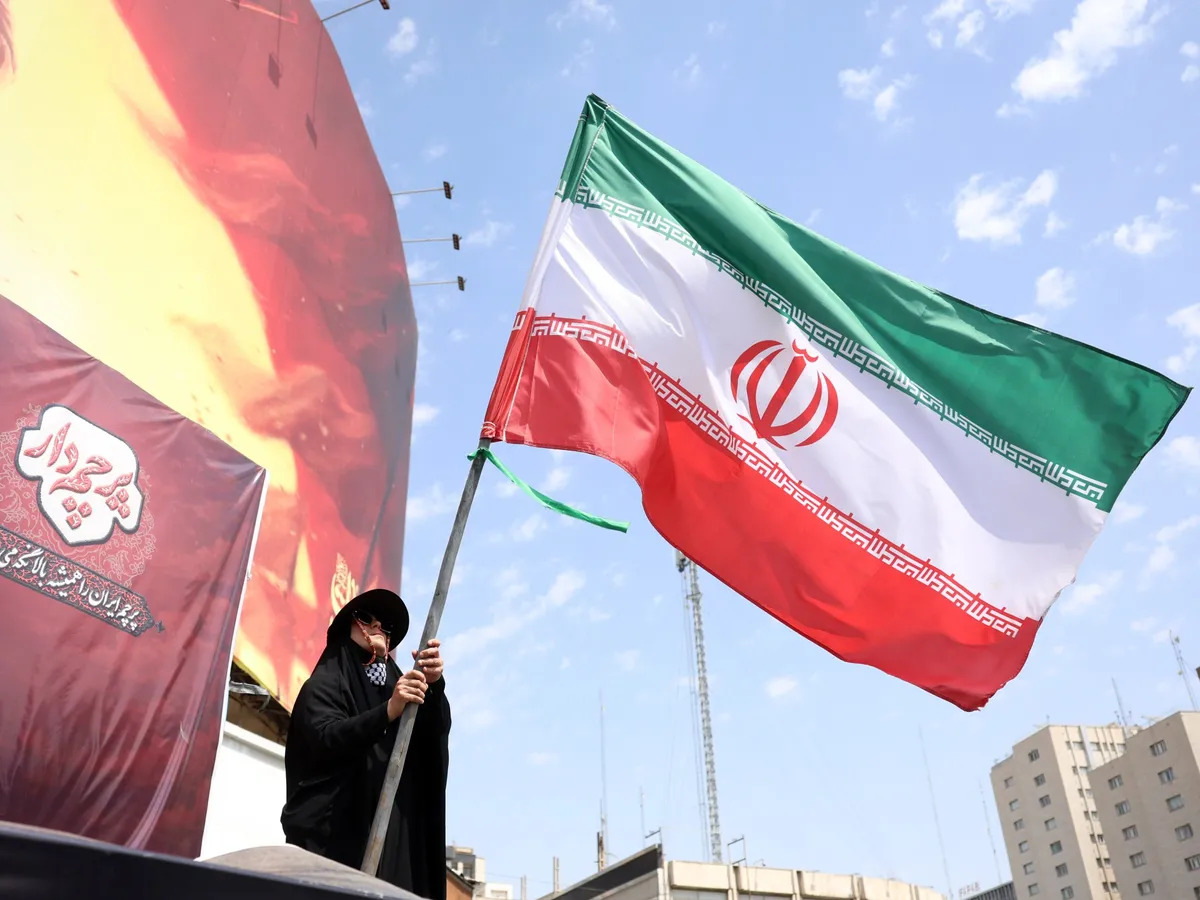
Iran says production is ongoing, but details will not be revealed during war conditions.An Iranian woman flies Iran's national flag at the Valiasr square in Tehran, Iran, August 17, 2026 [Abedin Taherkenareh/EPA]Published On 22 Aug 2026Tehran, Iran – The Iranian military is looking at how to respond to the United States’s planned implementation of economic measures that are designed to “collapse” the government in Tehran.It comes as US President Donald Trump announced this week the “most crushing economic operation” against Iran, saying Tehran would face “economic warfare and isolation on an unprecedented scale”.Iranian commanders are reviewing new military strategies to counteract the new US threats.“The only intelligent and effective solution to navigate difficult historical junctures and neutralise the enemy’s plots today and in the future,” Ahmad Vahdi, commander-in-chief of the Islamic Revolutionary Guard Corps (IRGC), warned on Friday.Marking National Day of Defence Industry in Iran on Saturday, Ali Abdollahi, chief of staff of Iran’s armed forces, hailed a “deterrent defensive industrial revolution” in the domestic production of weaponry.But as happened last year, authorities opted not to exhibit new arms.“We have limited unveilings of weapons and equipment in order to surprise the enemy and safeguard the country’s defensive information and secrets,” Ministry of Defence spokesman Reza Talaei-Nik told state media on Saturday.However, he claimed that in the 12 months after the 12-day war with Israel and the US in June 2025, Iran doubled its production of weapons and defensive equipment.Since the start of the current war with the US and Israel on February 28, manufacturing of some “strategic and prioritised products” has more than tripled, he claimed.Talaei-Nik also said more than 9,300 companies in Iran are involved in producing weapons, which means US and Israeli strikes would not be able to destroy this sector.Acting Defence Minister Majid Ebn-e Reza said on Friday that compared to last year’s war with Israel and the US, the Iranian armed forces were able to achieve deeper penetration of enemy bases, greater strike accuracy, and more successful air defence interceptions.In another future war, the IRGC will deploy new generations of warheads for its ballistic and cruise missiles, as production and development never stopped, IRGC spokesman Hossein Mohebbi said on Thursday.The truce between the US and Iran, which took hold on April 8, followed nearly 40 days of intense bombing and involved thousands of flight sorties.The White House claimed that more than 85 percent of Iran’s defence-industrial base had been destroyed, including the majority of its ballistic missiles, mobile launchers and long-range drones.It also said that more than 150 Iranian warships were destroyed, every submarine sunk, and 97 percent of Iran’s naval-mine inventory eliminated.But a confidential US intelligence assessment reported by media in May found that Iran retained approximately 75 percent of its mobile launchers and 70 percent of its pre-war missile inventory.Even after an additional two weeks of intense bombardment by the US in July, the IRGC and the Iranian army continued to launch missiles and drones at US bases and international shipping in the Strait of Hormuz – although at a slower pace compared with the start of the war.Two youth sit on the shoreline as ships are seen anchored in the Strait of Hormuz on August 10, 2026 off the coast of Bandar Abbas, Iran [Ali Saeedi/Getty Images]Iranian commanders have said the July strikes by the US signalled potential planning for ground operations in southern Iran, and the military was ready to counter any such efforts by Washington.Experts have said Iran has continued to produce weapons in geographically dispersed underground bases that have stayed out of reach of US bombs, even as many overground manufacturing lines were decimated.In addition to the more complex and costly ballistic missiles, cheaper and easier-to-make explosive drones have helped Iran consume a large number of US interceptors, reveal radar positions, force airports or energy sites to suspend operations, and create disruptions in the Strait of Hormuz.Iran’s air defences and ageing air force largely failed to prevent US, Israeli and Arab breaches of its airspace during bombing runs.But smaller electro-optical, heat-seeking and man-portable systems have managed some interceptions, including the downing of an F-15 fighter jet.At least 45 advanced MQ-9 Reaper drones of the US military, about a quarter of the entire fleet at the cost of more than $1.3bn, were either shot down by Iran or were lost through data-link or operational failures, according to US media reports.In the Strait of Hormuz, which US President Donald Trump declared US territory this week, Washington and its allies have managed to increase discrete oil and energy transfers over recent weeks.But despite significant damage inflicted on Iran’s naval capabilities, missile, drone and fast boat attacks mean oil flows via the Hormuz are still considerably lower than their pre-war levels.Disruptions to sea traffic are also happening in the Red Sea and Bab al-Mandeb strait, where Iran-aligned Houthis in Yemen have intermittently clashed with Saudi Arabia and its interests.Iran and the US are not engaged in any meaningful dialogue, so a diplomatic way out of the war is currently not in sight.
SRCAl Jazeera
LANGEN
LEANCenter
WORDS838
ENT12
SAT · 2026-08-22 · 14:19 GMTBRIEF NSR-2026-0822-104858
NSR-2026-0822-104858News Report·EN·Conflict
What did war with the US reveal about Iran’s weapons capabilities?
Iran claims its weapons production is ongoing, with some strategic items tripling in manufacturing since the start of the war with the US and Israel on February 28. Despite US claims of destroying over 85% of Iran's defense-industrial base, a confidential US intelligence assessment indicated Iran retained a significant portion of its mobile launchers and missile inventory.
Maziar MotamediAl JazeeraFiled 2026-08-22 · 14:19 GMTLean · CenterRead · 4 min
Al JazeeraFIG 01
Reading time
4min
Word count
838words
Sources cited
5cited
Entities identified
12entities
Quality score
100%
§ 01
Briefing Summary
AI-generatedNEWSAR · AI
Iran claims its weapons production is ongoing, with some strategic items tripling in manufacturing since the start of the war with the US and Israel on February 28. Despite US claims of destroying over 85% of Iran's defense-industrial base, a confidential US intelligence assessment indicated Iran retained a significant portion of its mobile launchers and missile inventory. Iran's Ministry of Defence stated that over 9,300 companies are involved in weapons production, making the sector difficult to destroy. Acting Defence Minister Majid Ebn-e Reza highlighted improvements in strike accuracy and air defense interceptions compared to a previous conflict. The IRGC plans to deploy new generations of warheads for its missiles, as production and development have continued.
Confidence 0.90Sources 5Claims 5Entities 12
§ 02
Article analysis
Model · rule-basedFraming
Conflict
National Security
Tone
Mixed Tone
AI-assessed
CalmNeutralAlarmist
Factuality
0.40 / 1.00
Mixed
LowHigh
Sources cited
5
Well sourced
FewMany
§ 03
Key claims
5 extracted01
US President Donald Trump announced the “most crushing economic operation” against Iran, saying Tehran would face “economic warfare and isolation on an unprecedented scale”.
quoteDonald Trump
Confidence
0.90
02
The White House claimed that more than 85 percent of Iran’s defence-industrial base had been destroyed.
statisticWhite House
Confidence
0.90
03
Iran claims manufacturing of some strategic products has more than tripled since the start of the current war with the US and Israel on February 28.
statisticReza Talaei-Nik
Confidence
0.80
04
Iran claims to have doubled its production of weapons and defensive equipment in the 12 months after a 12-day war with Israel and the US in June 2025.
statisticReza Talaei-Nik
Confidence
0.80
05
Acting Defence Minister claims Iranian armed forces achieved deeper penetration of enemy bases, greater strike accuracy, and more successful air defence interceptions compared to last year's war.
quoteMajid Ebn-e Reza
Confidence
0.70
§ 04
Full report
4 min read · 838 words§ 05
Entities
12 identifiedKey playerOppositionContextPositiveNeutralNegative
People6
Locations4
§ 06
Keywords & salience
10 termsiran's weapons capabilities
1.00
economic warfare
0.90
military strategies
0.80
weapon production
0.70
defensive industrial revolution
0.70
us-iran war
0.60
islamic revolutionary guard corps
0.60
ballistic and cruise missiles
0.50
air defence interceptions
0.40
economic measures
0.40
§ 07
Topic connections
Interactive graph Network visualization showing 51 related topics
View Full Graph Person Organization Location Event|Click node to navigate|Edge numbers = shared articles