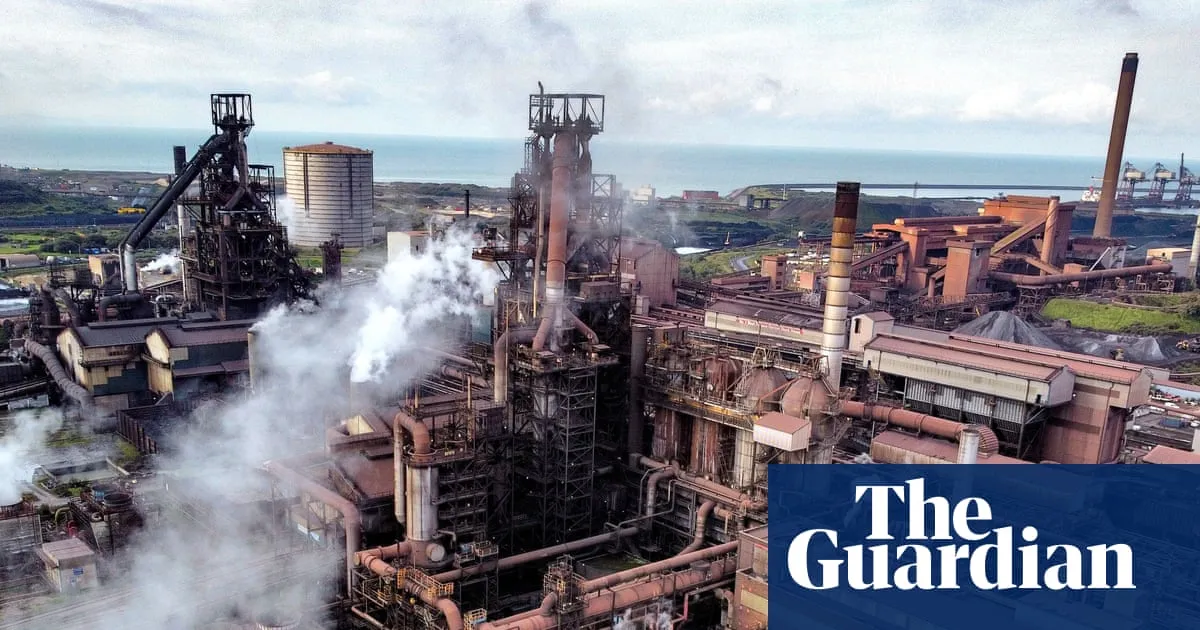
At Tata Steel’s factory in Llanwern, South Wales, production lines that should be running full-time are now falling quiet for parts of the day, with workers being put on to maintenance and cleaning work while machines sit idle.There aren’t enough orders to keep them running all the time, the company says, because of a surge of cheap steel coming from Asian countries that is threatening the viability of several UK sites that make similar products, and risk hundreds of jobs.“The line has been left running half empty, and the result of that is it won’t last very long unless we can find a solution here,” said one insider.New 50% import tariffs introduced by the government in July were designed to protect against cheap steel from countries including China and India from undercutting UK producers such as Tata.But for some types of product, such as the galvanised steel made at Llanwern, near Newport, the situation has worsened, after the government increased the tariff-free quotas – the amount of steel that can be brought in without paying the levy – for some countries.India’s allowance of galvanised steel rose from 98,000 to 125,000 tonnes, while Vietnam’s more than tripled, from 51,000 to 174,000 tonnes. South Korea was given an increased quota of 100,000 tonnes.Steel pipes at a factory in Que Vo, outside Hanoi. Vietnam’s UK allowance of galvanised steel more than tripled to 174,000 tonnes. Photograph: Kham/ReutersThe larger quota for India is understood to have been a last-minute move to help get a trade deal with the country over the line, which was first reported by the Financial Times. World Trade Organization rules require comparable exporters are. reated equally, forcing the increase in quotas to Vietnam and South Korea.Earlier this summer the Tata UK boss, Rajesh Nair, said he was “very concerned” about the new arrangement.Now, nearly two months later, Llanwern is struggling to compete on price and running at about half capacity as a result. The factory produces about 600,000 tonnes of galvanised steel a year, nearly half the UK’s total demand.Galvanised steel is a type of steel that has been dipped in molten zinc, giving it a protective layer that can last for decades and stop it corroding. It is widely used in items such as bridges, outdoor signs and car bodywork.The company is understood to have met Blair McDougall, the minister for industry, two weeks ago, and laid out the scale of the problem facing Llanwern.Russell Codling, the commercial director of Tata Steel, said: “Our world-class Zodiac galvanising line in Llanwern, South Wales, is already being significantly impacted by the new quotas, and that situation just isn’t sustainable.“The quotas have the power to turn this around and make us a truly sustainable business.”Tata is in the process of switching from its old blast furnaces in Port Talbot, South Wales, to a 3m tonne electric arc furnace. The move will reduce its carbon emissions but it cost 2,000 jobs in the region when the blast furnace was closed down in 2024.skip past newsletter promotionafter newsletter promotionThe process involves £1.25bn in investment, about £500m of which has come from a government grant. But a steel industry source said prolonged tariff pressure could even endanger that switch.The person said: “If there is a prolonged impact across a number of Tata Steel’s core sectors that affects the outputs of its downstream processing sites, that in itself could have a knock-on effect on the ability of its electric arc furnace and green steel making to transform the future of the business as they were hoping.”Alasdair McDiarmid, the assistant general secretary at the Community union, said: “There is no doubt that the increase in duty-free steel imports from China and Vietnam poses a threat to our domestic steel industry, and at Llanwern our members are already feeling the impact.“We will continue to call on the government to adopt a more robust approach to ensure that the long-term sustainability of Llanwern steelworks is not jeopardised.“Llanwern is a crucial strategic site for the Welsh and UK steel sectors, supplying top-quality galvanised steel to the automotive and construction sectors. It is vital that the plant and its dedicated workforce have security for the future.”The government has previously said it will review the quota system before it changes again in July 2027.A government spokesperson said: “Our steel measure aims to strike the right balance between protecting domestic production and maintaining a secure supply, and final quotas were shaped by extensive engagement with industry.“While category 4 imports are currently below the quota levels that have been set, we will continue to take industry feedback into account, monitor the impact closely and review the measure after 12 months.”
SRCThe Guardian - World News
LANGEN
LEANCenter-Left
WORDS776
ENT12
SUN · 2026-08-23 · 09:00 GMTBRIEF NSR-2026-0823-105031
NSR-2026-0823-105031News Report·EN·Economic Impact
‘The line’s running half-empty’: Llanwern steelworks feels the heat from cheap steel imports
Tata Steel's Llanwern steelworks in south Wales is operating at reduced capacity due to a surge in cheap steel imports, primarily from Asian countries. Despite new government tariffs intended to protect UK firms, increased tariff-free quotas for products like galvanised steel from India, Vietnam, and South Korea have worsened the situation.
Alex DanielThe Guardian - World NewsFiled 2026-08-23 · 09:00 GMTLean · Center-LeftRead · 4 min
The Guardian - World NewsFIG 01
Reading time
4min
Word count
776words
Sources cited
3cited
Entities identified
12entities
Quality score
100%
§ 01
Briefing Summary
AI-generatedNEWSAR · AI
Tata Steel's Llanwern steelworks in south Wales is operating at reduced capacity due to a surge in cheap steel imports, primarily from Asian countries. Despite new government tariffs intended to protect UK firms, increased tariff-free quotas for products like galvanised steel from India, Vietnam, and South Korea have worsened the situation. This has led to production lines running at half capacity, impacting jobs and threatening the viability of the plant. Tata Steel has met with the government to highlight the issue, emphasizing that the current quotas are unsustainable. The government states its steel measures aim to balance domestic protection with supply security and will monitor the impact.
Confidence 0.90Sources 3Claims 5Entities 12
§ 02
Article analysis
Model · rule-basedFraming
Economic Impact
Human Interest
Tone
Measured
AI-assessed
CalmNeutralAlarmist
Factuality
0.80 / 1.00
Factual
LowHigh
Sources cited
3
Well sourced
FewMany
§ 03
Key claims
5 extracted01
The new quotas have the power to make Tata Steel a truly sustainable business.
quoteRussell Codling, commercial director of Tata Steel
Confidence
1.00
02
India’s allowance of galvanised steel rose from 98,000 to 125,000 tonnes.
statisticarticle
Confidence
0.95
03
The government increased tariff-free quotas for galvanised steel from India, Vietnam, and South Korea.
factualarticle
Confidence
0.95
04
New 50% import tariffs introduced in July were intended to protect UK producers from cheap steel imports.
factualarticle
Confidence
0.90
05
Production lines at Tata Steel's Llanwern factory are running at half capacity due to a surge of cheap steel imports.
factualarticle
Confidence
0.90
§ 04
Full report
4 min read · 776 words§ 05
Entities
12 identifiedKey playerOppositionContextPositiveNeutralNegative
Organizations1
Locations7
§ 06
Keywords & salience
10 termsllanwern steelworks
1.00
cheap steel imports
1.00
tata steel
0.90
galvanised steel
0.80
import tariffs
0.70
tariff-free quotas
0.70
uk steel industry
0.60
asian countries
0.50
production capacity
0.40
trade deal
0.40
§ 07
Topic connections
Interactive graph No topic relationship data available yet. This graph will appear once topic relationships have been computed.