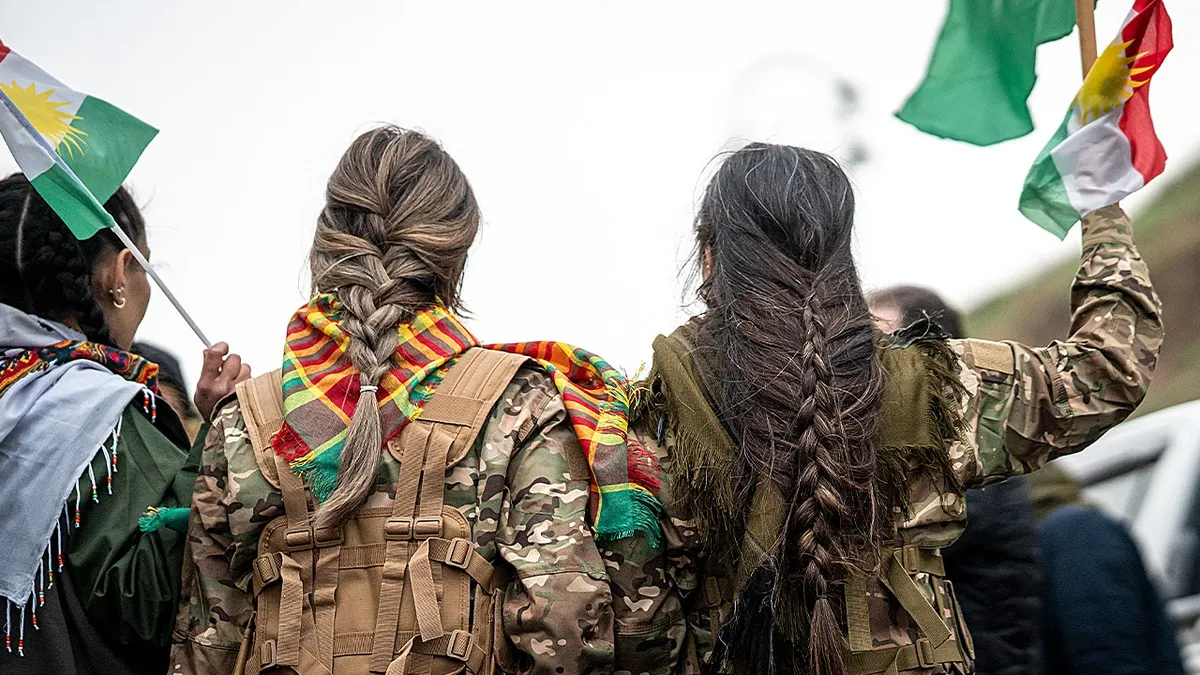
A video showing a Syrian militiaman holding what he claims to be a severed braid belonging to a Kurdish fighter killed in Raqqa has sparked outrage as Damascus moves to assert control in northeastern Syria amid a fragile ceasefire. In the video, the man holds up what appears to be a cut braid. He is said to tell the person filming that he took it from a woman he claims was affiliated with the Kurdish-led Syrian Democratic Forces (SDF). When asked why, he responds, "She’s already gone, what will she do?" according to London-based news outlet New Arab. The video prompted an online campaign and protests where Kurdish women braided their hair in solidarity. Outrage continued to grow as control in northeastern Syria began to shift, AFP reported. Turkey SAYS Syria USING FORCE IS AN OPTION AGAINST US-BACKED FIGHTERS WHO HELPED DEFEAT ISIS "The video highlighted the fears many Kurds have about what Syrian government control could mean for their communities," Syria analyst Nanar Hawach told Fox News Digital. "The Damascus-affiliated fighter held up a severed braid, claiming he cut it from a YPJ fighter killed in Raqqa, but he later claimed it was ‘artificial’ and ‘a joke.’ The woman’s identity and fate remain unverified," Hawach, of International Crisis Group , said "The response matters more than the video though," he added, noting that the braid carries "cultural significance in Kurdish tradition and has become a symbol of women’s resistance." US STRIKE ELIMINATES AL QAEDA OPERATIVE CONNECTED TO ISIS AMBUSH THAT KILLED 3 AMERICANS IN Syria The incident comes as Damascus, under President Ahmed al-Sharaa, pushes to expand its reach and authority into areas long governed by the SDF, the U.S.' main partner in the fight against ISIS in Syria. Raqqa, once the Islamic State group’s de facto capital, has also seen fighting emerge across the region between Syrian government forces and Kurdish units, prompting a U.S.-brokered cease-fire on Jan. 18. The truce followed diplomatic efforts by U.S. envoy Tom Barrack, who met SDF commander Mazloum Abdi and Kurdish leader Masoud Barzani in Erbil on Jan. 17 before traveling to Damascus to meet al-Sharaa, Reuters reported. "This new 15-day ceasefire extension has created a real diplomatic window, but postpones rather than resolves the fundamental dispute," Hawach said. ISIS FIGHTERS BREAK FREE FROM SYRIAN JAIL AMID CHAOTIC GOVERNMENT HANDOVER "For Syria’s Kurds, the extension offers temporary relief but perhaps little certainty about what comes next," he said. "The fundamental disagreement remains: Damascus insists on individual integration, while the SDF views organizational dissolution as political erasure." The ceasefire extension was also tied to security concerns surrounding ISIS prisoners held in northeastern Syria. Damascus has taken control of several detention sites. As previously reported by Fox News Digital, prisoners escaped amid the transfer of control before U.S. Central Command began moving detainees to Iraq on Jan. 21, with the operation ongoing. ISIS FIGHTERS STILL AT LARGE AFTER SYRIAN PRISON BREAK, CONTRIBUTING TO VOLATILE SECURITY SITUATION "Washington is racing to transfer detainees before the security situation deteriorates further," Hawach said. "Washington’s goal is to prevent this standoff from producing two outcomes: violence against Kurds, or an Islamic State resurgence from detention facilities," he said. "The U.S. is trying to ensure this transition doesn’t end in violence along ethnic lines or an Islamic State resurgence," Hawach added. "The fundamental dispute over integration between the SDF and Damascus remains unresolved. If they cannot bridge that gap, renewed fighting is possible when this new 15-day ceasefire expires," he said.
SRCFox News - World
LANGEN
LEANCenter-Right
WORDS582
ENT12
SUN · 2026-01-25 · 21:42 GMTBRIEF NSR-2026-0125-10519
NSR-2026-0125-10519News Report·EN·Conflict
Syrian militiaman shows off what he claims to be severed Kurdish fighter's braid as Damascus asserts control
A video showing a Syrian militiaman displaying what he claimed was a severed braid of a Kurdish fighter killed in Raqqa sparked outrage amid shifting control in northeastern Syria. The incident occurred as Damascus sought to assert authority in areas previously governed by the U.S.-backed SDF, leading to clashes between Syrian government forces and Kurdish units in the Raqqa region.
Emma BusseyFox News - WorldFiled 2026-01-25 · 21:42 GMTLean · Center-RightRead · 3 min
Fox News - WorldFIG 01
Reading time
3min
Word count
582words
Sources cited
4cited
Entities identified
12entities
Quality score
100%
§ 01
Briefing Summary
AI-generatedNEWSAR · AI
A video showing a Syrian militiaman displaying what he claimed was a severed braid of a Kurdish fighter killed in Raqqa sparked outrage amid shifting control in northeastern Syria. The incident occurred as Damascus sought to assert authority in areas previously governed by the U.S.-backed SDF, leading to clashes between Syrian government forces and Kurdish units in the Raqqa region. The video prompted online protests and highlighted Kurdish fears regarding Syrian government control. A U.S.-brokered ceasefire on January 18th followed diplomatic efforts, including meetings between a U.S. envoy and Syrian and Kurdish leaders. While the ceasefire provides temporary relief, it postpones resolving the underlying dispute between Syria and the Kurds.
Confidence 0.90Sources 4Claims 5Entities 12
§ 02
Article analysis
Model · rule-basedFraming
Conflict
Human Rights
Tone
Mixed Tone
AI-assessed
CalmNeutralAlarmist
Factuality
0.70 / 1.00
Factual
LowHigh
Sources cited
4
Well sourced
FewMany
§ 03
Key claims
5 extracted01
A U.S.-brokered cease-fire was established on Jan. 18 between Syrian government forces and Kurdish units.
factualArticle
Confidence
1.00
02
Damascus insists on individual integration, while the SDF views organizational dissolution as political erasure.
quoteNanar Hawach, International Crisis Group
Confidence
0.90
03
Damascus is pushing to expand its authority into areas governed by the SDF.
factualArticle
Confidence
0.90
04
The militiaman later claimed the braid was 'artificial' and 'a joke'.
quoteNanar Hawach, International Crisis Group
Confidence
0.90
05
A Syrian militiaman displayed what he claimed was a severed braid of a Kurdish fighter.
factualArticle
Confidence
0.90
§ 04
Full report
3 min read · 582 words§ 05
Entities
12 identifiedKey playerOppositionContextPositiveNeutralNegative
People5
Organizations2
§ 06
Keywords & salience
10 termssevered braid
0.90
syria
0.90
kurdish fighter
0.80
damascus
0.80
syrian democratic forces
0.70
ceasefire
0.70
isis
0.60
raqqa
0.60
cultural significance
0.50
women's resistance
0.40
§ 07
Topic connections
Interactive graph Network visualization showing 51 related topics
View Full Graph Person Organization Location Event|Click node to navigate|Edge numbers = shared articles