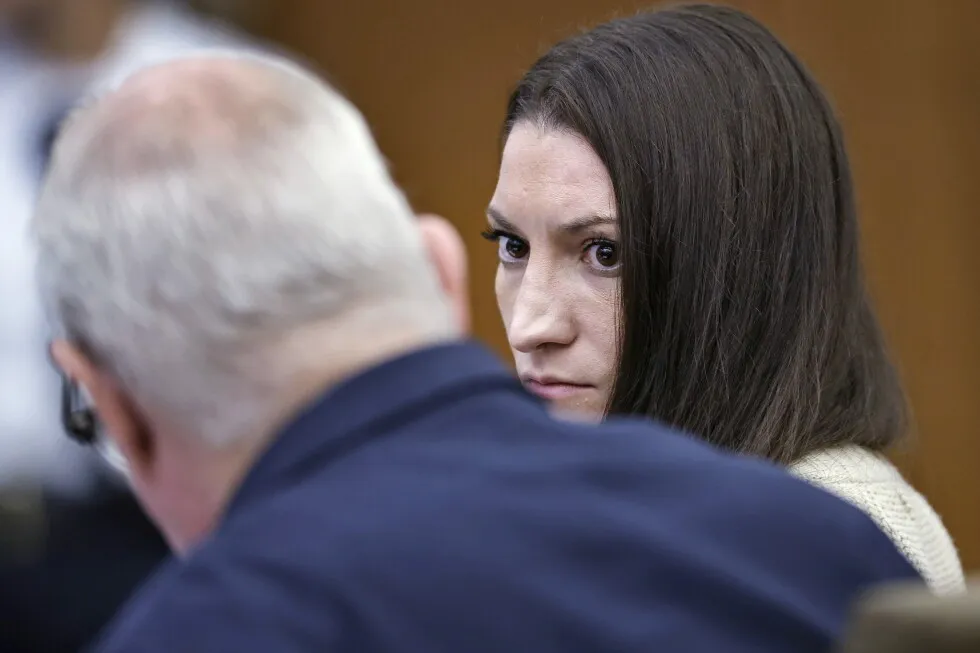
A psychologist at Lindsay Clancy’s Murder Trial says she has Bipolar Disorder 1 of 4 | Lindsay Clancy grins after her attorney Kevin Reddington concluded his cross examination of rebuttal witness Dr. Avram Mack during her Murder Trial at Plymouth-superior-court" class="entity-link entity-location" data-entity-id="172188" data-entity-type="location">Plymouth Superior Court, Monday, Aug. 24, 2026 in Plymouth, Mass. (Greg Derr/The Patriot Ledger via AP, Pool) 2 of 4 | Forensic Phycologist Dr. Kirk Heilbrun speaks on the witness stand during Lindsay Clancy’s Murder Trial at Plymouth-superior-court" class="entity-link entity-location" data-entity-id="172188" data-entity-type="location">Plymouth Superior Court, Monday, Aug. 24, 2026 in Plymouth, Mass. (Greg Derr/The Patriot Ledger via AP, Pool) 3 of 4 | Defense attorney Kevin Reddington, seated with client Lindsay Clancy, listens to testimony by forensic phycologist Dr. Kirk Heilbrun, a prosecution rebuttal witness during Clancy’s Murder Trial at Plymouth-superior-court" class="entity-link entity-location" data-entity-id="172188" data-entity-type="location">Plymouth Superior Court, Monday, Aug. 24, 2026 in Plymouth, Mass. (Greg Derr/The Patriot Ledger via AP, Pool) 4 of 4 | Lindsay Clancy’s parents Paula And Mike Musgrove listen to testimony during Clancy’s Murder Trial at Plymouth-superior-court" class="entity-link entity-location" data-entity-id="172188" data-entity-type="location">Plymouth Superior Court, Monday, Aug. 24, 2026 in Plymouth, Mass. (Greg Derr/The Patriot Ledger via AP, Pool) By MICHAEL CASEY Updated 8:36 PM MESZ, August 24, 2026 Add AP News on Google Add AP News as your preferred source to see more of our stories on Google. Share Share Facebook Copy Link copied Print Email X LinkedIn Bluesky Flipboard Pinterest Reddit Lindsay Clancy has Bipolar Disorder and was experiencing anxiety, depression, insomnia and suicidal thoughts in the weeks before she killed her three children, a forensic psychologist testified Monday in her Murder Trial Kirk Heilbrun, who examined Clancy over three days this year, said he came to a different conclusion than a forensic psychiatrist who also evaluated her and testified Friday that Clancy neither had Bipolar Disorder nor psychosis. Both Heilbrun and Dr. Avram Mack testified as rebuttal witnesses for prosecutors in a case that centers around Clancy’s mental state when she strangled her three young children before jumping from a second-story window in January 2023. Closing arguments are expected later this week. EDITOR’S NOTE: This story includes discussion of suicide. If you or someone you know needs help, the national suicide and crisis lifeline in the U.S. is available by calling or texting 988. Clancy’s attorney Kevin Reddington does not dispute that she killed the children. But he says she shouldn’t be held criminally responsible because she had Postpartum Psychosis, a rare mental illness linked to the stress, sleep deprivation and hormonal changes that follow childbirth. He said she also had Bipolar Disorder and that antidepressants prescribed worsened her condition. Prosecutors say the former labor and delivery nurse planned the killings and contrived to get her husband out of the house by sending him to pick up medicine for one of their children and dinner for the family. Before killing her kids, Lindsay Clancy searched about hallucinations, psychosis and ways to die 5 MIN READ 34 What to know about Postpartum Psychosis, which can affect a new mom’s sense of reality 3 MIN READ 116 At Lindsay Clancy trial, focus turns to medications prescribed before she killed her 3 children 3 MIN READ 116 Heilbrun said he struggled to reach a diagnosis of bipolar 2 disorder “because of all the diagnoses in the records and all the symptoms that she experienced.” People with bipolar 2 disorder experience cycles of depression and hypomania, which is less intense than the mania experienced with bipolar 1 disorder. “I was having a hard time finding something that looked like it was a manic episode,” Heilbrun said. “There were times when she felt, as she described it, after the birth of different children, she felt good. She felt on top of the world. She felt really close to them, her husband and her kids and so on. But, it’s also something that it didn’t look like a manic episode so much as it looked like she was really feeling good.” Heilbrun echoed earlier testimony about Clancy’s struggles with sleep, the negative reactions to medications she was prescribed, anxiety about returning to work and leaving her children as well as intrusive thoughts that include wanting to hurt herself. But he noted that at a psychiatric hospital she stayed about two weeks before she killed her children that she never reported having hallucinations or suicidal thoughts. Her main concern was insomnia. Clancy, 36, has pleaded not guilty to murder charges in the deaths of Callan, Dawson and Cora Clancy, who ranged from 8 months to 5 years old. The two sides have presented experts with starkly contradicting testimony on whether Clancy was suffering from Postpartum Psychosis. After the defense rested Friday, prosecutors began calling rebuttal witnesses, starting with Mack. He agreed that Clancy suffered from a major depressive episode but said he found no evidence of mania or hypomania to support a bipolar diagnosis — or of psychosis. MICHAEL CASEY Casey writes about the environment, housing and inequality for The Associated Press. He lives in Boston. twitter mailto
SRCAssociated Press (AP)
LANGEN
LEANCenter
WORDS822
ENT12
MON · 2026-08-24 · 18:53 GMTBRIEF NSR-2026-0824-105492
NSR-2026-0824-105492News Report·EN·Legal & Judicial
A psychologist at Lindsay Clancy’s murder trial says she has bipolar disorder
A forensic psychologist testified Monday in the murder trial of Lindsay Clancy that she has bipolar disorder and experienced anxiety, depression, insomnia, and suicidal thoughts in the weeks before she killed her three children. This testimony contradicts a forensic psychiatrist who previously testified that Clancy did not have bipolar disorder or psychosis.
Associated Press (AP)Filed 2026-08-24 · 18:53 GMTLean · CenterRead · 4 min
Associated Press (AP)FIG 01
Reading time
4min
Word count
822words
Sources cited
3cited
Entities identified
12entities
Quality score
100%
§ 01
Briefing Summary
AI-generatedNEWSAR · AI
A forensic psychologist testified Monday in the murder trial of Lindsay Clancy that she has bipolar disorder and experienced anxiety, depression, insomnia, and suicidal thoughts in the weeks before she killed her three children. This testimony contradicts a forensic psychiatrist who previously testified that Clancy did not have bipolar disorder or psychosis. Clancy's attorney argues she should not be held criminally responsible due to postpartum psychosis and that her bipolar disorder was worsened by prescribed antidepressants. Prosecutors contend Clancy planned the killings. Closing arguments are expected later this week in the case, which centers on Clancy's mental state at the time of the January 2023 deaths.
Confidence 0.90Sources 3Claims 5Entities 12
§ 02
Article analysis
Model · rule-basedFraming
Legal & Judicial
Human Interest
Tone
Mixed Tone
AI-assessed
CalmNeutralAlarmist
Factuality
0.70 / 1.00
Factual
LowHigh
Sources cited
3
Well sourced
FewMany
§ 03
Key claims
5 extracted01
Lindsay Clancy searched about hallucinations, psychosis and ways to die before killing her children.
factualnull
Confidence
0.90
02
Lindsay Clancy has bipolar disorder and was experiencing anxiety, depression, insomnia and suicidal thoughts in the weeks before she killed her three children.
factualDr. Kirk Heilbrun
Confidence
0.90
03
Lindsay Clancy should not be held criminally responsible because she had postpartum psychosis and bipolar disorder, which were worsened by antidepressants.
factualKevin Reddington (defense attorney)
Confidence
0.80
04
Lindsay Clancy neither had bipolar disorder nor psychosis.
factualDr. Avram Mack
Confidence
0.80
05
Lindsay Clancy planned the killings and contrived to get her husband out of the house.
factualProsecutors
Confidence
0.70
§ 04
Full report
4 min read · 822 words§ 05
Entities
12 identifiedKey playerOppositionContextPositiveNeutralNegative
People6
Locations3
§ 06
Keywords & salience
8 termsbipolar disorder
1.00
murder trial
0.90
mental state
0.80
forensic psychologist
0.70
postpartum psychosis
0.70
criminal responsibility
0.60
suicidal thoughts
0.50
lindsay clancy
0.40
§ 07
Topic connections
Interactive graph Network visualization showing 24 related topics
View Full Graph Person Organization Location Event|Click node to navigate|Edge numbers = shared articles