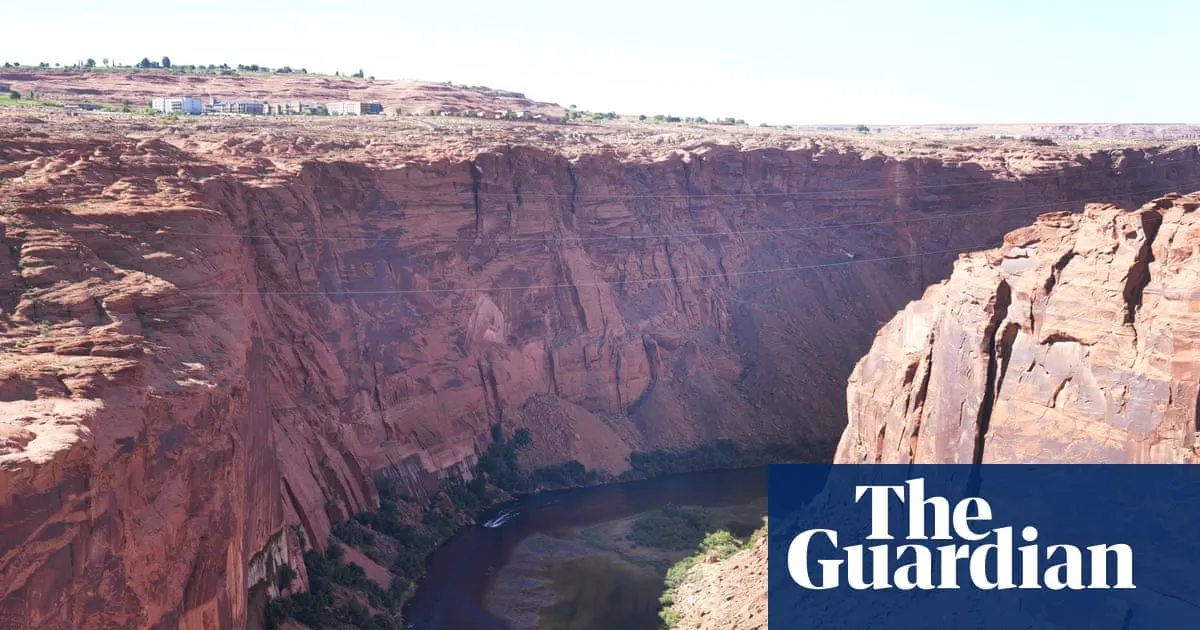
Nevada filed a federal lawsuit on Monday challenging the Trump administration’s new plan for the imperiled Colorado-river" class="entity-link entity-location" data-entity-id="28983" data-entity-type="location">Colorado River, launching what could become the first of many court battles over the waterway that supplies 40 million people, dozens of tribes and 5.5m acres of farm land across the American west.The federal plan, issued Friday, cut roughly 20% from the water supplied to lower basin states – Nevada, Arizona and California – over the next two years, with a potential for harsher cutbacks in the future, based on conditions.Filed in the US district court of Nevada, the state of Nevada, the Colorado-river" class="entity-link entity-location" data-entity-id="28983" data-entity-type="location">Colorado River commission of Nevada and the Southern Nevada Water Authority filed the suit against the Department of Interior and the US Bureau of Reclamation.Southern Nevada stood to lose more than 70% of its share under the framework, according to Joe Lombardo, the Nevada governor, who said in a statement issued with an announcement of the lawsuit that the so-called upper basin states – Colorado, Utah, New Mexico and Wyoming – were “not required to contribute a drop”.The governor echoed a complaint at the heart of the conflict between seven states that depend on the Colorado-river" class="entity-link entity-location" data-entity-id="28983" data-entity-type="location">Colorado River, which have struggled to reach a consensus over how to inflict the enormous cuts needed to pull the system back from the brink. Long-term overuse and the rising toll from the Climate crisis have served as a one-two punch that has left the river in crisis.The upper-basin states have resisted any mandatory cuts to their share, insisting they source their supply from the headwaters and that lower-basin states are responsible for the declining water levels at Lake Mead and Lake Powell – the federally-managed reservoirs that also supply hydroelectric energy to millions.The lower basin has balked at the idea. They have already agreed to take substantial cuts and are demanding their neighbors to the north share the burden. While disagreements range across a series of issues, this has been a major sticking point.Quick GuideThe Colorado-river" class="entity-link entity-location" data-entity-id="28983" data-entity-type="location">Colorado River crisis – explained ShowWhat is the Colorado-river" class="entity-link entity-location" data-entity-id="28983" data-entity-type="location">Colorado River?The Colorado-river" class="entity-link entity-location" data-entity-id="28983" data-entity-type="location">Colorado River is one of the largest waterways in North America, snaking across 1,450 miles (2,300km) from the Rocky Mountains into Mexico. It supplies roughly 40 million people in seven states, dozens of Indigenous tribes and two countries, and irrigates 5.5m acres (2.23m hectares) of farmland.Its waters raised bustling cities, including Los Angeles, Phoenix and Las Vegas, and fuel an estimated $1.4tn in economic activity. Large dams on the river’s two main reservoirs – Lake Mead and Lake Powell – provide hydroelectric power to millions of people. The sprawling basin is also home to diverse ecosystems, with scores of birds, fish, plants and animals, and provides critical habitat for more than 150 threatened or endangered species.Why is the river in crisis?The river has been overdrawn for more than a century. An outdated compact agreed to in 1922 doled out more rights than there was water in the system, a gap that’s only widened as the Climate crisis takes a larger share and the region warms and dries.Colorado, Utah, Wyoming and New Mexico, which form the upper-basin states, have resisted any mandatory cuts to their share, insisting the lower-basin states – California, Arizona and Nevada – are responsible for drawing down the reservoirs. The lower-basin states have already agreed to take substantial cuts but are demanding their neighbors to the north share the burden.What’s being done about it? There have been layers of agreements and emergency orders to conserve water over the years, but the framework currently governing the waterway is set to expire in October 2026. States urgently need to agree to a new plan, but that hasn’t been easy. Negotiators have spent years trying to iron out the thorny disagreements, without success, and the seven basin states remain at an impasse.The US federal government has limited jurisdiction to force more cuts or compliance but it does control Lake Powell and Lake Mead. By managing flows through them, federal officials have some power over how much water reaches the lower-basin states.The threat of lawsuits hangs over the process. Stakeholders agree that letting the courts decide through long, drawn-out legal battles would be a catastrophic outcome for all. In the region where water has long been the source of survival and conflict, the challenges that hinder consensus are as steep as the stakes are high.Words by Gabrielle CanonPhotograph: Daniel Cole/REUTERSWhile the federal government has limited authority over the states’ water policy and cannott force cuts across the board, the Bureau of Reclamation operates Lake Powell and Lake Mead, which gives it more jurisdiction over the lower basin’s water supply.Now the complex conflict could be decided in the courts. It’s an outcome that could sink urgent management decisions into years of drawn-out courtroom battles and leave critical decisions in the hands of judges rather than experts.“[Litigation] kind of freezes everything – and environmental values are one of the first things to go,” said Dr John Berggren, regional policy manager at Western Resource Advocates, earlier this year when the states missed a key deadline for a deal. “They’ll protect the reservoirs as best they can, but they’re probably not going to be able to consider environmental flows and things that actually benefit the river itself.”While Nevada was the first to file a legal challenge, more lawsuits are likely. Arizona has also voiced strong objections to the federal plan and outlined how the state believes it violates the original Colorado-river" class="entity-link entity-location" data-entity-id="28983" data-entity-type="location">Colorado River compact, agreed to in 1922, in a letter issued last week.The states could also challenge one another directly. Legal disputes would center on whether the upper basin can be held responsible for losses in supply due to the Climate crisis.“By this September or October, there’s going to be a pretty compelling argument from the lower basin that the upper basin hasn’t met its delivery obligation,” said Rhett Larson, a professor of water law at Arizona State University, before the federal plan was finalized.But with little hope of a reprieve from warm and dry conditions that have widened the gap between water demand and supply in a region where water has long been the source of survival and conflict, the continuing challenges have left the basin and those who rely on its essential water resources, into uncertain territory.“This isn’t about political posturing,” Lombardo said. “This is a matter of survival for a community that represents about two-thirds of our state’s citizens and the lion’s share of its economy.”The water cuts for Nevada would be felt in fast-growing population centers, including in the city of Las Vegas, according to officials.John Entsminger, Southern Nevada Water Authority general manager, said the area has effectively reduced consumption by roughly 40% even while more than 800,000 residents moved into the area. “However, conservation has its limits,” he said in a statement provided to the Las Vegas Sun. “There is just no way to meet even the basic needs of this community with the volume of water interior [department] has proposed.”
SRCThe Guardian - World News
LANGEN
LEANCenter-Left
WORDS1 161
ENT12
MON · 2026-08-24 · 20:56 GMTBRIEF NSR-2026-0824-105513
NSR-2026-0824-105513News Report·EN·Legal & Judicial
Nevada files lawsuit challenging federal plan for Colorado River revival
Nevada has filed a federal lawsuit challenging the Trump administration's plan for the Colorado River. This plan, issued Friday, mandates approximately a 20% cut to water supply for lower basin states—Nevada, Arizona, and California—over the next two years, with potential for further reductions.
Gabrielle CanonThe Guardian - World NewsFiled 2026-08-24 · 20:56 GMTLean · Center-LeftRead · 5 min
The Guardian - World NewsFIG 01
Reading time
5min
Word count
1 161words
Sources cited
2cited
Entities identified
12entities
Quality score
100%
§ 01
Briefing Summary
AI-generatedNEWSAR · AI
Nevada has filed a federal lawsuit challenging the Trump administration's plan for the Colorado River. This plan, issued Friday, mandates approximately a 20% cut to water supply for lower basin states—Nevada, Arizona, and California—over the next two years, with potential for further reductions. Nevada argues this disproportionately impacts its share, while upper basin states are not required to contribute. The lawsuit, filed in the US district court of Nevada, targets the Department of Interior and the US Bureau of Reclamation. This legal action arises from a long-standing conflict between the seven states dependent on the Colorado River, who have struggled to agree on necessary water conservation measures due to overuse and climate change.
Confidence 0.90Sources 2Claims 5Entities 12
§ 02
Article analysis
Model · rule-basedFraming
Legal & Judicial
Conflict
Tone
Measured
AI-assessed
CalmNeutralAlarmist
Factuality
0.80 / 1.00
Factual
LowHigh
Sources cited
2
Limited
FewMany
§ 03
Key claims
5 extracted01
The Colorado River supplies roughly 40 million people in seven states, dozens of Indigenous tribes and two countries.
statistic
Confidence
1.00
02
Upper basin states were not required to contribute a drop to the water cuts.
quoteJoe Lombardo, Nevada governor
Confidence
1.00
03
Southern Nevada stood to lose more than 70% of its share under the framework.
statisticJoe Lombardo, Nevada governor
Confidence
1.00
04
The federal plan cuts roughly 20% from the water supplied to lower basin states over the next two years.
factual
Confidence
1.00
05
Nevada filed a federal lawsuit challenging the federal plan for the Colorado River.
factual
Confidence
1.00
§ 04
Full report
5 min read · 1 161 words§ 05
Entities
12 identifiedKey playerOppositionContextPositiveNeutralNegative
Organizations3
Locations7
§ 06
Keywords & salience
10 termscolorado river
1.00
water rights
0.90
lawsuit
0.80
water scarcity
0.80
climate crisis
0.70
water allocation
0.60
federal plan
0.60
nevada
0.50
us bureau of reclamation
0.40
lake mead
0.40
§ 07
Topic connections
Interactive graph Network visualization showing 25 related topics
View Full Graph Person Organization Location Event|Click node to navigate|Edge numbers = shared articles