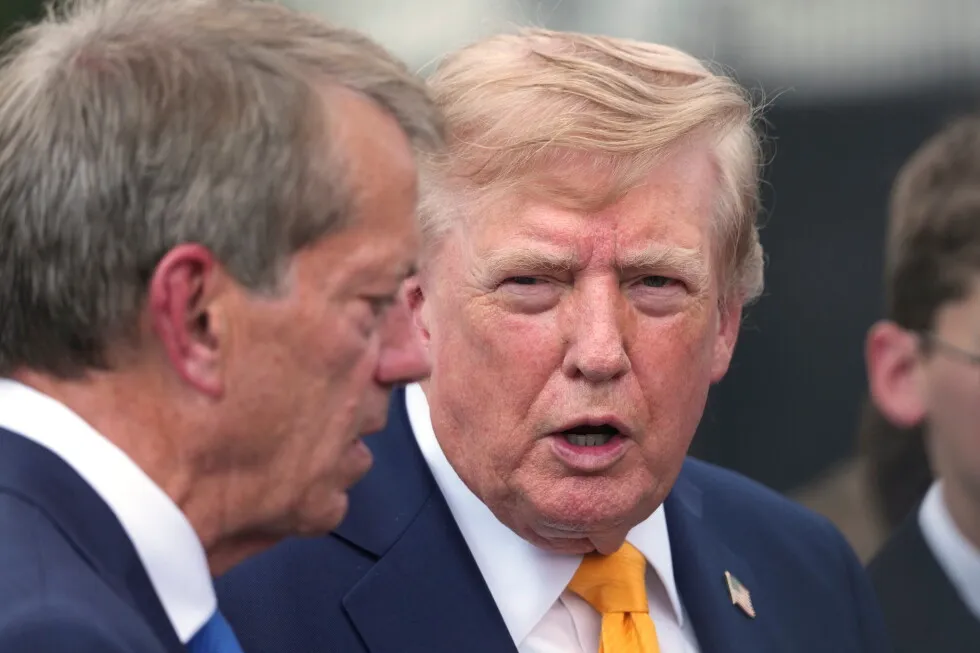
Trump’s trade war with Canada could rattle economies in states with key Senate races 1 of 4 | President Donald Trump speaks with Nebraska Gov. Jim Pillen after a back to school event in the Rose Garden of the White House, Monday, Aug. 24, 2026, in Washington. (AP Photo/Alex Brandon) 2 of 4 | FILE -Sen. Susan Collins, R-Maine, responds to reporters at the Capitol in Washington, July 14, 2026. (AP Photo/J. Scott Applewhite, File) 3 of 4 | Sen. Jon Husted, R-Ohio, speaks ahead of Vice President JD Vance’s speech at the Cleveland Cliffs Middletown Works, Friday, Aug. 21, 2026, in Middletown, Ohio. (AP Photo/Jon Cherry) 4 of 4 | U.S. Trade Representative Jamieson Greer speaks to reporters outside the White House, Monday, Aug. 24, 2026, in Washington. (AP Photo/Mark Schiefelbein) By BILL BARROW and PATRICK WHITTLE Updated 6:04 AM MESZ, August 25, 2026 Leer en español Add AP News on Google Add AP News as your preferred source to see more of our stories on Google. Share Share Facebook Copy Link copied Print Email X LinkedIn Bluesky Flipboard Pinterest Reddit PORTLAND, Maine (AP) — President Donald Trump’s trade war with Canada is escalating as the midterm elections approach, threatening Republican efforts to address voters’ economic concerns in a year when control of the U.S. Senate hinges on states along the border between the United States and its northern neighbor. The dispute flared over the weekend after negotiations broke down, leading Trump to raise tariffs on $20 billion in Canadian imports. Canada plans to announce tariffs of its own on Tuesday, and the spiraling conflict could lead to higher prices and scrambled supply chains for Americans already aggravated at the president’s management of the economy. Republican Sen. Susan Collins of Maine, one of Democrats’ top targets this year, warned that fallout from Trump’s approach would hurt U.S. businesses and consumers. “Imposing new tariffs on Canada is a mistake,” Collins said while campaigning Monday, and she mentioned lobsters, blueberries, lumber and other Maine products that end up in Canadian markets. The issue also puts pressure on Republicans in Michigan, Ohio and Alaska, states where Canada is an important trading partner. Many Democrats seem eager to capitalize on the matter as they try to regain the Senate majority, despite the party’s own history with protectionist sentiments. “Trump is escalating a trade war with Canada for his own vanity,” Michigan’s Democratic nominee Abdul El-Sayed said on social media, adding that his Republican opponent, former Rep. Mike Rogers, is a “rubber stamp” for such policies. A third of the state’s exports go north of the border. Vance campaigns at the Ohio steel plant where his grandfather worked 4 MIN READ 248 Trump touted his tariffs in Michigan despite rising costs. Even some of his supporters are worried 5 MIN READ 157 Graham Platner to speak at labor rally, one of his first public events since ending Maine campaign 5 MIN READ 157 Marc Short, a top adviser to then-Vice President Mike Pence during the first Trump presidency, said the issue is a political trap for Republicans. “It’s hard, obviously, because you don’t want to incur the wrath of the president,” he said. “But at the same time, I think if you’re representing agricultural states, especially, your voters are probably anxious to have somebody representing their interests in Washington right now.” It’s possible that Trump will change course or delay his plans. But for now, the president is making no apologies for the economic turmoil. “Canada has been ripping off the United States for years,” Trump blasted on his Truth Social platform Monday, adding that he will raise tariffs on all Canadian automobiles and auto parts and steel to 50% in 2027. He added, “WE DON’T NEED Canada, THEY NEED US!” This site is protected by reCAPTCHA and the Google and Terms of Service apply. Trump’s top trade official more calmly downplayed the dispute. “This is something where we don’t actually expect a huge impact,” U.S. Trade Representative Jamieson Greer told reporters outside the West Wing. Vice President JD Vance visited Maine on Monday, where he praised “our very independent friend Susan Collins” and assured voters “we’re very mindful of the fact that Maine is a border state with Canada.” He said the administration is trying to make sure Maine “gets a fair deal.” Collins did not appear with Vance on Monday or during his last trip to Maine. She campaigned on her own as she tries to hold off a challenge from Democratic nominee Troy Jackson, a former state legislative leader. Jackson, a logger before going into politics, said tariffs are another example of how Collins does not do enough to stand up to the president. “Troy spent most of his life working along the Canadian border, so he knows how important this relationship is to Maine’s economy,” Jackson spokesman Dan Gottlieb said. Trump made no secret of his affection for tariffs during his comeback campaign, promising that higher taxes on imports would generate a windfall for the U.S. Treasury and boost domestic manufacturing. But concerns about inflation and affordability have not receded, including in states with key races this year. Maine, Ohio, Michigan and Alaska boast industries including fisheries, auto parts, lumber and produce that export items across the northern border, while Canadian imports are sold by a range of U.S. retailers. Iowa, which also has a competitive Senate race, does not border Canada or its waters, but also exports more goods to Canada than any other nation. Majority Forward, a political action committee tied to Senate Democrats, already ran television s against Republican Sen. Dan Sullivan of Alaska during last year’s partial government shutdown. “The tariffs are hitting Alaska the hardest,” the ad said. “Call Dan Sullivan and tell him … stop raising our costs.” Former Ohio Sen. Sherrod Brown is trying to return to Washington by unseating Republican Sen. Jon Husted. Brown has long been a union-friendly protectionist Democrat. But he’s argued against Trump’s approach, saying it’s one thing to get aggressive with an adversarial economic powerhouse like China but another to impose uneven, unpredictable tariffs on neighboring nations. Husted signed a bipartisan letter earlier this year urging the administration to proceed carefully while renegotiating a trade agreement with Canada and Mexico. But he’s also embraced the White House’s economic policies, recently appearing with Vance at an Ohio steel plant to praise the administration’s economic agenda. “Today is a new day, it truly is,” Husted said. “It’s a new day because of the ‘America First’ agenda.” Brown has not yet criticized Husted on Canadian tariffs, concentrating instead on the senator’s support for data centers and Trump’s war with Iran. But Senate Majority PAC spokeswoman Lauren French said the Canada tariffs fight fits seamlessly into the broader case that Brown and other Democrats are making about Trump and his allies. “It’s another proof point for the argument that this is a guy who continues to raise your costs for no reason at all,” she said. Short said Trump’s first-term protectionism was easier to defend because it was more focused on China. In the second Trump presidency, Short said, “we’ve so alienated our normal trading partners that part of their retaliation has been not to buy agricultural products,” thus cutting off replacement markets for any lost trade with Beijing. In Maine, Vance insisted Trump only wants to level the playing field with Canada. “They don’t expect anybody to fight back,” Vance said. “We’re sick of that.” He also criticized Canada as treating China more fairly than the U.S. in trade negotiations. “It’s over,” Vance said. “We expect fairness in our trade policy.” “I really want us to go back to the very friendly, economically beneficial relationship that we have with our Canadian neighbors,” she said. ___ Barrow reported from Atlanta. Associated Press writers Julie Carr Smyth in Columbus, Ohio, and Seung Min Kim in Washington contributed to this report. BILL BARROW Barrow covers U.S. politics for The Associated Press. He is based in Atlanta. twitter mailto PATRICK WHITTLE Whittle is an Associated Press reporter based in Portland, Maine. He focuses on the environment and oceans. twitter mailto
SRCAssociated Press (AP)
LANGEN
LEANCenter
WORDS1 355
ENT12
TUE · 2026-08-25 · 04:23 GMTBRIEF NSR-2026-0825-105619
NSR-2026-0825-105619News Report·EN·Political Strategy
Trump’s trade war with Canada could rattle economies in states with key Senate races
President Donald Trump has escalated a trade dispute with Canada by imposing tariffs on $20 billion in Canadian imports, prompting Canada to plan retaliatory tariffs. This conflict arises as midterm elections approach, potentially impacting Republican efforts to address economic concerns in key Senate races in border states like Maine, Michigan, Ohio, and Alaska.
Associated Press (AP)Filed 2026-08-25 · 04:23 GMTLean · CenterRead · 6 min
Associated Press (AP)FIG 01
Reading time
6min
Word count
1 355words
Sources cited
3cited
Entities identified
12entities
Quality score
100%
§ 01
Briefing Summary
AI-generatedNEWSAR · AI
President Donald Trump has escalated a trade dispute with Canada by imposing tariffs on $20 billion in Canadian imports, prompting Canada to plan retaliatory tariffs. This conflict arises as midterm elections approach, potentially impacting Republican efforts to address economic concerns in key Senate races in border states like Maine, Michigan, Ohio, and Alaska. Republican Senator Susan Collins of Maine warned that the tariffs would harm U.S. businesses and consumers, while Democrats aim to capitalize on the issue. Trump defended his actions, stating Canada has "ripped off the United States for years." U.S. Trade Representative Jamieson Greer, however, downplayed the expected economic impact. The situation creates political pressure for Republicans, who must balance the president's stance with their constituents' economic interests.
Confidence 0.90Sources 3Claims 5Entities 12
§ 02
Article analysis
Model · rule-basedFraming
Political Strategy
Economic Impact
Tone
Measured
AI-assessed
CalmNeutralAlarmist
Factuality
0.70 / 1.00
Factual
LowHigh
Sources cited
3
Well sourced
FewMany
§ 03
Key claims
5 extracted01
Trump is escalating a trade war with Canada for his own vanity.
quoteAbdul El-Sayed
Confidence
1.00
02
Imposing new tariffs on Canada is a mistake.
quoteSen. Susan Collins
Confidence
1.00
03
Trump raised tariffs on $20 billion in Canadian imports after negotiations broke down.
factual
Confidence
0.95
04
Trump's trade war with Canada is escalating as midterm elections approach, threatening Republican efforts to address voters' economic concerns in states crucial for Senate control.
factual
Confidence
0.90
05
Canada plans to announce its own tariffs on Tuesday.
prediction
Confidence
0.85
§ 04
Full report
6 min read · 1 355 words§ 05
Entities
12 identifiedKey playerOppositionContextPositiveNeutralNegative
People9
§ 06
Keywords & salience
9 termstrade war
1.00
tariffs
0.90
canada
0.80
senate races
0.70
economic concerns
0.60
donald trump
0.50
supply chains
0.50
midterm elections
0.40
u.s. businesses
0.40
§ 07
Topic connections
Interactive graph No topic relationship data available yet. This graph will appear once topic relationships have been computed.