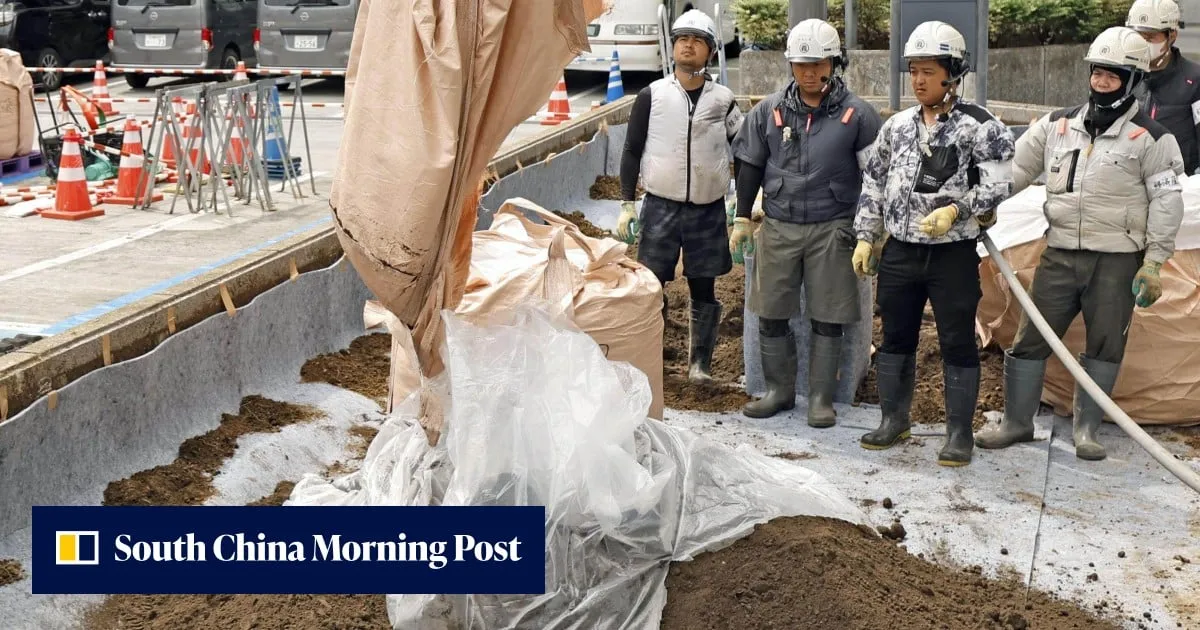
The government has already reused the soil at 12 sites in Tokyo since July last year, including the prime minister’s office and other buildings in the Kasumigaseki district.Excluding demonstration projects in Fukushima prefecture, the expansion to the cities of Sendai and Saitama will mark the first reuse of the soil outside Tokyo.The government aims to further expand the soil’s reuse to other branch offices in Japan to reduce the total amount of soil that eventually needs to be dealt with.As of the end of July, about 14.46 million cubic metres (510 million cubic feet) of removed soil and other waste had been placed at an interim storage facility near the nuclear complex.The damaged Unit 1 reactor (back) and exhaust stack shared by the Unit 1 and 2 reactors are seen at the Fukushima-daiichi-nuclear-power-plant" class="entity-link entity-location" data-entity-id="59582" data-entity-type="location">Fukushima Daiichi nuclear power plant on February 20, 2025. Photo: APThe Fukushima-daiichi-nuclear-power-plant" class="entity-link entity-location" data-entity-id="59582" data-entity-type="location">Fukushima Daiichi nuclear power plant, hit by a powerful earthquake and tsunami in 2011, suffered fuel meltdowns at three of its nuclear reactors, releasing radiation into the atmosphere.
SRCSouth China Morning Post
LANGEN
LEANCenter-Right
WORDS171
ENT12
WED · 2026-08-26 · 01:58 GMTBRIEF NSR-2026-0826-105934
NSR-2026-0826-105934News Report·EN·Environmental
Japan expands Fukushima soil recycling project to Sendai, Saitama
Japan's Environment Ministry plans to expand its soil recycling project, reusing soil from decontamination efforts near the Fukushima Daiichi nuclear complex. This soil has already been utilized at 12 sites in Tokyo since July of the previous year, including government buildings.
KyodoSouth China Morning PostFiled 2026-08-26 · 01:58 GMTLean · Center-RightRead · 1 min
South China Morning PostFIG 01
Reading time
1min
Word count
171words
Sources cited
0cited
Entities identified
12entities
Quality score
100%
§ 01
Briefing Summary
AI-generatedNEWSAR · AI
Japan's Environment Ministry plans to expand its soil recycling project, reusing soil from decontamination efforts near the Fukushima Daiichi nuclear complex. This soil has already been utilized at 12 sites in Tokyo since July of the previous year, including government buildings. The project will now extend to national government branch offices in Sendai, Miyagi Prefecture, and Saitama Prefecture, marking the first reuse of this soil outside of Tokyo. The government's objective is to further broaden the reuse of this soil at other branch offices across Japan to decrease the overall volume requiring disposal. As of late July, approximately 14.46 million cubic meters of removed soil and waste were stored at an interim facility near the nuclear complex.
Confidence 0.90Claims 5Entities 12
§ 02
Article analysis
Model · rule-basedFraming
Environmental
Political Strategy
Tone
Measured
AI-assessed
CalmNeutralAlarmist
Factuality
0.90 / 1.00
Factual
LowHigh
Sources cited
0
No named sources
FewMany
§ 03
Key claims
5 extracted01
As of the end of July, about 14.46 million cubic metres of removed soil and waste were at an interim storage facility.
statistic
Confidence
1.00
02
The government aims to reduce the total amount of soil that needs to be dealt with by expanding reuse.
factual
Confidence
1.00
03
The expansion to Sendai and Saitama marks the first reuse of the soil outside Tokyo (excluding demonstration projects).
factual
Confidence
1.00
04
The government has already reused soil at 12 sites in Tokyo since July last year.
factual
Confidence
1.00
05
Japan is expanding its Fukushima soil recycling project to Sendai and Saitama.
factual
Confidence
1.00
§ 04
Full report
1 min read · 171 words§ 05
Entities
12 identifiedKey playerOppositionContextPositiveNeutralNegative
Locations8
§ 06
Keywords & salience
9 termsfukushima soil recycling
1.00
fukushima daiichi nuclear power plant
0.90
soil reuse
0.80
interim storage facility
0.70
radiation
0.60
nuclear reactors
0.50
sendai
0.40
saitama
0.40
tokyo
0.40
§ 07
Topic connections
Interactive graph Network visualization showing 51 related topics
View Full Graph Person Organization Location Event|Click node to navigate|Edge numbers = shared articles