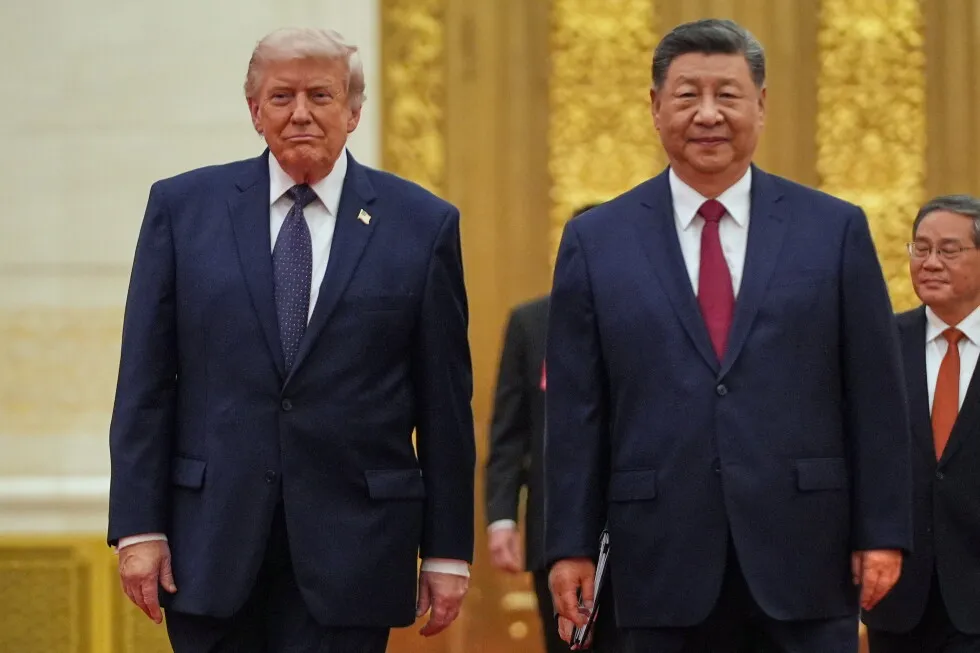
President Donald Trump, left, and Chinese President Xi Jinping arrive a state dinner at the Great Hall of the People May 14, 2026, in Beijing. (AP Photo/Mark Schiefelbein) By DIDI TANG and FARNOUSH AMIRI Updated 2:00 AM MESZ, August 26, 2026 Leer en español Add AP News on Google Add AP News as your preferred source to see more of our stories on Google. Share Share Facebook Copy Link copied Print Email X LinkedIn Bluesky Flipboard Pinterest Reddit WASHINGTON (AP) — The “ economic onslaught ” that Treasury Secretary Scott Bessent has declared on Iran’s financial connections around the world may have one major caveat: China. Beijing is Iran’s biggest trading partner and its leading oil buyer. While the U.S. is trying to isolate the Islamic Republic from its remaining economic partners, President Donald Trump also is preparing to host Chinese leader Xi Jinping next month to maintain a fragile trade truce. Absent from Bessent’s remarks this week were specifics about how the Trump administration would target China, casting doubts on how effective the new campaign would be when the U.S. must balance putting maximum pressure on Iran and avoiding higher tensions with China that could be costly to the American economy. “The announcement yesterday was very careful in my view to avoid specifics (against China), which could have led to a disruption in the summit,” Edgard Kagan, senior adviser and Freeman Chair in China studies at the Center for Strategic and International Studies, said Tuesday. “For Xi, a state visit to Washington is a big deal; and for Trump, hosting it is a big deal.” That means both Washington and Beijing will have a dance to do, said Kagan, who served as U.S. ambassador to Malaysia from December 2023 until this February. “I think the real question is, is there room to push (the Chinese) to reduce what they’re doing with Iran, to put more pressure on the Iranian regime in a way that doesn’t lead them to say, ‘This is unreasonable, and we’re not going to comply,’” he said. China is likely to wait and see and do the minimum In response to “Operation Economic Outcast,” which Bessent announced Monday, Beijing said its cooperation with Iran has always been “within the framework of international law.” China receives more than 80% of Iranian oil shipments but usually through indirect channels. Lin Jian, a spokesperson for the Chinese foreign ministry, said China-Iran cooperation “should not be disrupted or undermined.” Trump moves toward levying new tariff on China for flooding market with cheap goods, AP sources say 4 MIN READ 15 Trump’s ‘economic D-Day’ threats become warnings for countries to sever financial ties with Iran 1 MIN READ 27 US pulls last aircraft carrier in Asia as Trump focuses on Iran and the Western Hemisphere 1 MIN READ 27 “China is closely monitoring relevant developments and will take all necessary measures to resolutely safeguard its own rights and interests,” Lin said. He repeated China’s opposition to “illegal unilateral sanctions.” Kagan described Beijing’s remarks as “a holding response” and said Beijing will try to do the least to comply without openly confronting the U.S. “They’ve tended to be careful not crossing explicit red lines, but they haven’t addressed the spirit of what the U.S. has sought,” Kagan said, pointing to practices such as ship-to-ship oil transfers that obscure the origin of Iranian crude oil to evade American sanctions. This site is protected by reCAPTCHA and the Google and Terms of Service apply. Sun Yun, director of the China program at the Stimson Center, a Washington think tank, said China will not go along with the new campaign if the U.S. goal is to destroy the Iranian economy and seek the government’s collapse. But “if the goal is to exert enough pressure for Iran to make concessions on the Strait of Hormuz and potentially ending the conflict, I think China can and will demonstrate its cooperation without having to completely sever ties with Iran,” Sun said. “China only needs to do enough to demonstrate it is cooperating, such as cut back on its oil import from Iran.” With a planned summit between Trump and Xi weeks away, “neither side wishes to have a major escalation bilaterally at this point,” she said. “China needs to give U.S. something, and U.S. needs to understand and accept that it is not going to be everything U.S. asks for.” US is not likely to act tough on China, analysts say So far, the Trump administration has refrained from imposing sanctions on major Chinese businesses or banks connected to the U.S. financial system and thus vulnerable to American penalties. The Treasury Department said Monday that it was penalizing nearly 60 Iran-linked entities, accusing them of involvement in Iran’s nuclear and missile programs, cyber activities and oil shipments. It targeted a number of entities and individuals based in mainland China and Hong Kong for supporting Iran’s missile and nuclear programs. It sanctioned a China-owned crude oil tanker for transporting millions of barrels of Iranian oil to China this year as well as a Hong Kong-based business for its role in the shadow fleet that ships out Iranian oil. With Xi’s visit coming up, Trump may not act tough on China now, said Ali Wyne, senior research and advocacy adviser on U.S.-China relations at the International Crisis Group. “Given how keen Trump has been to maintain both a trade truce between the United States and China and his personal rapport with Xi, he seems unlikely to do a volte-face just a month before Xi’s state visit and adopt a highly confrontational posture,” he said. Plus, Xi’s visit to the U.S. could pave the way for Trump to return to China in November for the leaders summit of the Asia-Pacific Economic Cooperation grouping. In his second term, Trump has been less hawkish on China than in his first presidency and frequently touts his good relationship with Xi following a major trade war last year that featured back-and-forth escalating tariffs. The U.S. business community also welcomes Xi’s visit, saying it’s a good sign if the two leaders meet in person, even when any substantial deals may be elusive. “Beijing is betting that Washington will be reluctant to jeopardize the current leader-level dynamic by targeting major Chinese entities before the summit,” said Craig Singleton, senior director for China at the Foundation for Defense of Democracies, a hawkish Washington think tank. Amiri reported from New York. Associated Press writer Aamer Madhani contributed to this report. DIDI TANG Tang joined the AP Washington bureau in 2023 after spending 11 years in Beijing as a China correspondent. She covers anything related to the Indo-Pacific region with a focus on U.S.-China competitions mailto FARNOUSH AMIRI Amiri covers foreign policy and the United Nations as a correspondent for The Associated Press, based in New York. twitter mailto
SRCAssociated Press (AP)
LANGEN
LEANCenter
WORDS1 139
ENT12
WED · 2026-08-26 · 00:23 GMTBRIEF NSR-2026-0826-105946
NSR-2026-0826-105946News Report·EN·Diplomatic
Trump’s new economic squeeze on Iran has a big challenge: China
The Trump administration has launched a new economic campaign to isolate Iran financially, but China presents a significant challenge as Iran's largest trading partner and oil buyer. The U.S.
Associated Press (AP)Filed 2026-08-26 · 00:23 GMTLean · CenterRead · 5 min
Associated Press (AP)FIG 01
Reading time
5min
Word count
1 139words
Sources cited
2cited
Entities identified
12entities
Quality score
100%
§ 01
Briefing Summary
AI-generatedNEWSAR · AI
The Trump administration has launched a new economic campaign to isolate Iran financially, but China presents a significant challenge as Iran's largest trading partner and oil buyer. The U.S. is balancing pressure on Iran with the need to maintain a trade truce with China, especially with an upcoming summit between President Trump and Chinese leader Xi Jinping. China has stated its cooperation with Iran is within international law and opposes unilateral sanctions, indicating it will likely do the minimum to comply without openly confronting the U.S. Analysts suggest the U.S. may avoid taking a tough stance against China due to the upcoming summit and potential economic repercussions. While the U.S. has sanctioned some China-linked entities supporting Iran's programs, the administration has refrained from targeting major Chinese businesses or banks. China's cooperation level may depend on the U.S. objective, potentially cooperating if the goal is concessions rather than regime collapse.
Confidence 0.90Sources 2Claims 5Entities 12
§ 02
Article analysis
Model · rule-basedFraming
Diplomatic
Political Strategy
Tone
Measured
AI-assessed
CalmNeutralAlarmist
Factuality
0.70 / 1.00
Factual
LowHigh
Sources cited
2
Limited
FewMany
§ 03
Key claims
5 extracted01
China's foreign ministry spokesperson Lin Jian said that China-Iran cooperation has always been within international law and should not be disrupted.
quoteLin Jian
Confidence
1.00
02
Edgard Kagan stated that the announcement on economic pressure was careful to avoid specifics against China to prevent disruption of the upcoming summit.
quoteEdgard Kagan
Confidence
1.00
03
The U.S. "economic onslaught" on Iran's financial connections may face a major challenge from China, Iran's biggest trading partner and leading oil buyer.
factual
Confidence
0.90
04
The Trump administration's new campaign against Iran's economic ties may lack specifics on how to target China, raising doubts about its effectiveness.
factual
Confidence
0.80
05
China is likely to wait and see and do the minimum in response to the U.S. "Operation Economic Outcast."
prediction
Confidence
0.70
§ 04
Full report
5 min read · 1 139 words§ 05
Entities
12 identifiedKey playerOppositionContextPositiveNeutralNegative
People5
§ 06
Keywords & salience
9 termsiran sanctions
1.00
china-iran relations
1.00
economic pressure
0.90
us-china trade
0.80
xi jinping
0.70
donald trump
0.70
oil trade
0.60
geopolitical strategy
0.50
trade truce
0.40
§ 07
Topic connections
Interactive graph Network visualization showing 51 related topics
View Full Graph Person Organization Location Event|Click node to navigate|Edge numbers = shared articles