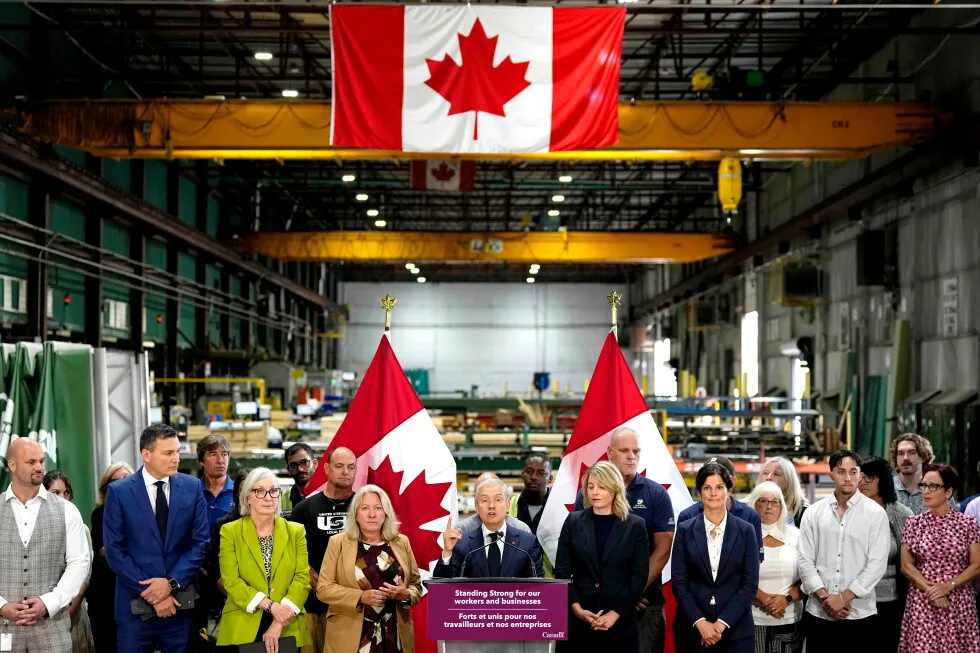
The US and Canada could pull back from an all-out Trade War. It’s not clear that they will 0 seconds of 51 secondsVolume 0% Press shift question mark to access a list of keyboard shortcuts Keyboard ShortcutsEnabledDisabled Shortcuts Open/Close/ or ? Play/PauseSPACE Increase Volume↑ Decrease Volume↓ Seek Forward→ Seek Backward← Captions On/Offc Fullscreen/Exit Fullscreenf Mute/Unmutem Decrease Caption Size- Increase Caption Size+ or = Seek %0-9 Next Up Residents in Ontario react as tensions on trade Tariffs escalate between Canada and US 01:31 Subtitle Settings OffEnglish(US)_v Font Color White Font Opacity 100% Font Size 100% Font Family Arial Character Edge None Edge Color Black Background Color Black Background Opacity 50% Window Color Black Window Opacity 0% Reset WhiteBlackRedGreenBlueYellowMagentaCyan 100%75%50%25% 200%175%150%125%100%75%50% ArialCourierGeorgiaImpactLucida ConsoleTahomaTimes New RomanTrebuchet MSVerdana NoneRaisedDepressedUniformDrop Shadow WhiteBlackRedGreenBlueYellowMagentaCyan WhiteBlackRedGreenBlueYellowMagentaCyan 100%75%50%25%0% WhiteBlackRedGreenBlueYellowMagentaCyan 100%75%50%25%0% 00:00 00:51 00:51 More Videos 01:31 Residents in Ontario react as tensions on trade Tariffs escalate between Canada and US 01:19 Provincial leader says Trump is a ‘bad person’ as Canada weighs concessions for trade deal 01:10 Popular Kenyan tourist area also has one of the country's highest rates of death in childbirth 01:50 Iran's currency hits new record low as US prepares to announce more sanctions 00:37 Zelenskyy holds bilateral meeting with UK Prime Minister Burnham in Kyiv 01:26 UK to help Ukraine produce long range missiles, UK prime ministser says 01:47 US states grapple with Supreme Court's order on elections 01:27 'Fabric that no electric machine can produce' - the designer who's using traditional hand looms Close 1 of 6 | The move came after the Trump administration imposed 50% Tariffs over the weekend on Canadian goods following the collapse of trade negotiations. Canadian Prime Minister Mark Carney accused Washington of trying to subordinate Canada. 2 of 6 | Minister of Finance and National Revenue Francois-Philippe Champagne speaks at a news conference on Canada’s response to U.S. Tariffs, at a roofing company in Ottawa, on Tuesday, Aug. 25, 2026. (Justin Tang/The Canadian Press via AP) 3 of 6 | A worker operates a forklift in front of steel coils at the manufacturing plant of Ideal Roofing in Ottawa on Tuesday, Aug. 25, 2026. (Justin Tang/The Canadian Press via AP) 4 of 6 | President Donald Trump speaks during a back to school event in the Rose Garden of the White House, Monday, Aug. 24, 2026, in Washington. (AP Photo/Alex Brandon) 5 of 6 | Lumber products are seen at Ideal Roofing in Ottawa on Tuesday, Aug. 25, 2026. (Justin Tang/The Canadian Press via AP) 6 of 6 | A transport truck carrying Chrysler Pacificas leaves the Windsor Assembly Plant, in Windsor, Ontario, Canada, on Monday, Aug. 24, 2026. (Dax Melmer/The Canadian Press via AP) By PAUL WISEMAN and ROB GILLIES Updated 6:06 AM MESZ, August 26, 2026 Add AP News on Google Add AP News as your preferred source to see more of our stories on Google. Share Share Facebook Copy Link copied Print Email X LinkedIn Bluesky Flipboard Pinterest Reddit WASHINGTON (AP) — The U.S. and Canada have ramped up their Trade War, hitting each other with steep new tit-for-tat Tariffs. Despite the bravado coming from both sides of the border, though, analysts suspect the longtime allies will eventually strike a deal to end a conflict neither really wants. The prospects for compromise looked bleak Tuesday, with Canadian Prime Minister Mark Carney reacting to new 50% U.S. Tariffs on certain Canadian goods by responding in kind on about $20 billion worth of American imports, including steel, dairy products, appliances and farm equipment. “You’re at war when you get attacked. We got attacked,’' Carney, who came to power last year on the promise that he’d stand up to U.S. President Donald Trump, said over the weekend. Doug Ford, Ontario’s populist premier, told The Associated Press on Monday that he was ready to escalate even further by cutting off his province’s shipments of electricity and critical minerals to the United States. Soon after, Trump declared his intention to hammer the Canadian auto industry with another set of import taxes if the Canadians don’t “fall in line.’’ With the breakdown threatening to harm one of the world’s largest trading relationships and clouding efforts to renew the United States-Mexico-Canada Agreement that Trump negotiated during his first term, experts cautioned that there’s still time to pull back from the brink of an even bigger Trade War. They’ve done it before. “If there is political will, there is an off ramp,’’ said former U.S. trade negotiator Wendy Cutler. Canada strikes back at US with retaliatory Tariffs as Trade War escalates 4 MIN READ 311 Canada targets steel, fish and hundreds of other goods as Trump Trade War escalates 3 MIN READ 246 Trump says US and Canada have a trade deal, but key terms remain unclear 3 MIN READ 246 ‘It’s not real until somebody walks away’ U.S.-Canada trade talks typically get testy, said Christopher Sands, who heads the Center for U.S.-Canada Studies at Johns Hopkins University. The two neighbors have a long history of sparring over things like Canada’s protected dairy market and subsidized softwood lumber exports. “We’ve gone through this with Canadians before,’’ Sands said. “It’s almost like it’s not real until somebody walks away from the table. ... I’m not panicked.’’ There are reasons to think something can be salvaged from the rubble of bilateral trade talks that collapsed Friday. First, the U.S. Tariffs that Trump imposed Saturday cover just $20 billion worth — around 5% — of Canada’s exports to the United States and are unlikely to do much lasting economic damage. Oxford Economics reckons the trade conflict would reduce Canadian economic growth only slightly next year — from a previously forecast 1.6% to 1.4%. On Monday, U.S. Trade Representative Jamieson Greer even tried to downplay the trade rift as a “tempest in a teapot.’’ Moreover, Carney’s retaliatory Tariffs wouldn’t take effect until Sept. 8. “That gives us this week. It gives us next week,’’ Sands said. “Time to take a breather and talk about how to avert’’ an all-out Trade War. Despite Trump’s tough talk on Truth Social, his punitive auto Tariffs wouldn’t kick in until Jan. 1 — well after the Nov. 3 midterm elections in which the president’s Republican Party is hoping to keep full control of Congress despite voter frustration with the high cost of living. So there’s at least enough time for the countries to find a stopgap solution. Cutler, now senior vice president at the Asia Society Policy Institute, suggested that the U.S. could tap an emissary that both countries trust to get talks back on track; she recalled that Trump’s son-in-law Jared Kushner helped negotiate the USMCA eight years ago. Cutler also noted that Trump suspended his global Tariffs for months last year to allow U.S. trading partners to negotiate with him. Many did, including the European Union and Japan, and ended up agreeing to lopsided trade agreements to dodge the worst of Trump’s Tariffs. Canadians, though, are in no mood for a Trump-friendly trade deal. The American president has enraged the Canadian public with inflammatory talk of making their country the 51st U.S. state. And on Tuesday, instead of trying to lower the temperature, he declared that he was considering changing the name of Lake Ontario to Lake America. He has also repeatedly hit Canada with Tariffs and threats of them, including when he suggested he might punish Canada for wildfires that were blackening U.S. skies. “Fighting with Washington is hugely popular in Canada right now,” said Scott Lincicome of the Cato Institute, a Washington-based free-trade think tank. “Guys like Doug Ford — like him, love him or hate him — understand this is a political winner for them.’’ The latest U.S.-Canada conflagration flared up last month when Trump said he planned to hit Canada with 50% Tariffs. He complained that Canada had been unfairly restricting U.S. exports of dairy, alcoholic beverages and autos. Trump set a deadline of Aug. 19 — last Wednesday — for the two countries to reach a deal and head off the Tariffs. Because the Supreme Court struck down his biggest Tariffs in February, the president turned this time to an obscure provision of a Depression-era trade law that gives him the power to impose Tariffs of up to 50% on imports from countries that have discriminated against U.S. businesses. No investigation is required, nor is there any limit on how long the Tariffs can last. But no president has ever imposed such Tariffs before, so they are untested in court. Last week, negotiators appeared to be close to resolving their differences. Less than two hours before levies were set to take effect, Trump announced a three-day reprieve, posting on social media that “Canada and the U.S.A., subject to the finalization of documents, have a DEAL!” Greer, the U.S. trade representative, later told CNBC that the United States had offered to cut in half existing 50% Tariffs on Canadian steel and aluminum, and to sharply reduce levies on Canadian auto and softwood lumber imports. But it all fell apart Friday and the Canadians walked away, with Carney saying the Americans had sought “to destroy our major industries, including autos, steel and aluminum. ... That was one of the main reasons we said no. It was a bad deal.’’ Carney also said that Washington viewed protections for French and Canadian culture — considered fundamental rights in Canada — as irritants to trade. Ford said he understood that late in the talks, Washington demanded veto power over trade deals Canada pursued with other countries, which would have violated Canadian sovereignty. Despite the differences, Cato’s Lincicome said, “both sides understand the economic consequences of some sort of a full-blown Trade War.’’ The two countries last year did $880 billion worth of trade, according to the U.S Commerce Department. Canada sends 72% of its exports to the United States. And U.S. communities along the border depend on Canadian electricity. American farmers need Canadian potash fertilizer. And U.S. refineries in the Midwest rely on imports from Alberta’s oil sands deposits. Then there’s U.S. politics. “Voters hate Tariffs,” Lincicome said. “They associate them with higher cost of living, and (Trump has) got to be hearing from political folks that if he wants any chance of salvaging the midterms he can’t start a Trade War with Canada. “My guess — and it’s only a guess — is that cooler heads do prevail somewhere in the next few weeks.’’ Gillies reported from Toronto. Associated Press reporter Seung Min Kim contributed.
SRCAssociated Press (AP)
LANGEN
LeanCenter
WORDS1,747
ENT10
WED · 2026-08-26 · 04:23 GMTBRIEF NSR-2026-0826-106002
NSR-2026-0826-106002News Report·EN·Diplomatic
The US and Canada could pull back from an all-out trade war. It’s not clear that they will
The United States and Canada have escalated their trade war, with both nations imposing significant retaliatory tariffs on each other's goods. Canadian Prime Minister Mark Carney responded to new U.S.
Associated Press (AP)Filed 2026-08-26 · 04:23 GMTLean · CenterRead · 7 min
Associated Press (AP)FIG 01
Reading time
7min
Word count
1,747words
Sources cited
3cited
Entities identified
10entities
NEWSAR · AI
The United States and Canada have escalated their trade war, with both nations imposing significant retaliatory tariffs on each other's goods. Canadian Prime Minister Mark Carney responded to new U.S. tariffs by placing tariffs on approximately $20 billion worth of American imports, including steel and dairy. This action came after the U.S. imposed 50% tariffs on certain Canadian products, citing unfair trade practices. Despite the escalating rhetoric and actions, analysts believe a deal to end the conflict is still possible, as neither country desires a full-blown trade war. Experts suggest there is time for negotiation before retaliatory tariffs take full effect, offering an "off ramp" if political will exists. The trade dispute threatens the significant economic relationship between the two countries and complicates efforts to renew the USMCA trade agreement.
Confidence 0.90Sources 3Claims 4Entities 10
Framing
Diplomatic
Economic Impact
Tone
Measured
AI-assessed
CalmNeutralAlarmist
Factuality
0.70 / 1.00
Factual
LowHigh
Sources cited
3
Well sourced
FewMany
01
Minister of Finance and National Revenue Francois-Philippe Champagne speaks at a news conference on Canada’s response to U.S. tariffs.
factual
Confidence
1.00
02
Canadian Prime Minister Mark Carney accused Washington of trying to subordinate Canada.
quoteMark Carney
Confidence
1.00
03
The Trump administration imposed 50% tariffs over the weekend on Canadian goods following the collapse of trade negotiations.
factual
Confidence
0.90
04
The US and Canada could pull back from an all-out trade war.
prediction
Confidence
0.60
§ 04
Full report
7 min read · 1,747 wordsKey playerOppositionContextPositiveNeutralNegative
trade war
1.00
tariffs
0.90
us canada trade
0.80
trade negotiations
0.70
trade deal
0.60
trump administration
0.50
escalate
0.40
concessions
0.40
§ 07
Connections
Who appears together in the newsIn this articleWider coverageLine weight = articles in common
Laying out network…
Strongest ties articles in common
- 1,261
- 795
- 446
- 335
- 215
- 109
Recurring context not named in this article
- PDonald Trumplinks 8
- LMexicolinks 8
- OUSMCAlinks 8
- LWashingtonlinks 7
- LIranlinks 7
- LRussialinks 7
- LWhite Houselinks 7
- LChinalinks 7