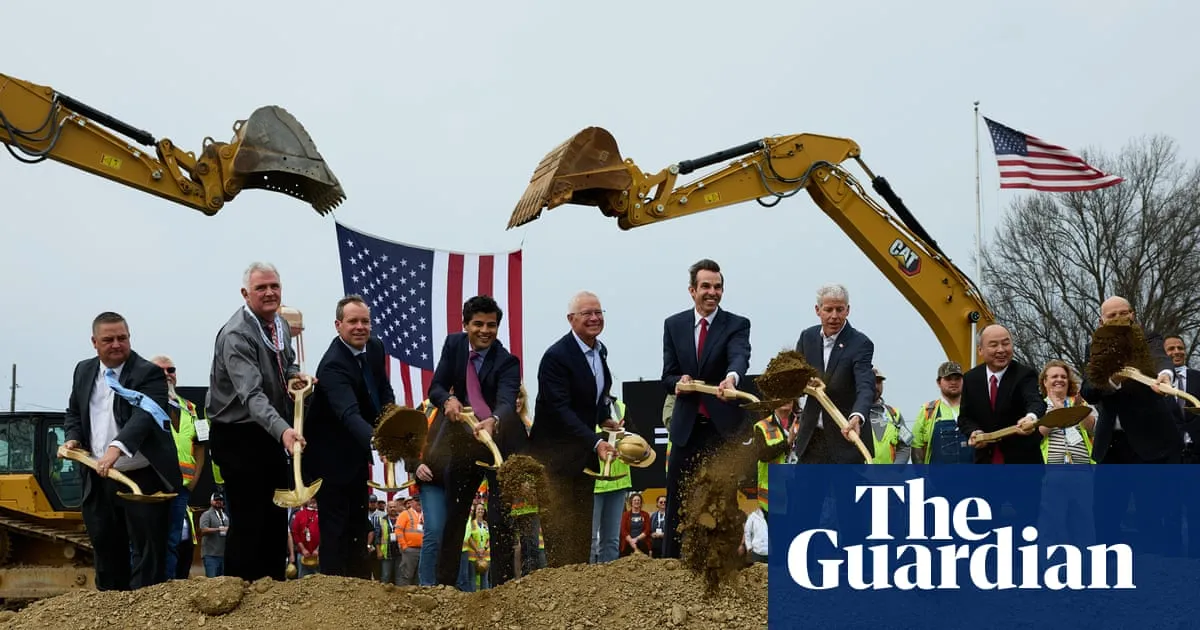
On a winding road tucked away behind forests in the Appalachian foothills of southern Ohio is where OpenAI, Nvidia and Japanese investors are set to spend $500bn on one of the largest Artificial Intelligence datacenters on the planet.Last March, the energy secretary, Chris Wright, the commerce secretary, Howard Lutnick and a host of Japanese and other dignitaries briefly descended on Piketon to enthusiastically break ground on a project to build 8GW worth of AI computing power.But locally, there’s a different feeling: a mix of hope but also concern.“Personally, my emotions range between positive and skeptical,” says Billy Spencer, who’s been mayor of Piketon for the past 23 years, of the project.“There’s not an organized opposition to it around here. There hasn’t been that much talk. No one’s come to council – I don’t know that there’s been one citizen who lives within the village of Piketon who has come and said: ‘Mayor, what do you think about it?’”SB Energy, a subsidiary of Japanese bank SoftBank Group Corp., will own and operate the project with OpenAI signing a 20-year lease with the company to use the computing capacity delivered by the site. OpenAI would deploy Nvidia AI computing infrastructure at the datacenter, which will open in 2028.Masayoshi Son, chairman and chief executive officer of SoftBank Group Corp,at the Portsmouth site in Piketon, Ohio, in March. Photograph: Bloomberg/Getty ImagesTo meet its major energy demands, a natural gas plant would be built nearby, infrastructure expected to be paid for by Japanese money through a $33bn investment.However, the project has fueled concern from environmental groups, with part of it situated on a decommissioned uranium enrichment site that operated for nearly 60 years until 2001.For decades, communities in Pike county have blamed the department of energy-run facility, known locally as the “A-Plant”, for fueling above-average cancer rates and a host of other health issues. In 2019, a local middle school was forced to close after high levels of radiation were recorded in the building.The project is in large part a consequence of the Trump administration’s tariff and reshoring efforts: The government of Japan in July 2025 agreed to invest $550bn in the US in exchange for lowering tariffs on Japanese products entering the US. America is Japan’s biggest trade partner.However, a new administration could prevail in Washington after the 2028 presidential election and it could be one that could end Trump’s tariffs and consequently erase any motivation for Japanese investment in the project. That is not lost on Spencer.“But this is part of Japan’s deal – if you don’t put tariffs on us, we’ll spend money here [is Japan’s motivation],” he says. “So anytime it’s a political football like that, it’s subject to change, whether you support Trump or not.”Datacenters and their electricity and water needs have created a lightning rod of anger for communities across America. In July, the state of New York announced a pause in permitting the development of hyperscale datacenters, the first state in the country to do so.But the allure of huge sums of money is hard to ignore in Pike county, a part of America where the poverty rate, at over 19%, is almost double the national level.The project has promised to generate 35,000 construction jobs and 2,500 long-term, operating jobs respectively, with the data center expected to take up around 640 acres, or an area around three-fourths the size of New York City’s Central Park.“Since the [enrichment] plant closed, people have been wondering where the jobs will come from,” says Spencer.“Pike county certainly can’t handle that alone,” he says of the estimated tens of thousands of construction workers expected to descend on the area over the next six years.Environmentalists, however, say there are a host of issues with the plan.Creating what would be the country’s largest natural gas power plant could see millions of pounds of noxious chemicals released into the air.Flaring produces huge volumes of carbon monoxide, carbon dioxide, sulfur dioxide and nitrogen oxides.A child holds a ‘No Data Center’ sign during a public meeting in Ashville, Ohio, on 19 August. Photograph: Bloomberg/Getty Images“As one of the largest natural gas facilities ever proposed, the greenhouse gas emissions and air pollution associated with a project of this size represents an astronomical contribution to climate change, not to mention the public health risks associated with the air pollution created by natural gas combustion,” says Carol Kauffman, chief executive officer of the Ohio Environmental Council.“There are also upstream impacts, too, with fracking wells and methane leakage from pipelines.”The US Energy Information Administration estimates that in 2022, “CO2 emissions from burning natural gas for energy accounted for about 35% of total US energy-related CO2 emissions”.What’s more, local leaders suggest that during the construction phase up to two million gallons of water may be required for waste purposes.Residents, including Spencer, have previously voiced opposition to a $650m waste disposal facility at the site, where low-level radioactive and other materials from the disassembled uranium-enrichment plant have been buried. Many are concerned that leaching, over time, could see hazardous waste enter the aquifer underground.Project managers, however, say that has been taken into account.“SB Energy performs thorough site reviews and due diligence for each of our infrastructure projects, including soil sampling,” a SB Energy spokesperson told the Guardian.“SB Energy has committed to paying for accelerated cleanup and remediation at the site.”Headquartered in Redwood City, California, SB Energy has said that Ohio ratepayers won’t have to pay into the cost for connecting the facility to the local electricity grid, and that additional electricity produced at the natural gas plant would go back onto the local grid, helping reduce costs for local customers.Many locals support any effort that would hasten funding for safer use and storage of the radioactive material that dots the site, which covers six square miles, or almost 4,000 acres.For its part, OpenAI announced this month plans to “invest $40m in a community grant fund supporting priorities identified by local residents” in Pike county. It also plans to give college students across Ohio a $100 credit to use one of its ChatGPT AI tools.But all this money being pumped into a community where the median household income is $41,313 or 40% less than the Ohio figure, could set off a wealth gap between land and property owners and everyone else.Locals say SB Energy is actively buying up large tracts of land, a move that has reset the local property market. A report filed by SB Energy with the Ohio Environmental Protection Agency says part of the project would be located on more than 1,000 acres of private land immediately adjacent to the former enrichment facility.And at the time of writing, SB Energy had posted just four jobs based in Piketon.On the streets of Piketon, several residents in the village of 2,700 people declined to comment on the project due to having no information about it.Dawn Winters, who runs several local gas stations, says her business is likely to benefit from the project.“I think it’s going to be a good thing for businesses like mine,” she says.“But on the other hand, we are seeing rent prices go up already. A friend of mine had to sell their land [to the project] and relocate. People are already needing affordable housing.”
SRCThe Guardian - World News
LANGEN
LEANCenter-Left
WORDS1 204
ENT12
WED · 2026-08-26 · 12:00 GMTBRIEF NSR-2026-0826-106125
NSR-2026-0826-106125News Report·EN·Economic Impact
Hope and concern swirls for Ohioans around ‘world’s largest datacenter’
A massive $500 billion AI datacenter, one of the world's largest, is planned for Piketon, Ohio, a project involving OpenAI, Nvidia, and Japanese investors led by SoftBank. The datacenter, set to open in 2028, promises significant job creation, with an estimated 35,000 construction jobs and 2,500 long-term positions in an area with high poverty.
Stephen Starr in Piketon, OhioThe Guardian - World NewsFiled 2026-08-26 · 12:00 GMTLean · Center-LeftRead · 5 min
The Guardian - World NewsFIG 01
Reading time
5min
Word count
1 204words
Sources cited
3cited
Entities identified
12entities
Quality score
100%
§ 01
Briefing Summary
AI-generatedNEWSAR · AI
A massive $500 billion AI datacenter, one of the world's largest, is planned for Piketon, Ohio, a project involving OpenAI, Nvidia, and Japanese investors led by SoftBank. The datacenter, set to open in 2028, promises significant job creation, with an estimated 35,000 construction jobs and 2,500 long-term positions in an area with high poverty. However, the project faces environmental concerns, as it's partly situated on a former uranium enrichment site with a history of health issues, and will be powered by a new natural gas plant, raising worries about air pollution and climate change contributions. The investment is partly driven by a Japanese agreement to spend in the US in exchange for tariff reductions, creating potential political uncertainty for the project's future.
Confidence 0.90Sources 3Claims 5Entities 12
§ 02
Article analysis
Model · rule-basedFraming
Economic Impact
Environmental
Tone
Mixed Tone
AI-assessed
CalmNeutralAlarmist
Factuality
0.70 / 1.00
Factual
LowHigh
Sources cited
3
Well sourced
FewMany
§ 03
Key claims
5 extracted01
The project is partly situated on a former uranium enrichment site (A-Plant) linked to health concerns and high radiation levels in the past.
factual
Confidence
1.00
02
SB Energy, a subsidiary of SoftBank Group Corp., will own and operate the project, with OpenAI leasing capacity for 20 years.
factual
Confidence
1.00
03
OpenAI, Nvidia, and Japanese investors plan to spend $500bn on one of the largest AI datacenters on the planet in Piketon, Ohio.
factual
Confidence
1.00
04
A natural gas plant will be built nearby to meet the datacenter's energy demands, with Japanese investment covering infrastructure costs.
factual
Confidence
0.90
05
Japan's investment is tied to a deal with the Trump administration to lower tariffs on Japanese products entering the US.
quoteBilly Spencer
Confidence
0.80
§ 04
Full report
5 min read · 1 204 words§ 05
Entities
12 identifiedKey playerOppositionContextPositiveNeutralNegative
People3
Organizations3
Locations5
§ 06
Keywords & salience
10 termsartificial intelligence datacenter
1.00
openai
0.90
nvidia
0.80
softbank group corp
0.70
energy demands
0.60
environmental concerns
0.60
radiation
0.50
japanese investment
0.50
decommissioned uranium enrichment site
0.50
trump administration tariffs
0.40
§ 07
Topic connections
Interactive graph Network visualization showing 51 related topics
View Full Graph Person Organization Location Event|Click node to navigate|Edge numbers = shared articles