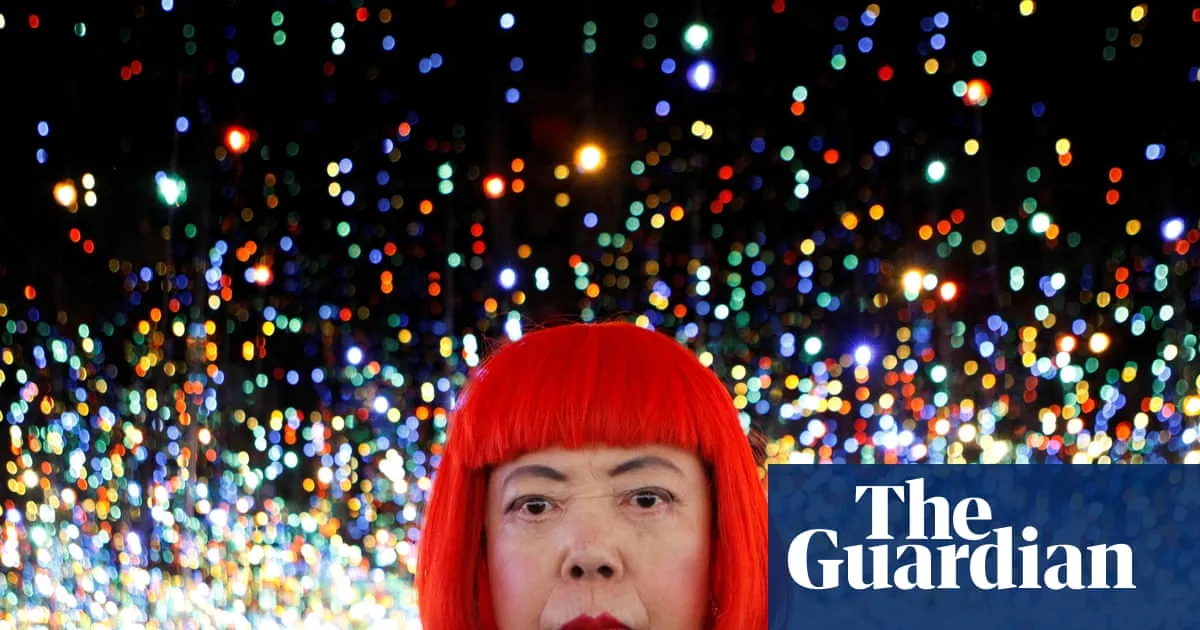
Yayoi Kusama, the Japanese outsider artist who reached superstar status after decades living in a psychiatric hospital, has died aged 97.Kusama died in a Tokyo hospital on 14 August, her studio announced in a statement on her website on Thursday.“Throughout an extraordinary lifetime devoted entirely to artistic creation, Kusama pursued an internationally acclaimed career as a pioneering avant garde artist whose creative practice encompassed visual art, performance, fiction, and poetry,” the statement read. “She continued to paint until her final days, never setting aside her brush, and continued exploration of forever love and eternal soul.”“We will carry forward Kusama’s wishes and, through art, continue to bring hope and strength for the future to people around the world.”Instantly recognisable by her bright red bobbed wig, Kusama became known for her psychedelic colour schemes and “infinity mirror room” installations, which helped her find a huge audience in the age of the social media selfie. Yet she had pioneered many of her enduring themes as a young artist in the 1960s before fading into temporary obscurity.Kusama’s work The Hope of the Polka Dots Buried in Infinity Will Eternally Cover the Universe, at the Museum Ludwig in Cologne, Germany in 2026. Photograph: Ina Fassbender/AFP/Getty ImagesAs well as being a sculptor and painter, Kusama put on numerous performance pieces throughout the hippy era that saw her name attached to scandal. She staged “body festivals” with naked performers painted in polka dots and once wrote to US president Richard Nixon offering to sleep with him in return for an end to the Vietnam War. News of such events appalled her conservative family back home.Kusama was born in Matsumoto, Japan, in 1929, enduring an unhappy childhood at the hands of an abusive mother and philandering father. Her wealthy family managed plant nurseries and Kusama would sit and draw the flowers despite her mother’s frequent attempts to stop her. As a child, Kusama began experiencing hallucinations, in which the flowers would swarm around and talk to her. Her coping mechanism was to draw what she saw.During the second world war, 13-year-old Kusama was conscripted to produce fabric for Japanese army parachutes. She later studied nihonga, a traditional Japanese style of painting, in Kyoto, but grew frustrated with its limitations. Rejecting her planned future of an arranged marriage and children, Kusama left Japan for New York in 1958. There, she fell in with the artist and theorist Donald Judd and made a breakthrough with her “infinity net” paintings – vast fields of impastoed polka dots that stretched across the canvas. In 1962, she sold her first of these to the artists Frank Stella and Judd for $75. In 2014, her White No 28 sold for $7.1m (£5.7m) at auction, a record at the time for a living female artist.Kusama next to her Dot Car (1965) in Scheveningen, the Netherlands. Photograph: Harrie VerstappenIn 1963, Kusama started making “soft sculptures” – pieces of furniture and other objects, such as ladders, covered with white, fabric-stuffed phallic shapes. They were, she said, her attempt to heal her disgust around sex, which she had been brought up to believe was dirty and shameful.Despite working loosely within the spheres of pop art and minimalism, Kusama was not embraced by the art world. She always maintained that many of her ideas from this period were appropriated by white male artists, including Andy Warhol, while she was written out of art history.Kusama’s work was often centred around the infinite and the idea of “self-obliteration”, a concept inspired by the hallucinations that would engulf her. Talking about her 1954 painting Flower (DSPS), she once said: “I was looking at the red flower patterns of the tablecloth on a table, and when I looked up I saw the same pattern covering the ceiling, the windows and the walls, and finally all over the room, my body and the universe. I felt as if I had begun to self-obliterate, to revolve in the infinity of endless time and the absoluteness of space, and be reduced to nothingness.”Kusama’s work Narcissus Garden, which she presented at the Venice Biennale in 1966 without being invited. The work was eventually shut down by the biennale. Photograph: Yayoi KusamaAt the 1966 Venice Biennale she continued these studies, presenting her infamous Narcissus Garden, a “lake” of 1,500 reflective balls that strived for a sense of mirrored infinity. When Kusama began selling the balls for $2 each under the banner “Your narcissism for sale”, the biennale moved to close the operation down.Kusama developed a flair for controversy. Her artistic “happenings” were often criticised for being mere shock material, yet their political statements now seem ahead of their time. In 1968, she staged New York’s first “homosexual wedding” in Tribeca and washed a “dirty” Soviet flag outside the United Nations building in protest over the invasion of Czechoslovakia.By this time Kusama was engaged in a platonic yet obsessive relationship with the outsider artist Joseph Cornell, which continued even after she had left the US to return to Japan. She had been frequently admitted to hospital during her time in New York and when Cornell died in 1972, her mental health deteriorated further, with hallucinations, panic attacks and suicide attempts. In 1977, she checked herself into a psychiatric hospital in Tokyo that offered art therapy courses and provided Kusama with the stability needed to pursue her projects without distraction. She made the decision to live there permanently, working each day from morning until night in her nearby studio.Kusama at work in her studio in Tokyo, Japan in 2017. Photograph: Toru Hanai/ReutersAlthough she published several novels during the 1980s, interest in Kusama appeared to have waned almost completely by the start of the 90s. But the recognition that eluded her during her early artistic career finally arrived later in life. In 1993 she created a mirrored room filled with small pumpkin sculptures for the Venice Biennale’s Japanese pavilion and won plaudits for the work. She had first seen a pumpkin with her grandfather when she was 11. When she tried to pick it, it had appeared to start speaking to her, and now it became a recurring motif in works such as All the Eternal Love I Have for the Pumpkins, from 2016.Kusama’s focus shifted towards installations that built on her 1965 work Infinity Mirror Room: Phalli’s Field. In that piece, hundreds of soft, pink phallic forms were arranged within a mirrored room. Half a century later, such immersive experiences connected with audiences on a global scale, with the coloured lights and brightly painted pumpkins providing perfect Instagram content. It was not without irony that an exhibition of hers at the Hirshhorn Museum in Washington DC in 2017 was temporarily closed after someone damaged an artwork while attempting to take a selfie.Visitors inside one of Kusama’s ‘infinity rooms’ at her exhibition at Tate Modern, London in 2021. Photograph: Guy Bell/REX/ShutterstockKusama received retrospectives at the New York’s Museum of Modern Art in 1998, Tate Modern in London in 2012 and Washington DC’s Hirshhorn Museum in 2017. Tickets for her shows sold out swiftly around the world and fans would queue for hours just to be allowed a 30-second experience within her installations. Yet despite some critics wondering if she had become the world’s most popular artist, Kusama always believed that her place in history would not be decided by the art establishment. “I cannot imagine how I will be classified after my death,” she once said. “It feels good to be an outsider.”
SRCThe Guardian - World News
LANGEN
LEANCenter-Left
WORDS1 242
ENT10
THU · 2026-08-27 · 02:17 GMTBRIEF NSR-2026-0827-106316
NSR-2026-0827-106316News Report·EN·Human Interest
Yayoi Kusama, Japanese artist who became a global superstar, dies aged 97
Japanese artist Yayoi Kusama, known for her vibrant polka dot motifs and immersive "infinity mirror rooms," has died at the age of 97. Kusama passed away in a Tokyo hospital on August 14th, as announced by her studio.
Tim Jonze and Sian CainThe Guardian - World NewsFiled 2026-08-27 · 02:17 GMTLean · Center-LeftRead · 5 min
The Guardian - World NewsFIG 01
Reading time
5min
Word count
1 242words
Sources cited
2cited
Entities identified
10entities
Quality score
100%
§ 01
Briefing Summary
AI-generatedNEWSAR · AI
Japanese artist Yayoi Kusama, known for her vibrant polka dot motifs and immersive "infinity mirror rooms," has died at the age of 97. Kusama passed away in a Tokyo hospital on August 14th, as announced by her studio. Throughout her career, which spanned from the 1950s to the 2020s, she produced paintings, sculptures, and installations often inspired by her experiences with hallucinations. Despite facing early struggles and a period of obscurity, Kusama achieved global superstardom, particularly in the social media age. Her avant-garde work, which encompassed visual art, performance, fiction, and poetry, explored themes of infinity and "self-obliteration."
Confidence 0.90Sources 2Claims 5Entities 10
§ 02
Article analysis
Model · rule-basedFraming
Human Interest
Social Justice
Tone
Measured
AI-assessed
CalmNeutralAlarmist
Factuality
0.80 / 1.00
Factual
LowHigh
Sources cited
2
Limited
FewMany
§ 03
Key claims
5 extracted01
In 2014, her painting 'White No 28' sold for $7.1m, a record at the time for a living female artist.
statistic
Confidence
1.00
02
Kusama was born in Matsumoto, Japan, in 1929.
factual
Confidence
1.00
03
Kusama became known for her psychedelic color schemes and "infinity mirror room" installations.
factual
Confidence
1.00
04
Kusama died in a Tokyo hospital on August 14, according to her studio.
factualYayoi Kusama's studio
Confidence
1.00
05
Yayoi Kusama, the Japanese outsider artist, has died at the age of 97.
factual
Confidence
1.00
§ 04
Full report
5 min read · 1 242 words§ 05
Entities
10 identifiedKey playerOppositionContextPositiveNeutralNegative
Organizations1
Locations6
§ 06
Keywords & salience
8 termsyayoi kusama
1.00
avant garde artist
0.90
artistic creation
0.80
infinity mirror room
0.70
performance art
0.60
japanese artist
0.50
polka dots
0.50
psychedelic
0.40
§ 07
Topic connections
Interactive graph Network visualization showing 2 related topics
View Full Graph Person Organization Location Event|Click node to navigate|Edge numbers = shared articles