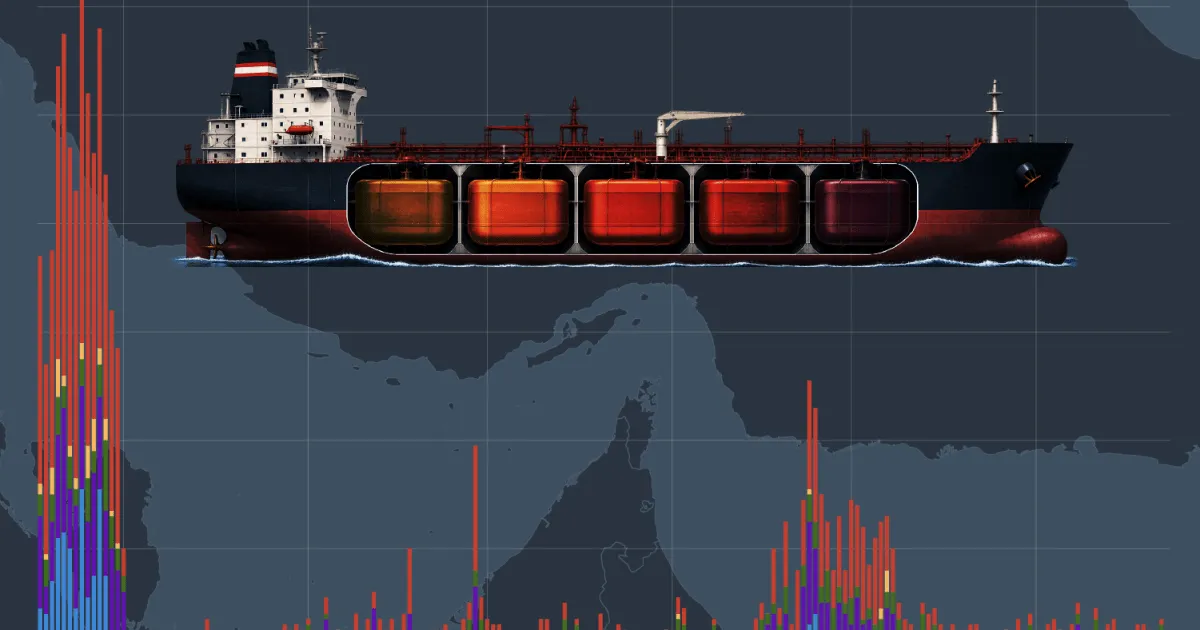
EXPLAINERA crisis in one narrow passage has disrupted an industry that carries about 80 percent of the world’s trade.(Al Jazeera)Published On 27 Aug 2026Six months into the Iran" class="entity-link entity-event" data-entity-id="44694" data-entity-type="event">United States-Israel war on Iran, the closure of the Strait of Hormuz continues to drive one of the worst maritime shipping disruptions in decades.Traffic through the 33km (21-mile) chokepoint has fallen from more than 100 vessels a day to just five, disrupting the flow of oil, gas and goods worldwide.Al Jazeera visualises how a crisis in one narrow passage has disrupted an industry that carries about 80 percent of the world’s trade.About 80 percent of goods move by seaAlmost everything people buy, from the fuel in their cars to the grain in their bread, has likely spent time on board a vessel at sea.About 80 percent of world trade by volume moves by sea at some point, making maritime shipping essential to the global economy, according to UNCTAD, the UN’s trade and development body.Not all ships are created equal. Different vessels are built for various purposes, from moving oil to the goods we rely on every day.(Al Jazeera) oil tankers are among the largest ships and carry energy products such as crude oil, refined petroleum, and chemicals. Most crude oil is transported by Very Large Crude Carriers, or VLCCs, which can access a wide range of ports and carry about two million barrels of crude. Container ships transport consumer goods such as phones and clothing in stacked steel boxes known as containers. Some are enormous, measuring more than 400m (1,312 feet) long and carrying more than 20,000 containers. Dry bulk carriers transport raw materials like grain, coal and iron ore. Lloyd’s List estimates they made about 7,000 Hormuz transits a year, or about 20 a day, before the war. General cargo ships carry mixed goods like steel and machinery, while Ro-Ro ships transport wheeled cargo such as cars, trucks and heavy machinery. The Middle East’s shipping problemThe Strait of Hormuz is a critical chokepoint for global energy trade. It is one of three main gateways in the Middle East, carrying more than one-third of global seaborne crude oil and nearly one-third of liquefied petroleum gas (LPG) flows, along with significant volumes of liquefied natural gas (LNG) and refined petroleum products.“That’s probably the first time we’ve really seen a major constriction of a choke point,” Richard Matthews, director of consultancy and research at Gibson Shipbrokers, a London-based shipbroking and maritime advisory service, told Al Jazeera.He explained that what makes the Strait of Hormuz different from other chokepoints is “there is no alternative maritime route. There are some pipelines, but there’s no alternative, which is why it’s been so significant in terms of cargo volume.”Ports along the Gulf are where much of the region’s energy begins its journey to the rest of the world.(Al Jazeera)What used to pass through the Strait of Hormuz?According to UNCTAD data, the week before the Iran war began, average flows of crude oil through the Strait of Hormuz accounted for roughly 38 percent of the global total, LPG was 29 percent and LNG was 19 percent.(Al Jazeera)Crude exports from the Gulf region have dropped by nearly half (47 percent) compared with before the war, down from about 17 million barrels a day in 2025 to roughly nine million bpd as of August 2026. According to Reuters, analysts estimate that five to seven million barrels of Gulf oil a day are currently being disrupted.Direct exports of crude oil moving via the strait have fallen to an average of just 2.2 million bpd, according to Kpler, a data and analytics company that tracks global commodity markets and trade flows.The chart below shows the combined crude oil shipments from the Gulf’s largest oil-producing countries – Saudi Arabia, Iraq, Iran and Kuwait – dropping sharply since the start of the war from roughly 400 million barrels in February to about 200 million barrels in July.From 100 ships daily to fiveBefore the war, about 100 ships passed through the Strait of Hormuz each day, more than half of them tankers, carrying tens of millions of barrels of oil.That collapsed within days of the February 28 US-Israeli strikes on Iran. After the IRGC announced the strait’s closure on March 2, traffic fell to an average of five vessels a day and stayed there through the April ceasefire and the US blockade of Iranian ports.A June 17 interim agreement lifted the daily average to 20, still only one-fifth of normal traffic, before the US resumed its blockade on July 14 and traffic sank back to five per day.Today, the strait remains, in effect, closed. From July 15 to August 23, an average of about five vessels a day passed through, marking an almost 95 percent decrease from pre-war traffic levels. What little traffic remains consists mostly of tankers operating under naval escort or with their tracking systems switched off.(Al Jazeera)The map below shows how the number of vessels passing through the strait plummeted during the first four days of the war.Before the war, the Strait of Hormuz functioned as one shared waterway, with ships using standard shipping lanes mainly through the centre of the strait, supported by the International Maritime Organization (IMO). These routes were chosen based on port schedules, contracts and safety.The little traffic now moving through the strait runs through a workaround, with the waterway split into two distinct paths after Iran and Oman agreed to temporary shipping routes, using their respective territorial waters to help vessels pass through. Iranian authorities insist ships use its northern route, which runs along its coastline near Larak and Qeshm islands and connects directly to Iranian ports and terminals.But in April, the US military placed a naval blockade on Iranian ports to stop roughly two million barrels of Iranian oil from reaching the rest of the world.(Al Jazeera)Which countries rely most on Middle East oil?For people and businesses further down the chain, the disruption is being felt through the rising cost of essentials.Countries which rely heavily on oil, gas and fertiliser from the Gulf are facing higher prices, longer waits for shipments and the need to find alternative suppliers. Even where deals have been struck to keep goods moving, the cost of doing so is being passed through the supply chain.The countries that rely most heavily on Middle Eastern oil include Eritrea and Madagascar, which each source about 90 percent of their oil from the region, followed by Pakistan which gets 78 percent, Japan (77 percent) and Kenya (77 percent).Where are ships going now?Hormuz’s closure has redrawn global shipping flows, pushing traffic away from the Gulf and towards the Red Sea and Southeast Asia, with Singapore and Malaysia emerging as hubs for redirected energy.Russia’s fuel oil shipments to Singapore and Malaysia, for example, rose 2.5 times month-on-month in July, making the region an increasingly important hub for redirected energy flows.The table below shows how port traffic changed across countries after the conflict began. Kuwait saw the steepest fall, with daily port calls – when a ship arrives at a port – dropping by 86 percent. Geographically, Kuwait’s only maritime route to the open sea runs through the Strait of Hormuz.Ukraine saw the second-largest percentage drop, driven by ongoing drone attacks on shipping in the Baltic and Black seas. The United Arab Emirates saw the third-largest percentage drop of 69 percent, with port calls dropping from 78 daily to 24. Qatar, Iraq and Bahrain saw similar declines of about 66-68 percent.
SRCAl Jazeera
LANGEN
LEANCenter
WORDS1 241
ENT12
THU · 2026-08-27 · 09:29 GMTBRIEF NSR-2026-0827-106430
NSR-2026-0827-106430Analysis·EN·Economic Impact
How a 95 percent drop in Hormuz traffic changed global shipping
The Strait of Hormuz, a critical chokepoint for global energy trade, has experienced a nearly 95 percent drop in traffic since the US-Israel war on Iran began six months ago. Daily vessel passage has fallen from over 100 to just five, significantly disrupting the flow of oil, gas, and goods.
Hanna Duggal,Marium Ali,Mohamed HusseinAl JazeeraFiled 2026-08-27 · 09:29 GMTLean · CenterRead · 5 min
Al JazeeraFIG 01
Reading time
5min
Word count
1 241words
Sources cited
2cited
Entities identified
12entities
Quality score
100%
§ 01
Briefing Summary
AI-generatedNEWSAR · AI
The Strait of Hormuz, a critical chokepoint for global energy trade, has experienced a nearly 95 percent drop in traffic since the US-Israel war on Iran began six months ago. Daily vessel passage has fallen from over 100 to just five, significantly disrupting the flow of oil, gas, and goods. This closure impacts approximately 80 percent of world trade, which moves by sea. Before the conflict, the Strait handled about 38 percent of global crude oil, 29 percent of LPG, and 19 percent of LNG. Crude exports from the Gulf region have dropped by 47 percent. The disruption is attributed to the war and subsequent actions, including blockades, by the US.
Confidence 0.90Sources 2Claims 5Entities 12
§ 02
Article analysis
Model · rule-basedFraming
Economic Impact
Conflict
Tone
Mixed Tone
AI-assessed
CalmNeutralAlarmist
Factuality
0.80 / 1.00
Factual
LowHigh
Sources cited
2
Limited
FewMany
§ 03
Key claims
5 extracted01
There is no alternative maritime route for the Strait of Hormuz.
quoteRichard Matthews
Confidence
1.00
02
The Strait of Hormuz carries more than one-third of global seaborne crude oil and nearly one-third of liquefied petroleum gas (LPG) flows.
statistic
Confidence
1.00
03
About 80 percent of world trade by volume moves by sea at some point.
statisticUNCTAD
Confidence
1.00
04
Traffic through the Strait of Hormuz has fallen from more than 100 vessels a day to just five.
statistic
Confidence
1.00
05
The closure of the Strait of Hormuz continues to drive one of the worst maritime shipping disruptions in decades.
factual
Confidence
0.90
§ 04
Full report
5 min read · 1 241 words§ 05
Entities
12 identifiedKey playerOppositionContextPositiveNeutralNegative
Locations3
§ 06
Keywords & salience
8 termsglobal shipping
1.00
strait of hormuz
1.00
maritime trade
0.90
energy trade
0.80
chokepoint
0.70
oil and gas
0.60
global economy
0.50
us-israel war on iran
0.40
§ 07
Topic connections
Interactive graph Network visualization showing 51 related topics
View Full Graph Person Organization Location Event|Click node to navigate|Edge numbers = shared articles