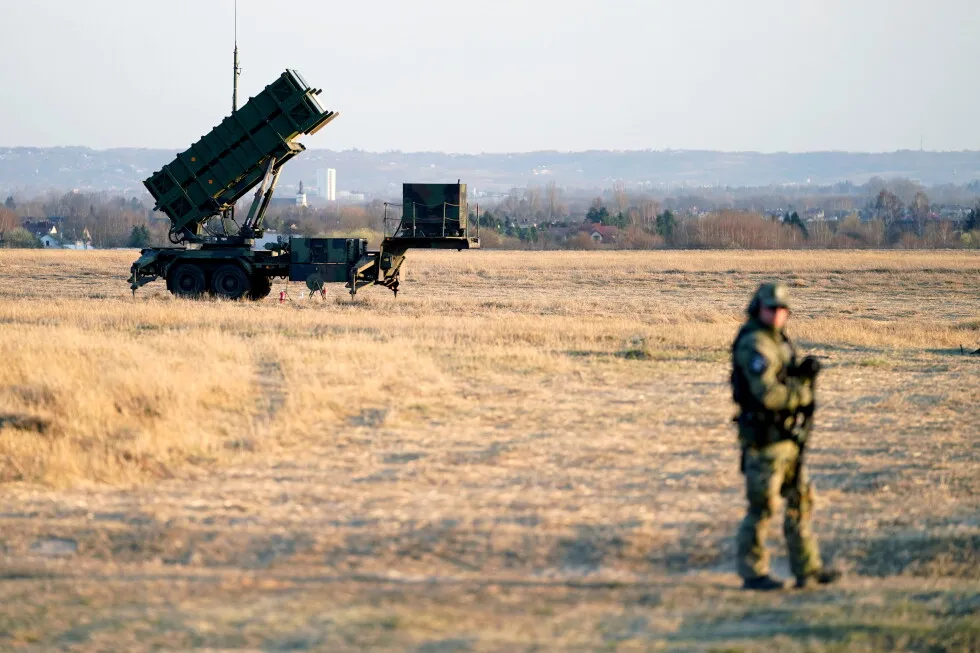
Exclusive: US Patriot missile stocks in Europe are ‘beyond critical’ due to Iran war, officials say 1 of 3 | Patriot missles are seen at the Rzeszow-Jasionka Airport, March 25, 2022, in Jasionka, Poland. (AP Photo/Evan Vucci, File) 2 of 3 | Smoke rises above warehouse stores after a Russian air attack in Kyiv, Ukraine, Thursday, Aug. 27, 2026. (AP Photo/Efrem Lukatsky) 3 of 3 | Smoke rises above warehouse stores behind a sunflower field following a Russian air attack in Kyiv, Ukraine, Thursday, Aug. 27, 2026. (AP Photo/Efrem Lukatsky) By EMMA BURROWS and BEN FINLEY Updated 5:36 PM MESZ, August 27, 2026 Add AP News on Google Add AP News as your preferred source to see more of our stories on Google. Share Share Facebook Copy Link copied Print Email X LinkedIn Bluesky Flipboard Pinterest Reddit WASHINGTON (AP) — The U.S. military is experiencing a “beyond critical” shortage of advanced missile interceptors in Europe largely driven by President Donald Trump’s war with Iran, a U.S. defense official in Europe and a NATO official told The Associated Press, raising concerns about vulnerabilities in NATO countries to a potential Russian attack. The U.S. defense official said the most concerning shortfall involves Patriot missile interceptors, which can shoot down Russia’s high-speed ballistic missiles. The NATO official confirmed the low inventories of Patriots among American and NATO forces in Europe. Both spoke on condition of anonymity to discuss sensitive military matters. In the event of a Russian ballistic missile assault on, for example, a military headquarters or power plant, NATO could be in a similar position to Patriot-starved Ukraine and be forced “to take punch after punch in the mouth,” the U.S. defense official said. In Europe, the American military “definitely” does not have enough Patriots to stop any possible sustained ballistic missile attack and would have “very limited” capability to defend against a single ballistic missile strike or a stray Russian missile that goes off course, the U.S. official said. It illustrates the cascading fallout from Trump’s decision to launch a war against Iran, a conflict that reaches the six-month mark on Friday. U.S. missile stocks in Europe have been moved to the Middle East, where U.S. and Gulf allies have fired off significant numbers of interceptors, including Patriots, to thwart Iran’s drones and missiles. Some of those attacks have killed and wounded American troops. Why Russia’s ballistic missiles are increasingly getting through Ukrainian defenses 6 MIN READ 12 Recent fighting with Iran further draws down key US air defense stockpiles, analysis says 1 MIN READ Russian strikes across Ukraine kill 10 and NATO scrambles jets after a missile falls in Poland 1 MIN READ Though a Russian ballistic missile attack against NATO countries is not imminently expected, CIA Director John Ratcliffe went to Moscow this week to warn Russia not to attack, The Wall Street Journal reported. Trump played down the significance of the rare and secretive trip, saying it was “sort of semi-routine.” European and NATO officials say Russia could be in a position to attack countries in the alliance by 2030. Patriot stockpiles are projected to rebound by then. In the meantime, Russia’s war in Ukraine could hinder its ability to carry out any missile attack on Europe as it would be a challenge for Moscow to fight an air war on two fronts. US Patriot transfers to Ukraine played a role in the drawdown, but the Iran war wasn’t expected The Patriot missile shortage is most acutely felt in Ukraine, where officials are begging for more air defense support and where previous U.S. transfers also have drawn down some supply. Kyiv says only U.S.-made Patriots can stop Russia’s advanced ballistic missiles, which increasingly are getting through Ukrainian defenses, including as part of a barrage overnight into Thursday. This site is protected by reCAPTCHA and the Google and Terms of Service apply. The U.S. supplied hundreds of Patriot missiles to Ukraine over the course of the 4 1/2-year-long conflict, but the Iran war was the tipping point for shrinking inventories, said Ed Arnold, senior associate fellow at the Royal United Services Institute, a military think tank in London. The supply to Ukraine was planned for and reasonably measured, he said, whereas stocks in the Middle East have been unexpectedly and quickly drained, exposing supply chain constraints. The U.S. military in Europe also is grappling with critical shortages of the Army Tactical Missile System, or ATACMS, a medium-range ballistic missile designed to strike behind enemy lines, the two officials said. But the overall munitions picture in Europe is less dire than on air defenses alone because some European militaries have their own offensive missiles, such as the Taurus and Storm Shadow, which are both long-range air-launched bunker-busting missiles. The Pentagon said it would not discuss weapons stockpile levels for security reasons. U.S. Army Col. Martin O’Donnell, a senior NATO military spokesperson, said it is “simply not the case” that the number of Patriot missiles in Europe is beyond critical. NATO, he said, is able to “block punches” and has enough air defense munitions available to defend itself as well as to donate to Ukraine. The dearth of Patriot interceptors in Europe would leave few alternatives for shooting down Russia’s more advanced ballistic missiles, which can be combined with swarms of inexpensive drones to overwhelm defenses, experts say. Ukraine and some allies already use systems that can destroy slower-moving drones without expensive missiles. But ballistic missiles are a challenge because they dive steeply toward targets at more than five times the speed of sound, leaving little time to stop them. The Patriot system tracks the missile, predicts its path and launches within minutes, all while carrying out complex calculations to ensure the interceptor finds its target. One Patriot battery can only cover a limited area: for example, a small military base but not a whole city. One alternative could be France and Italy’s SAMP/T NG air defense system. France has promised to speed up the delivery of the system — the upgraded version of the current SAMP/T — to Ukraine, which the manufacturer says is better able to counter ballistics. The new iteration, however, has not yet been battle tested and the current version of the SAMP/T has a smaller range than the Patriot. While U.S. and European militaries have warships that can serve as mobile air defense, they may be too far from a target to protect it and could risk getting sunk. Ukraine has received Patriots from American and European stockpiles since Russia’s 2022 invasion, with the U.S. providing about 600 of the interceptors during the Biden administration, said Mark Cancian, a retired Marine colonel who is now senior adviser at the Center for Strategic and International Studies, a Washington think tank. But the greatest expenditure has been during the Iran conflict, which has used up 65% of U.S. Patriots, amounting to roughly 1,500 of the nation’s 2,330 interceptors, CSIS says. About 600 missiles, including those destined for Europe, should be made this year, with a production goal of 2,000 Patriot missiles a year set for 2030, Cancian said. NATO says Europe’s first Patriot missile production facility is expected to open in Germany in September, with deliveries possibly beginning early next year. The first deliveries should go to countries that have already placed orders, including Germany, the Netherlands, Romania and Spain, the U.S. defense official said. But for now, that means some countries, such as Germany, have bought expensive Patriot systems but are in the “ridiculous” position of not having any ammunition to fire from them, said Arnold of the London think tank. Germany’s defense ministry said it does not comment on stockpiles. Moscow likely cannot carry out a sustained air assault on a NATO target while it launches almost nightly attacks on Ukraine, Arnold said. Ukraine’s recent strikes into Russia also have exposed weaknesses in Russia’s air defenses, which could prompt Putin to think twice about provoking a retaliatory attack. “The uncomfortable truth is possibly the best air defense that we have is Russian constraints,” Arnold said. Burrows reported from London. Associated Press writer Konstantin Toropin contributed to this report. EMMA BURROWS Burrows covers security, defense and intelligence for The Associated Press in Europe. She is based in London. twitter
SRCAssociated Press (AP)
LANGEN
LEANCenter
WORDS1 372
ENT10
THU · 2026-08-27 · 15:53 GMTBRIEF NSR-2026-0827-106547
NSR-2026-0827-106547News Report·EN·National Security
Exclusive: US Patriot missile stocks in Europe are ‘beyond critical’ due to Iran war, officials say
U.S. military officials report a "beyond critical" shortage of Patriot missile interceptors in Europe, primarily due to the ongoing war with Iran.
Associated Press (AP)Filed 2026-08-27 · 15:53 GMTLean · CenterRead · 6 min
Associated Press (AP)FIG 01
Reading time
6min
Word count
1 372words
Sources cited
3cited
Entities identified
10entities
Quality score
100%
§ 01
Briefing Summary
AI-generatedNEWSAR · AI
U.S. military officials report a "beyond critical" shortage of Patriot missile interceptors in Europe, primarily due to the ongoing war with Iran. These missiles are crucial for defending against Russia's high-speed ballistic missiles. The U.S. has moved significant numbers of Patriot interceptors to the Middle East to counter Iranian drone and missile attacks, depleting European stockpiles. This situation raises concerns about NATO countries' vulnerability to a potential Russian attack, as they could be left with limited defensive capabilities. While a Russian attack is not imminent, and production is expected to increase by 2030, the current shortage leaves Europe with few alternatives for ballistic missile defense.
Confidence 0.90Sources 3Claims 4Entities 10
§ 02
Article analysis
Model · rule-basedFraming
National Security
Conflict
Tone
Mixed Tone
AI-assessed
CalmNeutralAlarmist
Factuality
0.70 / 1.00
Factual
LowHigh
Sources cited
3
Well sourced
FewMany
§ 03
Key claims
4 extracted01
US missile stocks in Europe have been moved to the Middle East to support the conflict with Iran.
factualarticle
Confidence
0.90
02
US Patriot missile stocks in Europe are 'beyond critical' due to the war with Iran.
quoteUS defense official in Europe and a NATO official
Confidence
0.90
03
CIA Director John Ratcliffe warned Russia not to attack NATO countries.
factualThe Wall Street Journal
Confidence
0.80
04
The US military does not have enough Patriots to stop a sustained ballistic missile attack in Europe.
factualUS defense official
Confidence
0.80
§ 04
Full report
6 min read · 1 372 words§ 05
Entities
10 identifiedKey playerOppositionContextPositiveNeutralNegative
Locations7
§ 06
Keywords & salience
8 termspatriot missile stocks
1.00
iran war
0.90
missile interceptors
0.80
us military
0.70
nato countries
0.60
ballistic missiles
0.50
russian attack
0.50
vulnerabilities
0.40
§ 07
Topic connections
Interactive graph Network visualization showing 7 related topics
View Full Graph Person Organization Location Event|Click node to navigate|Edge numbers = shared articles