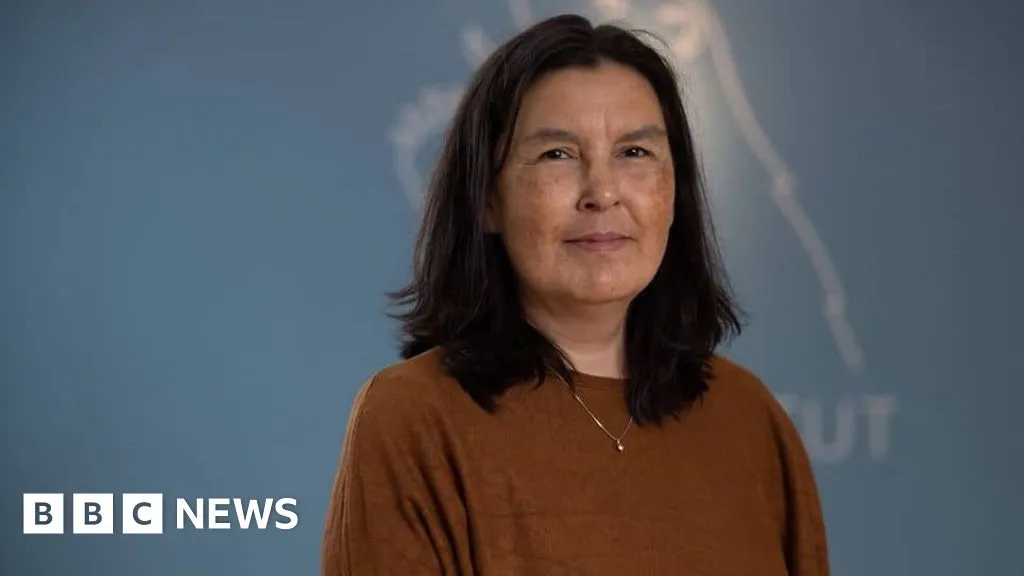
Inuit AtaqatigiitGreenlandic Justice Minister Marianne Paviasen said the government could not say whether there had been a genocide through forced contraceptionGreenland's justice minister has said the government cannot conclude whether genocide was committed against the Inuit community after experts examined the use of forced contraception in the 1960s and 70s."We cannot say, on behalf of the government, whether there was genocide," Marianne Paviasen told reporters. "This is something we can continue to debate."Two reports on the practice were released on Friday, a year after Denmark apologised for the treatment of Inuit women and girls in its autonomous territory. Greenlandic Prime Minister Jens-Frederik Nielsen said a "reconciliation commission" would be set up while Danish PM Mette Frederiksen promised the governments would work together. Denmark has passed a compensation law to pay 300,000 Danish crowns (£34,404; $46,800) to each woman affected by the policy.Records from the national archives show that, between 1966 and 1970, 4,500 Greenlandic women and girls, some as young as 13, had an intra-uterine device (IUD) implanted under a birth-control programme administered by Danish doctors.In recent years, many women came forward to say they had been fitted with an IUD without their knowledge or consent.Use of the birth control was so widespread that Greenland's population growth severely slowed.Frederiksen issued an apology last August to Greenlandic women and their families affected by "systematic discrimination".In 2024, a former prime minister of Greenland, Mute B Egede, described the practice as "genocide".Under the UN Convention on the Prevention and Punishment of the Crime of genocide, one definition of genocide is "imposing measures intended to prevent births" within a "national, ethnical, racial or religious group". The territory tasked a panel of four experts with establishing whether human rights had been violated and whether such violations met the definition of genocide.However, the panel split, with two members resigning and producing a separate report. The two experts who remained, Alaskan lawyer Dalee Sambo Dorough and University of Copenhagen law professor Miriam Cullen, found in their report that the rights of Inuit women in Greenland had been violated.But they said that they could not conclude that genocide had taken place "on the basis of contraceptive practices alone".They added that genocidal intent by Denmark remained a "possible inference" that a court might establish, based on evidence that fell outside the scope of their report, such as the removal of Inuit children to be raised by Danish families. The rival report, produced by Jonas Christoffersen, former head of the Danish Institute for Human Rights, and Jensine Nedergaard, a psychologist who had worked in Greenland, accepted that women had been wronged but could not establish the extent of their mistreatment.They found no evidence "any authority or health professional at any time had any intention of destroying the Greenlandic population".Reacting on Friday, Greenland's justice minister said the two reports were so different that one "says there was no genocide at all" while the other "says there could have been".One woman affected by the forced contraception policy, Henriette Berthelsen, told news agency AFP before the reports were presented that their conclusions had been skewed from the start because no Greenlandic Inuits had been appointed as experts."For me, this is not just about history or politics. It's my body, my life and my right to self-determination," she said."And once again, I see that it is others who will investigate and define what was done to me and to other Inuit women."Another woman, Inger Platou, 70, told Reuters that she remembered waking up from what she had been told was a minor operation to discover an IUD had been inserted without her consent."It turns out we were treated like animals," she said. "Without consent, they just wanted to stop women from giving birth or having children. It was a very inhumane act."A doctor, she added, later told her complications from the coil had left her unable to become pregnant. She went on to adopt two children from Colombia."We are very deferential to authority because we are colonial children," she said.ReutersInger Platou says Inuit women and girls were "treated like animals"Reacting to the reports on Friday, Frederiksen said: "We will handle the political process together with the government of Greenland. The most important thing for me is that we find the right path together."Greenland was a Danish colony until 1953 and did not gain home rule until 1979. Copenhagen continued to oversee its healthcare system until 1992.The Inuit, or mixed Danish and Inuit, make up nearly 90% of the island's population of 56,000.The birth-control campaign was designed to control the territory's population, which had ballooned since the 1950s, aided by modernisation and better healthcare. This growth, in addition to an increasing rate of teenage pregnancies, had alarmed the Danish authorities.In 1970, the campaign was considered a "success" as fertility rates had fallen sharply, though the rate continued to fall for some time after that. In the eight years from the campaign's inception in 1966 until 1974 when it levelled off, Greenland's fertility rate plunged from seven children per woman to 2.3.
SRCBBC News - World
LANGEN
LEANCenter
WORDS836
ENT12
FRI · 2026-08-28 · 19:57 GMTBRIEF NSR-2026-0828-106969
NSR-2026-0828-106969News Report·EN·Human Rights
Greenland says findings on genocide allegation not final
Greenland's justice minister stated that the government cannot definitively conclude whether genocide occurred through forced contraception against the Inuit community in the 1960s and 70s. Experts examined the practice, which involved implanting IUDs in thousands of Inuit women and girls, some as young as 13, often without their knowledge or consent.
Just nowShareSaveAdd as preferred on GooglePatrick JacksonBBC News - WorldFiled 2026-08-28 · 19:57 GMTLean · CenterRead · 4 min
BBC News - WorldFIG 01
Reading time
4min
Word count
836words
Sources cited
6cited
Entities identified
12entities
Quality score
100%
§ 01
Briefing Summary
AI-generatedNEWSAR · AI
Greenland's justice minister stated that the government cannot definitively conclude whether genocide occurred through forced contraception against the Inuit community in the 1960s and 70s. Experts examined the practice, which involved implanting IUDs in thousands of Inuit women and girls, some as young as 13, often without their knowledge or consent. Two reports on the findings were released, with one concluding that human rights were violated but not necessarily genocide, while the other found no evidence of intent to destroy the Greenlandic population. Denmark previously apologized for the treatment and has passed a compensation law for affected women. Greenland and Denmark have pledged to work together on reconciliation.
Confidence 0.90Sources 6Claims 5Entities 12
§ 02
Article analysis
Model · rule-basedFraming
Human Rights
Legal & Judicial
Tone
Measured
AI-assessed
CalmNeutralAlarmist
Factuality
0.80 / 1.00
Factual
LowHigh
Sources cited
6
Well sourced
FewMany
§ 03
Key claims
5 extracted01
Denmark has passed a compensation law to pay 300,000 Danish crowns to each affected woman.
factual
Confidence
1.00
02
Between 1966 and 1970, 4,500 Greenlandic women and girls had IUDs implanted under a Danish-administered birth-control program.
statisticnational archives
Confidence
1.00
03
Two reports examined the use of forced contraception in Greenland in the 1960s and 70s.
factual
Confidence
1.00
04
Greenland's justice minister stated the government cannot conclude if genocide was committed regarding forced contraception.
quoteMarianne Paviasen
Confidence
1.00
05
Genocidal intent by Denmark remains a 'possible inference' based on evidence outside the scope of the contraceptive practices alone.
quoteDalee Sambo Dorough and Miriam Cullen
Confidence
0.90
§ 04
Full report
4 min read · 836 words§ 05
Entities
12 identifiedKey playerOppositionContextPositiveNeutralNegative
People6
§ 06
Keywords & salience
9 termsforced contraception
1.00
genocide allegation
1.00
inuit community
0.90
greenland
0.80
denmark
0.70
human rights violations
0.60
birth control program
0.50
reconciliation commission
0.40
systematic discrimination
0.40
§ 07
Topic connections
Interactive graph Network visualization showing 40 related topics
View Full Graph Person Organization Location Event|Click node to navigate|Edge numbers = shared articles