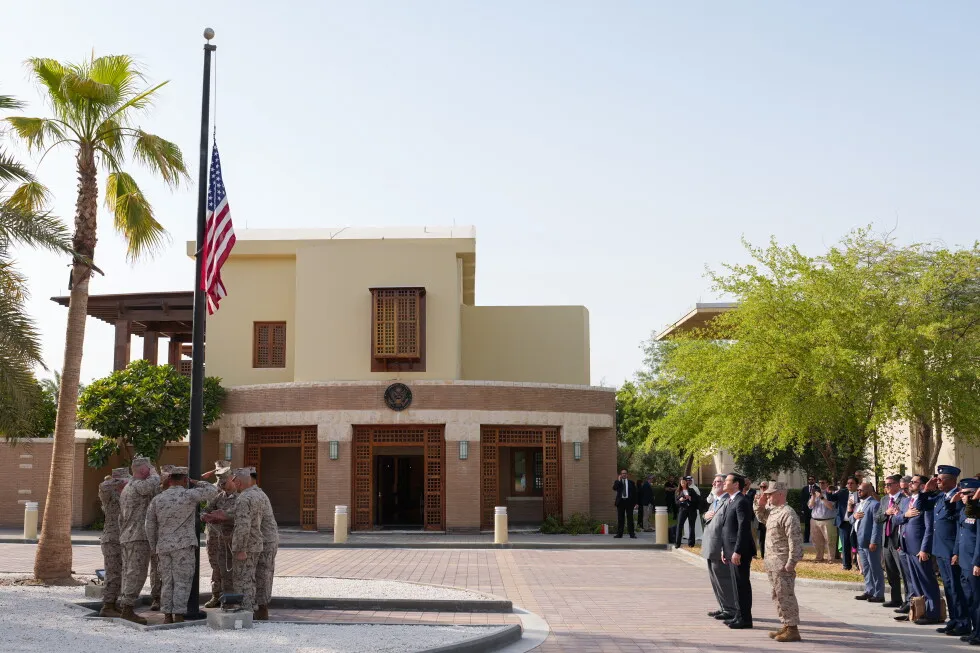
US diplomats and family members slowly begin to return to the Mideast embassies 1 of 4 | U.S. Secretary of State Marco Rubio and Steven Butler, charge d’affaires ad interim of the U.S. embassy in Kuwait, attend a flag raising ceremony at the embassy in Kuwait-city" class="entity-link entity-location" data-entity-id="38325" data-entity-type="location">Kuwait City, Kuwait, June 24, 2026. '(Eric Lee/Pool photo via AP, File) 2 of 4 | A Bahraini armored personnel vehicle and personnel reinforce U.S. Embassy security just outside of a gate to the building, surrounded in barbed wire, in Manama, Bahrain, Aug. 4, 2013.(AP Photo/Hasan Jamali, File) 3 of 4 | Qatar’s police surround the U.S. embassy during a demonstration in Doha, Qatar, Sept. 14, 2012. (AP Photo/Osama Faisal, File) 4 of 4 | This is a locator map for the Gulf Cooperation Council member states: Saudi Arabia, Bahrain, Qatar, Oman, Kuwait and United Arab Emirates. (AP Photo) By MATTHEW LEE Updated 10:41 PM MESZ, August 28, 2026 Add AP News on Google Add AP News as your preferred source to see more of our stories on Google. Share Share Facebook Copy Link copied Print Email X LinkedIn Bluesky Flipboard Pinterest Reddit WASHINGTON (AP) — American diplomats and at least some of their family members are beginning to return to U.S. embassies in the Middle East after many were ordered to leave their posts during the early days of the war with Iran. Although most embassies are not returning to full strength immediately, starting this week the State Department has begun to lift certain staffing and other restrictions on personnel. The changes are not necessarily reflective of a shift in the Trump administration’s policy toward Iran — now focused on economic rather than kinetic military warfare. Instead, the changes are mainly due to the legalities of human resources policy, which limits the time diplomats may be away from post while still being paid and collecting benefits for themselves and their families. On Friday, the day the Iran war hit its six-month mark, embassies in Qatar, Kuwait and Bahrain announced they would allow diplomats’ family members to return, although in Bahrain and Kuwait it applies only to those older than 18. Earlier in the week, all family members of U.S. government employees in Israel, as well as those who are over 21 of those who work in Lebanon, were given the go-ahead to return. These embassies were all placed on “ordered departure” or “authorized departure” status in March as Iran began retaliating for U.S. and Israeli attacks by targeting U.S. interests, including embassies and military facilities, and creating chaotic situations in countries around the region. Israeli strikes kill 5 in Gaza and 3 in West Bank, and other news in the Middle East 5 MIN READ 12 A deal with Iran over the Strait of Hormuz may require a compromise from Trump 5 MIN READ 275 Regional powers seek off-ramp from Iran war, and other Middle East developments 5 MIN READ 275 Ordered departure means that all nonessential personnel and families must leave the country. Authorized departure means that staff deemed nonessential and their families may leave. However, regulations time-limit those statuses, which were beginning to expire six months after being initiated, meaning affected diplomats and their families would be losing their housing and other benefits, creating significant hardships among the workforce. This site is protected by reCAPTCHA and the Google and Terms of Service apply. To deal with this, the State Department created a new status — that of “restricted operations” — which is designed to allow the embassies to resume normal functions. On a case-by-case basis, each affected embassy will make its own determination on appropriate staffing, the presence of families and pay and benefits. Diplomats and their families were ordered to leave embassies in another five countries in the region early in the war, and changes in status at some of them also were anticipated soon. “We remain committed to supporting our workforce and their families throughout this process and will provide updates through appropriate channels as decisions are made,” the department said.
SRCAssociated Press (AP)
LANGEN
LEANCenter
WORDS671
ENT12
FRI · 2026-08-28 · 20:53 GMTBRIEF NSR-2026-0828-106989
NSR-2026-0828-106989News Report·EN·Diplomatic
US diplomats and family members slowly begin to return to the Mideast embassies
U.S. diplomats and some family members are beginning to return to Middle East embassies following an earlier order to leave during the war with Iran.
Associated Press (AP)Filed 2026-08-28 · 20:53 GMTLean · CenterRead · 3 min
Associated Press (AP)FIG 01
Reading time
3min
Word count
671words
Sources cited
0cited
Entities identified
12entities
Quality score
100%
§ 01
Briefing Summary
AI-generatedNEWSAR · AI
U.S. diplomats and some family members are beginning to return to Middle East embassies following an earlier order to leave during the war with Iran. This change, effective this week, is primarily driven by human resources policies that limit the duration diplomats can be away from their posts while maintaining pay and benefits. Embassies in Qatar, Kuwait, and Bahrain have announced that family members can return, with some age restrictions. Previously, all family members of U.S. government employees in Israel and those over 21 in Lebanon were permitted to return. The State Department has introduced a "restricted operations" status to allow embassies to resume normal functions on a case-by-case basis, addressing the expiring "ordered departure" or "authorized departure" statuses that were causing hardship.
Confidence 0.90Claims 4Entities 12
§ 02
Article analysis
Model · rule-basedFraming
Diplomatic
Conflict
Tone
Measured
AI-assessed
CalmNeutralAlarmist
Factuality
0.80 / 1.00
Factual
LowHigh
Sources cited
0
No named sources
FewMany
§ 03
Key claims
4 extracted01
These embassies were all placed on “ordered departure” or “authorized departure” status in March as Iran began retaliating for U.S. and Israeli attacks.
factual
Confidence
0.90
02
Embassies in Qatar, Kuwait and Bahrain announced they would allow diplomats’ family members to return.
factual
Confidence
0.90
03
American diplomats and at least some of their family members are beginning to return to U.S. embassies in the Middle East.
factual
Confidence
0.90
04
The changes are mainly due to the legalities of human resources policy, which limits the time diplomats may be away from post while still being paid and collecting benefits.
factual
Confidence
0.80
§ 04
Full report
3 min read · 671 words§ 05
Entities
12 identifiedKey playerOppositionContextPositiveNeutralNegative
Organizations1
§ 06
Keywords & salience
10 termsmideast embassies
1.00
us diplomats
1.00
iran war
0.90
state department
0.80
ordered departure
0.70
family members
0.60
human resources policy
0.50
kuwait
0.40
bahrain
0.40
qatar
0.40
§ 07
Topic connections
Interactive graph Network visualization showing 51 related topics
View Full Graph Person Organization Location Event|Click node to navigate|Edge numbers = shared articles