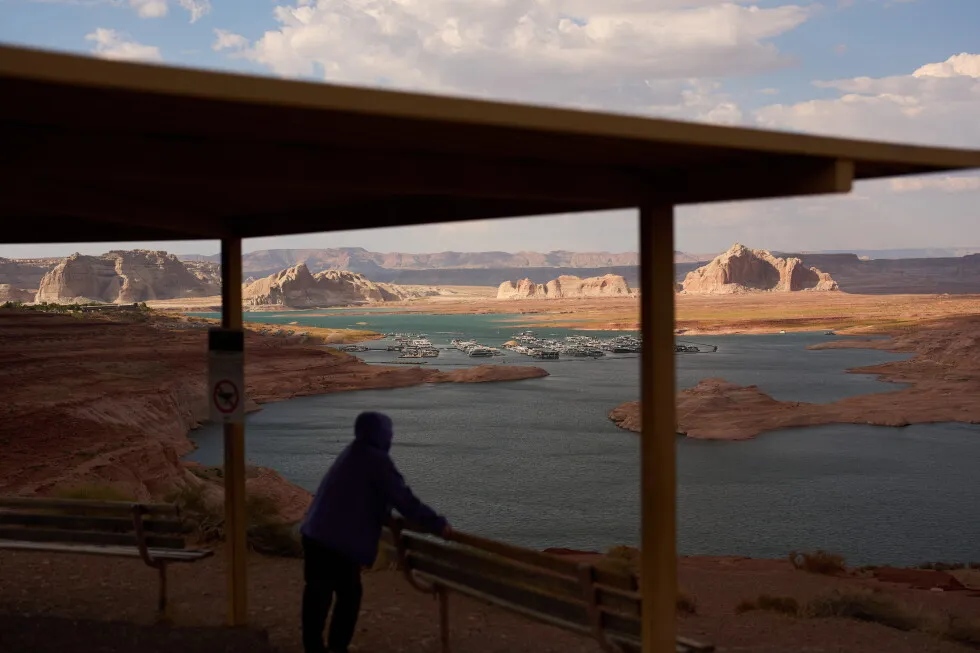
Colorado River plan to cut water amid drought brings uncertainty for cities and farmers 1 of 4 | A person stands at an overlook near the Wahweap Marina on Lake Powell at the Glen Canyon National Recreation Area, July 15, 2026, near Page, Ariz. (AP Photo/John Locher, File) 2 of 4 | The Colorado River flows near the Glen Canyon Dam, July 15, 2026, near Page, Ariz. (AP Photo/John Locher, File) 3 of 4 | Tom Brundy looks over his field that is being prepared for planting near Calexico, Calif., Feb. 28, 2023. (AP Photo/Gregory Bull, File) 4 of 4 | Boats are moored at a marina on Lake Mead amid a droughtnat the Lake Mead National Recreation Area near Boulder City, Nev., June 30, 2026. (AP Photo/John Locher, File) By WUFEI YU and DORANY PINEDA Updated 2:06 PM MESZ, August 29, 2026 Add AP News on Google Add AP News as your preferred source to see more of our stories on Google. Share Share Facebook Copy Link copied Print Email X LinkedIn Bluesky Flipboard Pinterest Reddit Phoenix (AP) — On the outskirts of Phoenix, a small town with a huge reliance on the Colorado River has capped growth, revived old wells and struck water deals. But Cave Creek Mayor Robert Morris can’t shake the real possibility that it’s not enough to keep the desert community of about 5,000 people afloat well into the future. And a recent federal plan to address a deepening crisis in the river basin won’t help. Cave Creek gets nearly all of its water from the river, which serves 40 million people across the U.S. West and has been dwindling because of climate change, demand and overuse. The town already was forced to make cuts this year and it stands to lose more under a new federal plan. Morris likened the situation to planning for a meteor strike. “You can see it coming, but you can’t get out of the way and you don’t know what the damage is going to be,” he said. The uncertainty stretches across seven U.S. states, tribal nations and Mexico. Farmers are deciding which crops are worth the investment. Phoenix could lose some municipal and industrial water for the first time and turn to backup supplies. And residents could face even more costly water. Nevada raised the stakes this week by suing the Interior Department and the U.S. Bureau of Reclamation, saying basic needs in the Las Vegas region will go unmet if the area has to absorb planned reductions of up to 70% of its Colorado River water in the next decade. Federal officials announce water cuts as Colorado River supplies continue to plunge 3 MIN READ Arizona, California and Nevada would share cuts under federal proposal to manage the Colorado River 3 MIN READ Lake Mead hits historic low water level as Colorado River struggles 3 MIN READ The bureau said Thursday it does not comment on litigation. “The uncertainty is going to continue to build in the wrong direction,” said Tom Buschatzke, director of the Arizona Department of Water Resources. In the U.S. West, water is stored primarily in reservoirs, aquifers and snowpacks. But a record snow drought means there’s far less water to recharge those sources. The two largest reservoirs in the country serve as barometers of health for the Colorado River system: Lake Mead and Lake Powell. Both hit record lows this month. Eight other reservoirs operated by the Bureau of Reclamation recently recorded the lowest levels in at least the last 30 years. Among them is Elephant Butte Lake in New Mexico that’s critical for supplying water for crops in southern New Mexico, Texas and Mexico. The Green Mountain Reservoir serves the western part of Colorado, and the Guernsey Reservoir in Wyoming funnels water to farmers in the eastern part of the state and western Nebraska. Under the Bureau of Reclamation’s plan, California, Nevada and Arizona will collectively reduce water use by 1.25 million acre-feet (about 1.54 billion cubic meters) — enough to fill over 600,000 Olympic-sized swimming pools — annually in the next two years, with the possibility of larger cuts depending on conditions. Colorado, Utah, Wyoming and New Mexico are not required to make cuts for now but could voluntarily reduce water. While El Niño could bring intense moisture to the northern Rockies and the Southwest in the coming months, it won’t erase decades of drought. “Drought is a slow-moving phenomena and it can take some time to come into it and also come out of it,” said David Mocko, senior research scientist who authored a recent U.S. Drought Monitor map. John Boelts grows vegetables, melons, durum wheat and other crops in Yuma, Arizona — a region that produces about 90% of leafy greens eaten in North America during the winter. Farmers there have high-priority rights and may avoid cuts to their Colorado River supply over the next two years but, Boelts said, the reprieve isn’t enough to make longer-term plans. That makes farmers reluctant to plant new acreage. Citrus, date and other orchard crops that thrive in the region take years to become commercially productive, he said. “There’s no food that we grow in a hurry,” said Boelts, the Arizona Farm Bureau president. “Beef takes years to produce. The lettuce you eat today? A farmer was working on how they would grow that crop six plus months ago.” Ray Martinez grows alfalfa on a reservation that’s home to the Colorado River Indian Tribes. The tribe holds some of the river’s oldest rights, and while its Arizona allocation is huge, an old irrigation system and the lack of infrastructure have kept much of the water out of reach. Martinez and the water department are concerned about having enough water to finish this growing season. He has left some fields unplanted for years to help prop up Lake Mead. If the reservoir keeps dropping, he said, surface water coming to him and neighboring farms will be further limited. “Unfortunately, Mother Nature has its own way of doing things, and we have no control of that,” he added. The Associated Press receives support from the Walton Family Foundation for coverage of water and environmental policy. The AP is solely responsible for all content. For all of AP’s environmental coverage, visit https://apnews.com/hub/climate-and-environment WUFEI YU Yu covers national news and the Southwest for the Associated Press. He is based in Phoenix. twitter instagram mailto DORANY PINEDA Pineda writes about water, climate and the environment in Latino communities across the U.S. twitter mailto
SRCAssociated Press (AP)
LANGEN
LEANCenter
WORDS1 086
ENT12
SAT · 2026-08-29 · 12:23 GMTBRIEF NSR-2026-0829-107158
NSR-2026-0829-107158News Report·EN·Economic Impact
Colorado River plan to cut water amid drought brings uncertainty for cities and farmers
A new federal plan to cut water usage from the Colorado River amid a deepening drought is creating uncertainty for cities and farmers across the U.S. West.
Associated Press (AP)Filed 2026-08-29 · 12:23 GMTLean · CenterRead · 5 min
Associated Press (AP)FIG 01
Reading time
5min
Word count
1 086words
Sources cited
4cited
Entities identified
12entities
Quality score
100%
§ 01
Briefing Summary
AI-generatedNEWSAR · AI
A new federal plan to cut water usage from the Colorado River amid a deepening drought is creating uncertainty for cities and farmers across the U.S. West. The plan requires Arizona, California, and Nevada to reduce their water use by 1.25 million acre-feet annually over the next two years, with potential for larger cuts. This comes as major reservoirs like Lake Mead and Lake Powell have reached record low levels due to climate change, demand, and overuse. Farmers face difficult decisions about crop investments, while cities like Phoenix could experience municipal and industrial water cuts for the first time. Nevada has filed a lawsuit against the Interior Department, arguing its basic needs will go unmet under the planned reductions. While other states are not mandated to cut water, the long-term drought conditions persist.
Confidence 0.90Sources 4Claims 5Entities 12
§ 02
Article analysis
Model · rule-basedFraming
Economic Impact
Environmental
Tone
Mixed Tone
AI-assessed
CalmNeutralAlarmist
Factuality
0.70 / 1.00
Factual
LowHigh
Sources cited
4
Well sourced
FewMany
§ 03
Key claims
5 extracted01
Arizona, California, and Nevada would share cuts under a federal proposal to manage the Colorado River.
factual
Confidence
1.00
02
Nevada is suing the Interior Department and the U.S. Bureau of Reclamation over planned reductions in Colorado River water.
factual
Confidence
1.00
03
The Colorado River serves 40 million people across the U.S. West and is dwindling due to climate change, demand, and overuse.
factual
Confidence
1.00
04
A new federal plan to address the Colorado River crisis will not help Cave Creek, Arizona, which relies heavily on the river for its water supply.
quoteCave Creek Mayor Robert Morris
Confidence
1.00
05
Residents could face even more costly water due to the Colorado River crisis.
prediction
Confidence
0.80
§ 04
Full report
5 min read · 1 086 words§ 05
Entities
12 identifiedKey playerOppositionContextPositiveNeutralNegative
Organizations1
Locations10
CR
Colorado River
StrategicContext
7x
90
CC
Cave Creek
CityContext
3x
80
LM
Lake Mead National Recreation Area
StrategicContext
70
GC
Glen Canyon National Recreation Area
StrategicContext
70
LP
Lake Powell
StrategicContext
70
P
Phoenix
CityContext
2x
70
N
Nevada
CityContext
60
CC
Calexico, California
CityContext
50
BC
Boulder City, Nevada
CityContext
50
PA
Page, Arizona
CityContext
2x
50
§ 06
Keywords & salience
10 termswater cuts
1.00
colorado river
1.00
drought
0.90
water scarcity
0.80
climate change
0.70
water management
0.60
cities
0.50
farmers
0.50
uncertainty
0.40
water deals
0.40
§ 07
Topic connections
Interactive graph Network visualization showing 14 related topics
View Full Graph Person Organization Location Event|Click node to navigate|Edge numbers = shared articles