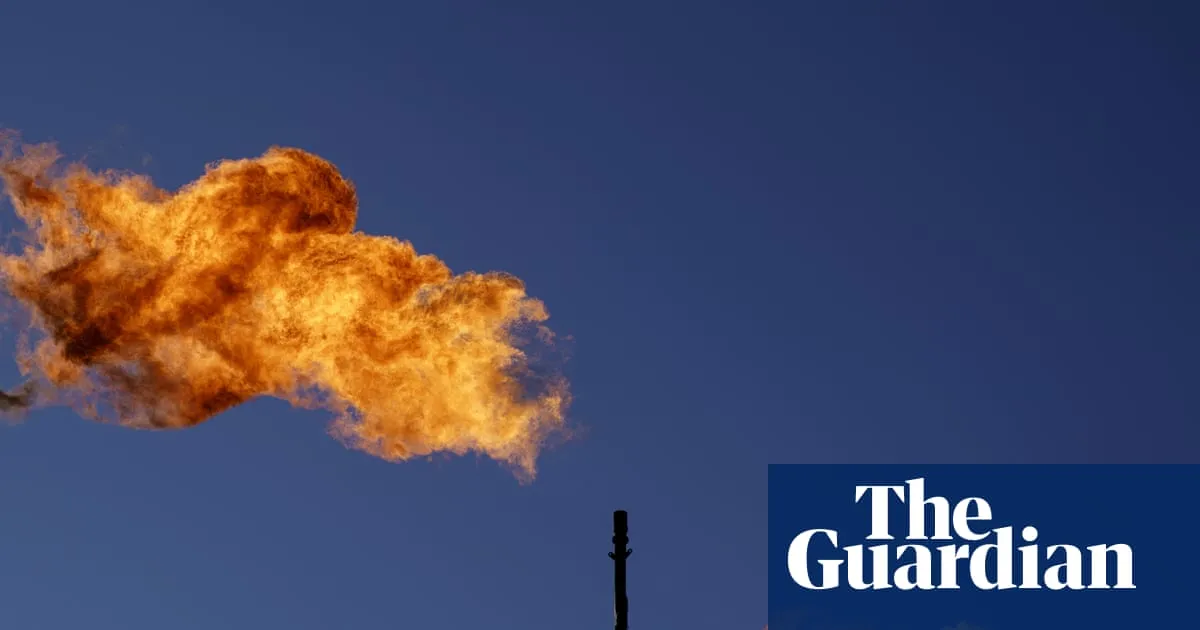
Turkmenistan has started plugging the mega-leaks of Methane that spew from its ageing oil and gas facilities, the latest UN data shows, in a move hailed as a breakthrough.Methane, also called natural or fossil gas, is a potent greenhouse gas. It traps 80 times more heat than carbon dioxide and causes 25% of global heating today. Stopping leaks can be quick and cheap and, because Methane breaks down in the atmosphere far quicker than CO2, this has a rapid impact, with some experts calling it the climate “emergency brake”.The Guardian revealed in 2023 that Turkmenistan was the worst country for Methane mega-leaks. Sources in Turkmenistan said this scrutiny was the “critical step” in leading the secretive and authoritarian government to engage with foreign partners.A “super-emitter” leak, the escape of tonnes of Methane per hour from a single valve or pipeline, heats the planet more than the emissions from a million SUVs or an entire coal-fired power station.Turkmenistan had now stopped eight leaks by repairing corroded pipes, faulty wells and failing flares. The work was an “incredible first step”, said the UN, but much remained to be done.A satellite image of a Methane leak in Turkmenistan's Lebap province, which was plugged in March after a corroded pipe was fixed. Illustration: UNEP’s International Methane Emissions ObservatoryThe UN Methane Alert and Response System (Mars) sent 192 alerts of Methane plumes to Turkmenistan in the last year. The country had three of the six worst leaks detected in the world by Mars in last six months, and nine of the top 50.Turkmenistan responded to about 20% of the alerts with on-the-ground information about the leaks and potential plans to fix them. In contrast, the US was sent the second highest number of alerts – 138 – but responded to none and had fixed no leaks in the last year. Other nations that failed to respond to any alerts were Iran, Russia and China.The worst Methane leak detected was an extraordinary leak in Mexico’s offshore oil and gas industry of 37 tonnes per hour, equivalent to the emissions of more than 7m SUVs. Mexico responded to all 23 Mars alerts in the last year, but had yet to complete a fix.The plugging of leaks in Turkmenistan was encouraging, said Meghan Demeter, the programme manager of Mars, which is part of the UN Environment Programme. “These mitigation cases are a proof point of what can be done with satellite data, especially in situations like Turkmenistan, where there are a lot of detections. We’re seeing that the pipeline of satellite data to mitigation action works, and it can work quite quickly.”“This is a breakthrough in terms of having real documented mitigation action,” she told The Guardian. “But it is not yet a breakthrough in the overall magnitude of emissions. Eight cases is an incredible first step, but there’s also a lot more sources in Turkmenistan that need to be addressed. We are in pretty constant communication and the response rate is growing month by month. We’re seeing steady progress.”A major Methane leak detected in the US in June. Illustration: UNEP’s International Methane Emissions ObservatoryIn March 2023, The Guardian revealed Turkmenistan had the most super-emitting Methane leaks in the world. It then revealed in May that the Methane emissions alone from the nation’s two main fossil fuel fields caused more global heating in 2022 than the entire carbon emissions of the UK, which experts described as both “mind-boggling” and “infuriating”.The findings caused a furore in Turkmenistan, prompting the government to engage with the UN, the EU and other nations and institutions to try to end the leaks, according to sources in the capital, Ashgabat. In December 2023, Turkmenistan joined the global Methane pledge, two years after it had launched.Turkmenistan has huge gas reserves and is a major supplier to China. Previously, leaks were ignored due to the enormous volumes on tap. But in November 2024, the first leak was fixed after a faulty well was repaired. The most recent repair, in March, was to a corroded pipeline. Turkmenistan’s ministry of foreign affairs and state companies Turkmenoil and Turkmengaz did not respond to a request for comment.The most recent Mars data shows Kazakhstan, another former Soviet republic with ageing oil and gas infrastructure, has stopped eight leaks. However, the overall number of leaks in Kazakhstan is smaller, with 38 Mars alerts in the last year.In total, Mars alerts have led to 43 leaks being sealed so far. Many have been straightforward fixes, with leaks plugged on the spot, while others required more planning and funding. One major leak now stemmed in Algeria had been running for almost 40 years, due to a faulty flare. Flares burn unwanted Methane and turn it into CO2, a much less potent greenhouse gas.skip past newsletter promotionafter newsletter promotionThe previous US administration, under President Joe Biden, did engage with Mars and one small leak in New Mexico was fixed in 2024 after a pressure safety valve was repaired. But this engagement ended with the second presidency of Donald Trump. Last year, Trump called climate change “the greatest con job ever perpetrated on the world” at the UN general assembly.Mexico, Brazil and Argentina have 100% response rates to Mars alerts, while Libya and Azerbaijan have high response rates.A Methane leak at Baiji, in Iraq, was stopped in May after a corroded pipe was fixed. Illustration: Methane-emissions-observatory" class="entity-link entity-organization" data-entity-id="197022" data-entity-type="organization">UNEP’s International Methane Emissions Observatory“Turkmenistan and Kazakhstan are home to some of the world’s most significant Methane hotspots and their response to satellite alerts is much-needed good news in the global effort to minimise Methane pollution,” said Dan Grossman, the vice-president at the Environmental Defense Fund.“Stemming Methane emissions from oil and gas operations is the quickest and most cost-effective method to reduce climate pollution available today,” he said. “Alerts only matter if they lead to action, and governments and industry must do a better job.”The UN secretary general, António Guterres, has called for all countries to respond to 80% of alerts.Demeter said: “We’re scaling up a lot in terms of the support that we can offer – knowledge building and technical support – and we are working alongside many partners. There are also a lot of requests for funding for direct mitigation.”The Mars system uses artificial intelligence to analyse data from more than a dozen satellites and detect potential leaks, which are then checked by two layers of review by analysts. Verified leaks are then notified to the relevant government or company. Responses are recorded if they report on-the-ground information and an intention to plug the leak. If a leak is reported as fixed, Mars monitors the site until the data shows emissions have ended before recording it as a success. The Guardian’s climate forum 2026On Tuesday 20 October, join Damian Carrington and our panel of experts, including Prof Andy Haines, Katie White MP, Asad Rehman, Shruti Suresh Gareth Thomas and Amy Fairman, for a hopeful and solutions-focused evening. Book tickets here or at guardian.live
SRCThe Guardian - World News
LANGEN
LEANCenter-Left
WORDS1 155
ENT12
MON · 2026-08-31 · 07:00 GMTBRIEF NSR-2026-0831-107598
NSR-2026-0831-107598News Report·EN·Environmental
‘Breakthrough’ as Turkmenistan starts fixing ‘mindboggling’ methane mega-leaks
Turkmenistan has begun repairing significant methane leaks from its aging oil and gas facilities, a move described as a breakthrough by the UN. These leaks, previously identified by The Guardian as the worst globally, release a potent greenhouse gas that contributes significantly to climate change.
Damian Carrington Environment editorThe Guardian - World NewsFiled 2026-08-31 · 07:00 GMTLean · Center-LeftRead · 5 min
The Guardian - World NewsFIG 01
Reading time
5min
Word count
1 155words
Sources cited
3cited
Entities identified
12entities
Quality score
100%
§ 01
Briefing Summary
AI-generatedNEWSAR · AI
Turkmenistan has begun repairing significant methane leaks from its aging oil and gas facilities, a move described as a breakthrough by the UN. These leaks, previously identified by The Guardian as the worst globally, release a potent greenhouse gas that contributes significantly to climate change. The country has so far fixed eight leaks by repairing corroded pipes and faulty wells, responding to some of the 192 methane plume alerts sent by the UN's Methane Alert and Response System (Mars). While this is an encouraging first step, much more work remains to address the numerous sources of emissions. Turkmenistan's engagement with foreign partners and the UN, prompted by international scrutiny, has led to this progress, with the country joining the global methane pledge in late 2023.
Confidence 0.90Sources 3Claims 5Entities 12
§ 02
Article analysis
Model · rule-basedFraming
Environmental
Diplomatic
Tone
Mixed Tone
AI-assessed
CalmNeutralAlarmist
Factuality
0.80 / 1.00
Factual
LowHigh
Sources cited
3
Well sourced
FewMany
§ 03
Key claims
5 extracted01
Methane traps 80 times more heat than carbon dioxide and causes 25% of global heating.
statisticarticle
Confidence
0.95
02
The UN sent 192 alerts of methane plumes to Turkmenistan in the last year, with the country responding to about 20% of them.
statisticUN Methane Alert and Response System (Mars)
Confidence
0.90
03
Turkmenistan was the worst country for methane mega-leaks in 2023, as revealed by The Guardian.
factualThe Guardian
Confidence
0.90
04
Turkmenistan has started plugging mega-leaks of methane from its oil and gas facilities, according to UN data.
factualUN data
Confidence
0.90
05
Turkmenistan has stopped eight methane leaks by repairing pipes, wells, and flares.
factualUN
Confidence
0.85
§ 04
Full report
5 min read · 1 155 words§ 05
Entities
12 identifiedKey playerOppositionContextPositiveNeutralNegative
Organizations4
Locations6
Topics1
§ 06
Keywords & salience
8 termsmethane leaks
1.00
climate change
0.90
turkmenistan
0.80
greenhouse gas
0.70
un
0.60
oil and gas
0.50
satellite data
0.50
super-emitter
0.40
§ 07
Topic connections
Interactive graph Network visualization showing 14 related topics
View Full Graph Person Organization Location Event|Click node to navigate|Edge numbers = shared articles