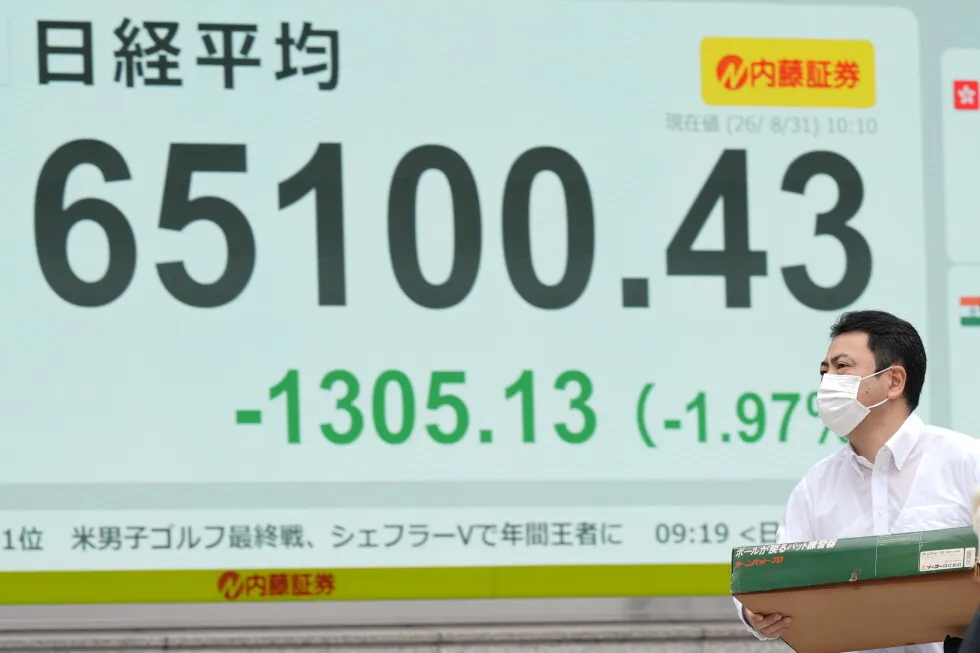
Asian shares, US futures retreat and oil prices surge after US strike on Iranian rocket launchers 1 of 5 | Currency traders work at the foreign exchange dealing room of the Hana Bank headquarters in Seoul, South Korea, Friday, Aug. 28, 2026. (AP Photo/Ahn Young-joon) 2 of 5 | A person walks in front of an electronic stock board showing Japan’s Nikkei index at a securities firm Monday, Aug. 31, 2026, in Tokyo. (AP Photo/Eugene Hoshiko) 3 of 5 | A person walks in front of an electronic stock board showing Japan’s Nikkei index at a securities firm Monday, Aug. 31, 2026, in Tokyo. (AP Photo/Eugene Hoshiko) 4 of 5 | A person walks in front of an electronic stock board showing Japan’s Nikkei index at a securities firm Monday, Aug. 31, 2026, in Tokyo. (AP Photo/Eugene Hoshiko) 5 of 5 | Specialists Dilip Patel works on the floor of the New York Stock Exchange, Thursday, Aug. 27, 2026, in New York. (AP Photo/Yuki Iwamura) By ELAINE KURTENBACH Updated 8:32 AM MESZ, August 31, 2026 Add AP News on Google Add AP News as your preferred source to see more of our stories on Google. Share Share Facebook Copy Link copied Print Email X LinkedIn Bluesky Flipboard Pinterest Reddit BANGKOK (AP) — Shares were mostly lower in Asia and U.S. futures also declined Monday on expectations that the U.S. Federal Reserve may raise interest rates soon. Oil prices surged about 3% after U.S. forces struck Iranian rocket launchers on the Strait of Hormuz, marking their first military action in a month. The Trump administration just days earlier had shifted its focus to economic pressure, and a return to open conflict would be dangerous for the region. Brent crude, the international standard, was up 2.9% at $90.61 per barrel early Monday. U.S. benchmark crude oil jumped 2.7% to $85.66 per barrel. “The Middle East had finally gone quiet enough for oil traders to start sanding some of the war premium out of crude. Then Sunday arrived, with a reminder that quiet in the Strait of Hormuz is not the same as peace,” Stephen Innes of SPI Asset Management said in a commentary. Markets in Asia fell following a speech Friday by Fed Chairman Kevin Warsh that reinforced expectations the U.S. central bank will do what is needed, such as raising rates, to bring inflation down despite possible short-term pain for the economy. The futures for the S&P 500 and the Dow Jones Industrial Average slipped 0.3%. Wall Street drifts at the start of a week that could swing stocks and bonds 4 MIN READ The bond market prepares for a hike to interest rates, while US stocks drift lower 5 MIN READ US stocks rise to a record as oil prices drop and inflation gets less bad 5 MIN READ In Tokyo, the Nikkei 225 lost 0.4% to 66,164.66, while the Kospi in South Korea declined 0.5% to 6,757.67. Hong Kong’s Hang Seng lost 0.4% to 25,479.52 and the Shanghai Composite index gained 0.4% to 3,967.94. Shares in e-commerce and fast fashion giant Shein are due to begin trading in Hong Kong on Tuesday in the city’s biggest initial public offering this year, part of a trend toward big Chinese-founded companies raising funds in Chinese markets. An official survey released Monday showed Chinese factory activity remained in contraction for a second straight month in August, though there were slight improvements in some areas such as new export orders and production. Elsewhere in the region, Australia’s S&P/ASX 200 lost 0.2% to 9,076.80. Taiwan’s Taiex fell 0.4% and the Sensex in India slipped 0.6%. On Friday, the S&P 500 fell 0.2% and the Dow industrials dipped by less than 0.1%. The Nasdaq composite fell 0.5%. In what is seen as a big move for the bond market, the yield on the two-year Treasury, which closely tracks expectations about Fed moves, jumped to 4.35% from 4.22% just before Warsh’s speech at an annual economic symposium held in Jackson Hole, Wyoming. Worries had grown that his tough talk about getting inflation down to the Fed’s 2% target may be just that. The Fed could hike short-term interest rates to get price increases under control, but it could also be reluctant to do so because that would slow the economy and hurt prices for investments. U.S. President Donald Trump, who appointed Warsh, has emphasized he wants lower interest rates. Warsh was adamant again on Friday that he wants to give financial markets fewer clues about what the Fed plans to do with rates for its two jobs of keeping inflation low and the job market strong. But he also said “short-term interest rates are the predominant tool” for the Fed to do its job. Longer-term yields also rose following some initial zigzags, but not by as much as shorter-term yields. The 10-year Treasury yield climbed to 4.72% from 4.67% late Thursday, and the 30-year Treasury yield got to 5.21% from 5.19%. Yields for longer-term bonds have risen this summer, in part because of worries that inflation will remain high. In other dealings early Monday, the U.S. dollar fell to 159.85 Japanese yen from 160.10 yen. It has rebounded after a rare coordinated intervention by the U.S. Treasury and Japanese regulators in late July. ELAINE KURTENBACH Based in Bangkok, Kurtenbach is the AP’s business editor for Asia, helping to improve and expand our coverage of regional economies, climate change and the transition toward carbon-free energy. She has been covering economic, social, environmental and political trends in China, Japan and Southeast Asia throughout her career. twitter mailto
SRCAssociated Press (AP)
LANGEN
LEANCenter
WORDS929
ENT12
MON · 2026-08-31 · 06:53 GMTBRIEF NSR-2026-0831-107611
NSR-2026-0831-107611News Report·EN·Economic Impact
Asian shares, US futures retreat and oil prices surge after US strike on Iranian rocket launchers
Asian shares and U.S. futures declined Monday as markets reacted to expectations of imminent interest rate hikes by the U.S.
Associated Press (AP)Filed 2026-08-31 · 06:53 GMTLean · CenterRead · 4 min
Associated Press (AP)FIG 01
Reading time
4min
Word count
929words
Sources cited
1cited
Entities identified
12entities
Quality score
100%
§ 01
Briefing Summary
AI-generatedNEWSAR · AI
Asian shares and U.S. futures declined Monday as markets reacted to expectations of imminent interest rate hikes by the U.S. Federal Reserve. Oil prices surged approximately 3% following U.S. military strikes on Iranian rocket launchers in the Strait of Hormuz, marking the first such action in a month. These events occurred amidst concerns about regional stability and the Fed's commitment to controlling inflation. Fed Chairman Kevin Warsh's recent remarks reinforced the likelihood of rate increases, despite potential economic slowdown. In Asia, major indices like the Nikkei 225 and Kospi saw losses, while Shanghai Composite experienced a slight gain. Bond yields also rose, particularly for shorter-term Treasuries, reflecting increased anticipation of Fed policy changes.
Confidence 0.90Sources 1Claims 5Entities 12
§ 02
Article analysis
Model · rule-basedFraming
Economic Impact
Conflict
Tone
Mixed Tone
AI-assessed
CalmNeutralAlarmist
Factuality
0.70 / 1.00
Factual
LowHigh
Sources cited
1
Limited
FewMany
§ 03
Key claims
5 extracted01
U.S. benchmark crude oil jumped 2.7% to $85.66 per barrel.
statistic
Confidence
0.95
02
Brent crude was up 2.9% at $90.61 per barrel early Monday.
statistic
Confidence
0.95
03
Oil prices surged about 3% after U.S. forces struck Iranian rocket launchers on the Strait of Hormuz.
factual
Confidence
0.90
04
Asian shares and U.S. futures declined on Monday.
factual
Confidence
0.90
05
Markets in Asia fell following a speech Friday by Fed Chairman Kevin Warsh that reinforced expectations the U.S. central bank will raise rates to bring inflation down.
factual
Confidence
0.85
§ 04
Full report
4 min read · 929 words§ 05
Entities
12 identifiedKey playerOppositionContextPositiveNeutralNegative
People3
Organizations5
§ 06
Keywords & salience
10 termsus strike
1.00
oil prices
1.00
iranian rocket launchers
0.90
strait of hormuz
0.90
asian shares
0.80
us futures
0.80
federal reserve
0.70
interest rates
0.60
economic pressure
0.50
inflation
0.40
§ 07
Topic connections
Interactive graph Network visualization showing 51 related topics
View Full Graph Person Organization Location Event|Click node to navigate|Edge numbers = shared articles