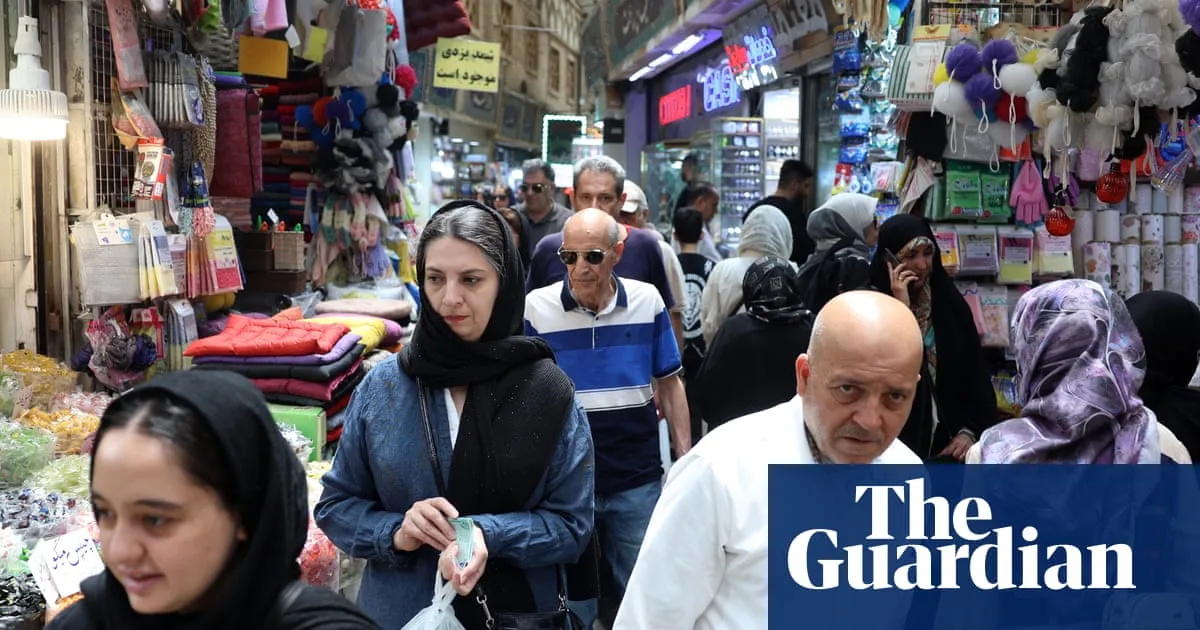
For many Iranians, the new US sanctions campaign, called Operation Economic Outcast, seems superfluous given the grim economic situation in their country.Iranians are facing runaway food inflation, closed petrol stations and a seemingly never-ending depreciation of the nation’s currency caused by a lack of foreign exchange reserves.Vegetable oil in Iran in August cost 383% more than a year ago. The price of eggs rose by 294%, chicken by 177% and red meat by 148%.The cratering economy leaves the country’s political class on edge as they try to prevent economic conditions leading to social chaos.In truth, long before Donald Trump’s latest sanctions push, Iran’s economy had become a parallel battlefield in which the country’s economic commanders were struggling to maintain control.On 23 August, the US dollar reached roughly 2m rials on Iran’s open market, a new record.Three days later, Iran’s statistical centre announced that year-on-year inflation in August reached 84.4%; the rolling annual average rate was about 65%.As purchasing power in Iran collapses, households are buying fewer goods.Diets are changing, clothes are being patched up and repaired rather than replaced, and medicine is in short supply, though it can be found on the hidden market.According to the Mehr news agency, demand for red meat fell by 50% in April 2026 compared with the same period last year. There has also been a leap in the consumption of potatoes, leading to shortages.Basic goods like eggs are now unaffordable to middle- and working-class families, Golshan Fathi, an Iranian feminist, recently said. “They don’t understand that people can no longer afford even a normal life.”Mohsen Zavaar, a biomedical engineer, said: “For part of the population, the issue is no longer buying a house or a car; the issue is cutting out meat, reducing food quality, postponing medical treatment, and scraping by until the end of the month.”Frustrated by the inability of officials to tackle the problems, he added: “The people don’t want miracles – they want decisions.”The crisis has spread beyond food and clothes. Long lines of cars stretched through parts of Tehran and the north-eastern Iranian city of Mashhad on Tuesday and Wednesday as motorists queued for fuel, with some lines blocking entire streets. Many petrol stations, including some of the largest, were closed.Drivers queue outside a petrol station in Tehran on Tuesday. Photograph: Vahid Salemi/APOfficials blamed isolated panic buying caused by rumours of a government-planned price increase, or Israeli bombs that destroyed two of Tehran’s three main oil depots.Inside the government, anxious discussions have been under way for weeks about increasing the price of oil to reduce costly subsidies, but the political class know from past experience that there could be significant pushback. A sudden overnight petrol price rise of 50% in November 2019 sparked week-long violent protests.Public anger has been exacerbated by an admission that vested interests in the government made it hard to tackle fuel smuggling.Saqab Esfahani, deputy to Iran’s president, said: “Both political factions in the country are involved in fuel smuggling, and if I were to shut down their operations, they would break my windows.”Masoud Pezeshkian, Iran’s president, has been urged to investigate the remarks.Iran’s leaders have appealed to the public’s sense of patriotism as they try to weather the country’s economic downturn. Photograph: Abedin Taherkenareh/EPAHowever, transparency over the economic conditions in Iran is likely to decrease.Fatemeh Mohajerani, a spokesperson for the Iranian government, said recently that future poverty statistics would only be published with the permission of the country’s supreme national security council, making the decline in living standards akin to a classified state secret.Iran’s leaders now cast the home front as part of the war against America. Hojatoleslam Taeb, the new head of the Basij paramilitary force and a close ally of Mojtaba Khamenei, Iran’s supreme leader, recently delivered a speech that conjured up an image of resistance against market forces distorted by US sanctions.As part of this war, he said it was necessary to reduce petrol consumption by as much as 10% to reduce the need for expensive imports. Avoiding unnecessary travel would be an act of patriotism, he implied.But these patriotic appeals increasingly have an air of desperation as the economic crisis becomes worse.Mohsen Rezaei, the new, more hardline secretary of the supreme national security council, said: “I advise young people to start producing the products they and society need in their homes, just as they gather in public spaces.”Mohammad Taheri, editor of the economics magazine Tejarat Farda, said the advice reminded him of Mao’s “backyard steel furnaces” during the Great Leap Forward. Mao encouraged people to produce their own steel, with disastrous effect.Amirhossein Hashemi-Javid, an energy expert, said Iran’s true economic crisis was its inability to export oil due to the US blockade. “The channels for selling Iranian oil are drying up.“Oil that cannot reach customers from the well provides no revenue for the Iranian economy; it is simply barrels that incur increasing production, storage and risk costs every day,” he said.At some point, the Iranian government will have to decide if it might achieve more through diplomacy than through continued confrontation.Only six months on from starting a war, after Trump promised protesters in January that help was on its way, the only commodity the US is now offering Iranians is deeper poverty.
SRCThe Guardian - World News
LANGEN
LEANCenter-Left
WORDS870
ENT12
MON · 2026-08-31 · 13:00 GMTBRIEF NSR-2026-0831-107700
NSR-2026-0831-107700News Report·EN·Economic Impact
Iran’s economy in crisis as US launches new sanctions campaign
Iran's economy is facing a severe crisis characterized by soaring food inflation, currency depreciation, and fuel shortages, even before new US sanctions. Vegetable oil prices have risen over 383% year-on-year, with significant increases also seen in eggs, chicken, and red meat.
Patrick Wintour Diplomatic editorThe Guardian - World NewsFiled 2026-08-31 · 13:00 GMTLean · Center-LeftRead · 4 min
The Guardian - World NewsFIG 01
Reading time
4min
Word count
870words
Sources cited
3cited
Entities identified
12entities
Quality score
100%
§ 01
Briefing Summary
AI-generatedNEWSAR · AI
Iran's economy is facing a severe crisis characterized by soaring food inflation, currency depreciation, and fuel shortages, even before new US sanctions. Vegetable oil prices have risen over 383% year-on-year, with significant increases also seen in eggs, chicken, and red meat. The rial has reached record lows against the US dollar, and overall inflation is at 84.4%. These economic hardships are forcing Iranians to reduce consumption, alter diets, and postpone medical treatments. The government is struggling to manage public discontent, with officials admitting internal factions are involved in fuel smuggling. In response, leaders are framing the economic struggle as a patriotic resistance against US sanctions, urging reduced consumption and domestic production.
Confidence 0.90Sources 3Claims 5Entities 12
§ 02
Article analysis
Model · rule-basedFraming
Economic Impact
Political Strategy
Tone
Mixed Tone
AI-assessed
CalmNeutralAlarmist
Factuality
0.70 / 1.00
Factual
LowHigh
Sources cited
3
Well sourced
FewMany
§ 03
Key claims
5 extracted01
Year-on-year inflation in Iran reached 84.4% in August, with a rolling annual average rate of about 65%.
statisticIran's statistical centre
Confidence
1.00
02
The US dollar reached roughly 2 million rials on Iran's open market on August 23rd, a new record.
statistic
Confidence
1.00
03
Vegetable oil prices in Iran increased by 383% in August compared to the previous year.
statistic
Confidence
1.00
04
A 50% petrol price increase in November 2019 sparked week-long violent protests in Iran.
factual
Confidence
0.90
05
Iran is facing runaway food inflation, closed petrol stations, and currency depreciation due to a lack of foreign exchange reserves.
factual
Confidence
0.90
§ 04
Full report
4 min read · 870 words§ 05
Entities
12 identifiedKey playerOppositionContextPositiveNeutralNegative
Organizations1
Locations4
§ 06
Keywords & salience
10 termsus sanctions
1.00
iran economy
1.00
inflation
0.90
currency depreciation
0.80
economic crisis
0.80
food prices
0.70
social chaos
0.60
foreign exchange reserves
0.50
purchasing power
0.50
operation economic outcast
0.40
§ 07
Topic connections
Interactive graph Network visualization showing 51 related topics
View Full Graph Person Organization Location Event|Click node to navigate|Edge numbers = shared articles