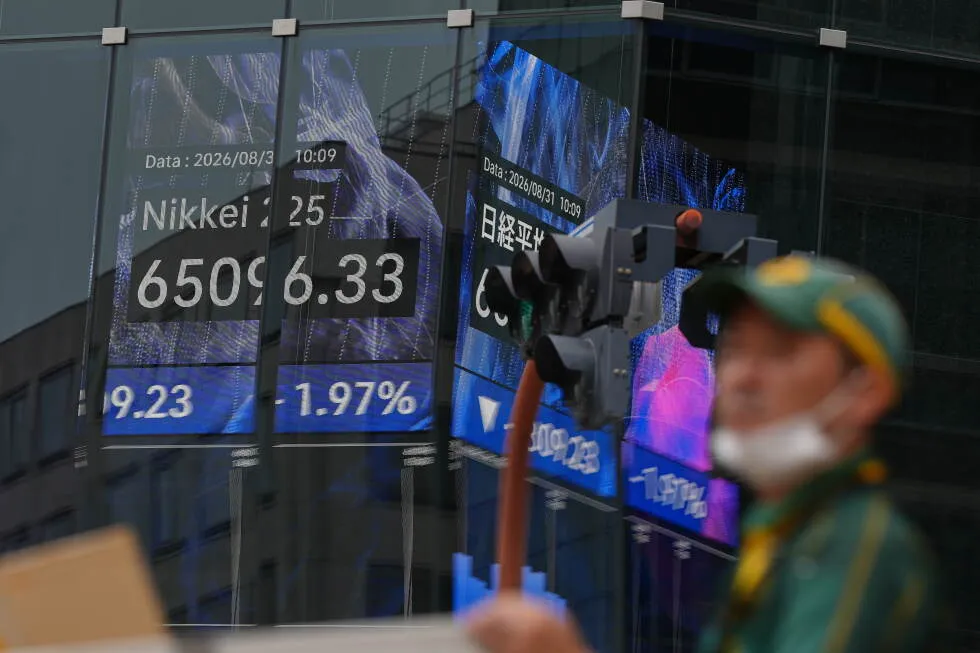
Oil prices rise and stocks waver as Middle East violence flares, adding to uncertainty 1 of 4 | A person walks in front of an electronic stock board showing Japan’s Nikkei index at a securities firm Monday, Aug. 31, 2026, in Tokyo. (AP Photo/Eugene Hoshiko) 2 of 4 | Currency traders watch monitors at the foreign exchange dealing room of the Hana Bank headquarters in Seoul, South Korea, Tuesday, Sept. 1, 2026. (AP Photo/Ahn Young-joon) 3 of 4 | Currency traders watch monitors near a screen showing the Korea Composite Stock Price Index (KOSPI) and the foreign exchange rate between U.S. dollar and South Korean won at the foreign exchange dealing room of the Hana Bank headquarters in Seoul, South Korea, Tuesday, Sept. 1, 2026. (AP Photo/Ahn Young-joon) 4 of 4 | A person walks in front of an electronic stock board showing Japan’s Nikkei index at a securities firm Monday, Aug. 31, 2026, in Tokyo. (AP Photo/Eugene Hoshiko) By ELAINE KURTENBACH Updated 8:41 AM MESZ, September 1, 2026 Add AP News on Google Add AP News as your preferred source to see more of our stories on Google. Share Share Facebook Copy Link copied Print Email X LinkedIn Bluesky Flipboard Pinterest Reddit BANGKOK (AP) — Oil prices climbed further and Asian shares were mixed Tuesday as recurring violence in the Iran war after more than a month with no significant fighting heightened uncertainty over the future of the conflict. Shares in online fast-fashion retailer Shein fell as much as 10% after they began trading in Hong Kong on Tuesday. By midday they were 5% lower. Brent crude gained 0.8% to $91.23 per barrel. It gained 2.7% on Monday after the U.S. attacked rocket launchers on an Iranian island on Sunday, saying they were preparing to launch mines into the Strait of Hormuz. Iran responded by launching missiles at U.S. sites in Jordan, all of which were intercepted. The war has curtailed traffic in the Strait of Hormuz, which once accounted for about 20% of the world’s oil shipments. Oil prices remain high after an initial surge earlier in the war, and that has made everything from gasoline to shipped goods more expensive. U.S. benchmark crude was up 1% at $86.62 per barrel. In Asian share trading, Hong Kong’s Hang Seng fell 0.9% to 25,332.10 and the Shanghai Composite index was nearly unchanged, at 3,985.93. Tokyo’s Nikkei 225 edged 0.2% higher, to 66,420.26, while the Kospi in South Korea added more than 0.2%, to 6,835.51. Oil prices rise and stocks fall after US hits Iranian sites in the Strait of Hormuz 4 MIN READ 185 US stocks edge lower as oil prices rise and more earnings reports roll in 4 MIN READ Regional powers seek off-ramp from Iran war, and other Middle East developments 4 MIN READ The S&P/ASX 200 in Australia slipped 0.1% to 9,066.40. Taiwan’s Taiex picked up 0.2% and the Sensex in India gained 0.3%. Wall Street closed out August on a downbeat note Monday as the S&P 500 index fell 0.3%. The Dow Jones Industrial Average dropped 0.7% and the Nasdaq composite slipped 0.1%. Monday’s losses were broad, with nearly every sector within the benchmark S&P 500 finishing in the red. Edison International slumped 23.1% and PG&E fell 20.1% for the two steepest declines. That followed reports about potential California wildfire legislation that would allow insurers to sue utilities over related claims. But energy stocks notched gains. Exxon Mobil rose 2.7% and Chevron rose 2.1%. Higher energy prices have fueled already stubbornly high inflation, well above the Federal Reserve’s 2% target. That has been weighing on household spending and consumer confidence and given the Fed a more complicated path ahead for its interest rate policy. The yield on the two-year Treasury, which closely tracks expectations about Fed moves, held steady Monday at 4.34%, where it was late Friday. That’s up significantly from about 3.50% at the beginning of 2026. The yield on the 10-year Treasury rose to 4.75% from 4.73% late Friday. That’s back up around the level seen two weeks ago when the Trump administration took the unusual step of announcing it would intervene in the bond market. Any increase to interest rates that could cool inflation also risks hurting the jobs market. Later this week, the U.S. will report August jobs data. In July, the U.S. job market stalled unexpectedly as employers cut 23,000 jobs. Labor Department revisions slashed another 103,000 jobs from May and June payrolls. In other dealings early Tuesday, the U.S. dollar rose to 159.94 Japanese yen from 159.74 yen. The euro slipped to $1.1604 from $1.1619. AP Business Writers Alex Veiga, Damian Troise and Michelle Chapman contributed to this report. ELAINE KURTENBACH Based in Bangkok, Kurtenbach is the AP’s business editor for Asia, helping to improve and expand our coverage of regional economies, climate change and the transition toward carbon-free energy. She has been covering economic, social, environmental and political trends in China, Japan and Southeast Asia throughout her career. twitter mailto
SRCAssociated Press (AP)
LANGEN
LEANCenter
WORDS832
ENT12
TUE · 2026-09-01 · 06:53 GMTBRIEF NSR-2026-0901-107993
NSR-2026-0901-107993News Report·EN·Economic Impact
Oil prices rise and stocks waver as Middle East violence flares, adding to uncertainty
Oil prices increased and Asian stock markets showed mixed performance on Tuesday due to renewed violence in the Iran war, which has heightened uncertainty. Brent crude rose to $91.23 per barrel after the U.S.
Associated Press (AP)Filed 2026-09-01 · 06:53 GMTLean · CenterRead · 4 min
Associated Press (AP)FIG 01
Reading time
4min
Word count
832words
Sources cited
0cited
Entities identified
12entities
Quality score
100%
§ 01
Briefing Summary
AI-generatedNEWSAR · AI
Oil prices increased and Asian stock markets showed mixed performance on Tuesday due to renewed violence in the Iran war, which has heightened uncertainty. Brent crude rose to $91.23 per barrel after the U.S. attacked Iranian rocket launchers on Sunday, leading to Iran launching missiles at U.S. sites in Jordan. The conflict has impacted traffic in the Strait of Hormuz, a key oil shipping route, contributing to sustained high oil prices. In Asian trading, Hong Kong's Hang Seng fell, while Tokyo's Nikkei 225 and South Korea's Kospi saw slight gains. U.S. benchmark crude also climbed. Higher energy costs are contributing to inflation, complicating the Federal Reserve's interest rate policy.
Confidence 0.90Claims 5Entities 12
§ 02
Article analysis
Model · rule-basedFraming
Economic Impact
Conflict
Tone
Measured
AI-assessed
CalmNeutralAlarmist
Factuality
0.90 / 1.00
Factual
LowHigh
Sources cited
0
No named sources
FewMany
§ 03
Key claims
5 extracted01
Brent crude gained 0.8% to $91.23 per barrel.
statistic
Confidence
1.00
02
The war has curtailed traffic in the Strait of Hormuz, which once accounted for about 20% of the world’s oil shipments.
factual
Confidence
0.90
03
Iran responded by launching missiles at U.S. sites in Jordan, all of which were intercepted.
factual
Confidence
0.90
04
The U.S. attacked rocket launchers on an Iranian island on Sunday, saying they were preparing to launch mines into the Strait of Hormuz.
factual
Confidence
0.90
05
Oil prices climbed further and Asian shares were mixed as violence in the Iran war heightened uncertainty.
factual
Confidence
0.90
§ 04
Full report
4 min read · 832 words§ 05
Entities
12 identifiedKey playerOppositionContextPositiveNeutralNegative
Organizations4
Locations6
§ 06
Keywords & salience
10 termsmiddle east violence
1.00
oil prices
1.00
stock market
0.90
strait of hormuz
0.80
iran war
0.80
geopolitical uncertainty
0.70
brent crude
0.60
asian shares
0.50
us attacks
0.50
oil shipments
0.40
§ 07
Topic connections
Interactive graph Network visualization showing 51 related topics
View Full Graph Person Organization Location Event|Click node to navigate|Edge numbers = shared articles