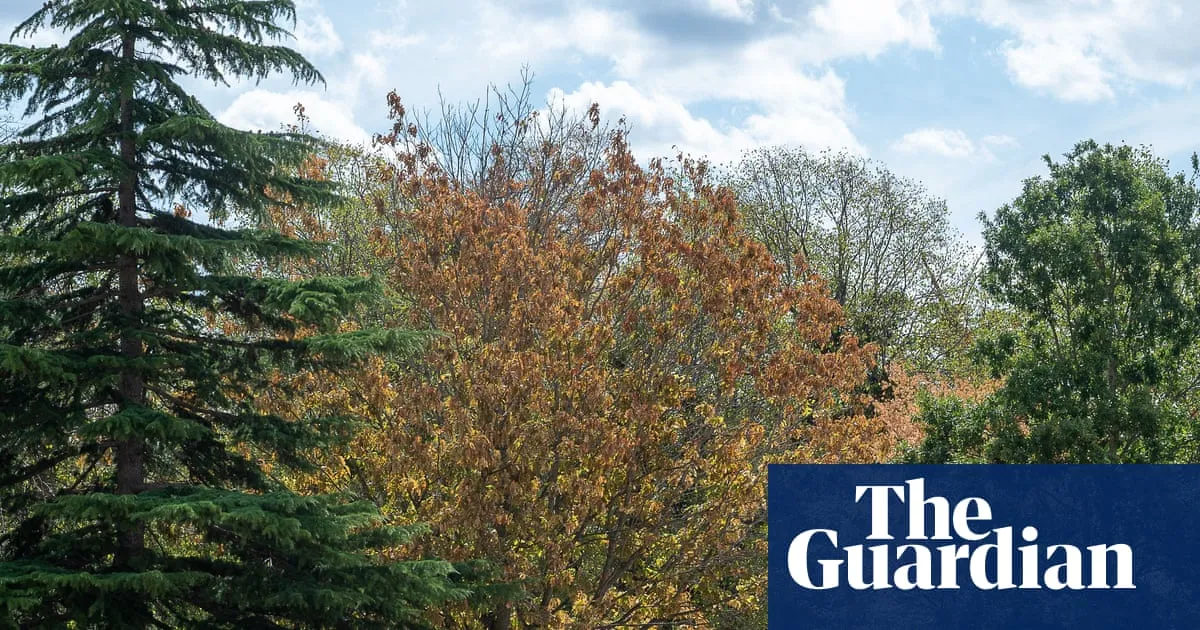
High winds associated with El Niño could cause widespread mortality among tree species already weakened by a prolonged period of extreme heat and drought, experts have warned.This summer much of Europe has been scorched by a series of record-breaking climate crisis-induced heatwaves. The impact is notable across much of England’s countryside, where once green land has turned brown, and many trees are undergoing “early autumn” – wilting and losing their leaves early – to cope with extreme heat.Kevin Martin, head of tree collections at Kew Gardens, said to cope with these extreme conditions, trees had not grown as they normally would, and had become less flexible and more brittle.“If we see the extreme winds that are predicted this year because of El Niño, we’re going to see potentially large impacts on trees,” he said.The UK’s Met Office has said the El Niño event developing over the Pacific Ocean is likely to be the strongest for more than a century, with increased rainfall and storms forecast to hit the UK this autumn. El Niño is a natural phenomena that has been made worse by global heating.Could ‘Godzilla’ El Niño bring the hottest year on record? – video explainerMartin said this extreme weather could lead to root death, where dry weather followed by heavy rain can undermine the structure of the soil.“We could then start to see some trees actually fail at the root plate. I’m really worried about this autumn,” he said.This year’s weather has been so extreme that Martin thinks some species could be lost completely from certain landscapes. “We may lose species like the silver birch, the common beech and oak from landscapes where we’re used to seeing them,” he said.While the impact is widespread, the heat is disproportionately affecting the oldest trees, with experts warning that England’s ancient oaks are dying in the hot and dry weather.Martin said that what made 2026 so unprecedented was the spring heatwave, when temperatures reached 35C, making it the hottest May ever recorded. “The whole growing season this year has been under stress, I don’t think we’ve ever experienced environmental impact like this before,” he said.Simon Richmond, a technical officer at the Arboricultural Association, said trees were extremely resilient organisms, able to adapt to one-off years of extreme weather. However, he said the “danger that we face now is the likelihood with Climate Change of this being a prolonged pattern of weather”.After the 2022 heatwave, Kew Gardens lost more than 400 trees due to heat and drought. Martin thinks the impact of the 2026 heatwave could be much worse.He predicts that at Kew and across the south-east, there will be a “significant amount of mortality”.“From what I can see from the landscape here at Kew, we’re going to see a lot more mortality than what we saw in 2022 because a lot of trees that just got through 2022 are not going to make it through this year.” However, he said the full impact of this year’s extreme weather would not be known for the next two to three years.Marcus Lindner, a principal scientist at the European Forest Institute, said that several years of extreme weather could push certain species over the edge, with almost all tree species at risk from the changing climate.“Species that are normally drought-tolerant are adapted to a certain level of drought stress, but if we have continuous and repeated drought these trees will at some point not be comfortable with that any more,” he said.
SRCThe Guardian - World News
LANGEN
LEANCenter-Left
WORDS578
ENT10
TUE · 2026-09-01 · 14:00 GMTBRIEF NSR-2026-0901-108134
NSR-2026-0901-108134News Report·EN·Environmental
High winds during El Niño could be deadly for England’s stressed trees, say experts
Experts warn that strong El Niño-associated winds this autumn could cause significant tree mortality in England. A prolonged period of extreme heat and drought this summer has weakened trees, making them brittle and less flexible.
Pippa Neill Environment reporterThe Guardian - World NewsFiled 2026-09-01 · 14:00 GMTLean · Center-LeftRead · 3 min
The Guardian - World NewsFIG 01
Reading time
3min
Word count
578words
Sources cited
2cited
Entities identified
10entities
Quality score
100%
§ 01
Briefing Summary
AI-generatedNEWSAR · AI
Experts warn that strong El Niño-associated winds this autumn could cause significant tree mortality in England. A prolonged period of extreme heat and drought this summer has weakened trees, making them brittle and less flexible. This stress, exacerbated by climate change, has caused many trees to enter "early autumn" prematurely. The Met Office forecasts a strong El Niño event with increased rainfall and storms for the UK. This combination of brittle trees and high winds, potentially coupled with root damage from dry weather followed by heavy rain, could lead to widespread tree failure, with some species like silver birch, beech, and oak at risk of local extinction. Ancient oaks are particularly vulnerable, and the full impact may not be evident for several years.
Confidence 0.90Sources 2Claims 5Entities 10
§ 02
Article analysis
Model · rule-basedFraming
Environmental
Public Health
Tone
Mixed Tone
AI-assessed
CalmNeutralAlarmist
Factuality
0.60 / 1.00
Mixed
LowHigh
Sources cited
2
Limited
FewMany
§ 03
Key claims
5 extracted01
Kew Gardens lost more than 400 trees due to heat and drought after the 2022 heatwave.
statisticKew Gardens
Confidence
1.00
02
Trees had not grown as they normally would and had become less flexible and more brittle due to extreme heat.
quoteKevin Martin
Confidence
0.95
03
The El Niño event developing over the Pacific Ocean is likely to be the strongest for more than a century, with increased rainfall and storms forecast to hit the UK this autumn.
predictionUK’s Met Office
Confidence
0.90
04
High winds associated with El Niño could cause widespread mortality among trees already weakened by extreme heat and drought.
predictionexperts
Confidence
0.80
05
Species like silver birch, common beech, and oak could be lost from landscapes where they are commonly seen.
predictionKevin Martin
Confidence
0.70
§ 04
Full report
3 min read · 578 words§ 05
Entities
10 identifiedKey playerOppositionContextPositiveNeutralNegative
Locations4
Events1
§ 06
Keywords & salience
10 termsclimate crisis
1.00
el niño
1.00
tree mortality
0.90
extreme heat
0.80
high winds
0.70
drought
0.60
global heating
0.50
ancient oaks
0.40
kew gardens
0.40
met office
0.40
§ 07
Topic connections
Interactive graph Network visualization showing 47 related topics
View Full Graph Person Organization Location Event|Click node to navigate|Edge numbers = shared articles