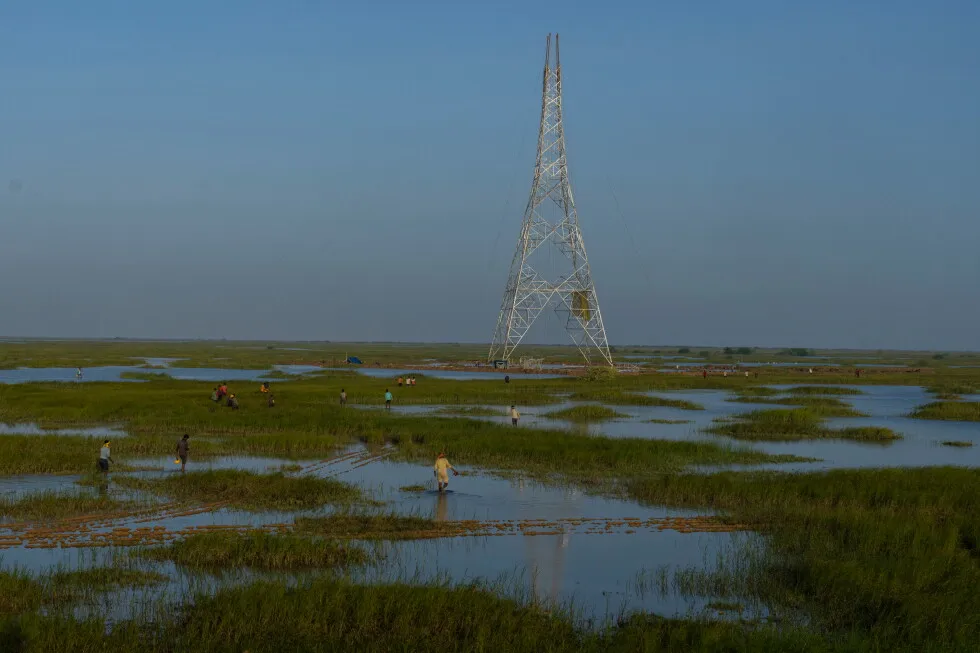
Workers walk through a swamp to install electric transmission towers for the Adani renewable energy Park near Khavda, Bhuj district, near the India-Pakistan border in the western state of Gujarat, India, Sept. 21, 2023. (AP Photo/Rafiq Maqbool, File) Updated [hour]:[minute] [AMPM] [timezone], [monthFull] [day], [year] BENGALURU, India (AP) — When India’s power demand surged at the height of summer, the country struggled to meet evening needs as air conditioners ran longer amid hotter nights. Despite this demand, some renewable energy providers were told to limit their output because the country had more clean electricity available than its grid could safely handle.In the last 15 months, India curtailed nearly 11 terawatt-hours of solar generation — enough electricity to power about 10 million homes, according to government data and research by energy think tank Ember. That solar power went unused even as extreme heat and poor monsoon rains drove up demand for power in India for cooling and pumping groundwater for agriculture. India, the world’s most populous country and one of the largest emitters of climate-polluting gases, is rapidly adding clean energy, especially solar, to its power mix. However, it can’t use all the clean power it could generate because of insufficient transmission and storage capacity and the technical difficulty of shifting between fossil power and renewables. Energy experts say that contradiction points to the next big challenge for India’s energy transition. Building solar and wind farms is no longer enough. India also needs more transmission lines to move electricity across the country, batteries to store renewable power until it is needed and a more flexible power system that can quickly adjust as wind and solar output rises or falls.“We’re in a stage where some of the biggest hurdles in renewables are starting to hit us,” said Neshwin Rodrigues, an energy analyst at Ember. Clean power gets switched off despite record demand Workers install solar panels at the under-construction Adani Green Energy Limited’s renewable energy Park in the salt desert of Karim Shahi village, near Khavda, Bhuj district near the India-Pakistan border in the western state of Gujarat, India, Sept. 21, 2023. (AP Photo/Rafiq Maqbool, File) Workers install solar panels at the under-construction Adani Green Energy Limited’s renewable energy Park in the salt desert of Karim Shahi village, near Khavda, Bhuj district near the India-Pakistan border in the western state of Gujarat, India, Sept. 21, 2023. (AP Photo/Rafiq Maqbool, File) Add AP News on Google Add AP News as your preferred source to see more of our stories on Google. Share India has more than 300 gigawatts of clean power capacity, more than half its total installed electricity capacity. But coal still produces most of the country’s electricity.Experts said the main reason for this is curtailment — when a wind or solar plant could produce electricity but is ordered to reduce or stop generation as the grid cannot take the power.Rodrigues said that when solar generation surges in the afternoon, it’s difficult for coal units to reduce their output because they are relatively inflexible and cannot ramp down quickly without compromising efficiency, increasing costs or risking operational problems. 3 MIN READ 5 MIN READ 2 MIN READ Trying to make thermal power plants flexible and adapt to increasing supply from clean energy sources “is like asking an elephant to dance,” said Vinay Pabba, CEO of Hyderabad-based renewable energy company Vibrant Energy. Pabba said curtailment results in losses for clean power developers. “We get paid only for what we put on the grid,” he said. The high concentration of renewable generation in western India has also meant that transmission lines in that part of the country get congested quickly. The western states of Gujarat and Rajasthan account for nearly 50% of India’s solar power capacity. “When solar peaks, usually in the afternoon, there is a limited pipe to evacuate it,” said Pabba. A motorcyclist ride past wind turbines, an Adani Group project, near Sadla village in Surendranagar district of Gujarat state, India, March 20, 2023. (AP Photo/Ajit Solanki, File) A motorcyclist ride past wind turbines, an Adani Group project, near Sadla village in Surendranagar district of Gujarat state, India, March 20, 2023. (AP Photo/Ajit Solanki, File) Add AP News on Google Add AP News as your preferred source to see more of our stories on Google. Share Another risk of not building storage quickly is that dirty fuels get used more. “Without enough storage, India risks keeping coal plants running even when cheap renewable power is available,” said Vibhuti Garg, South Asia director at the Institute for Energy Economics and Financial Analysis.While a solar or wind farm can sometimes be completed within two years, building new power lines can take a minimum of three years, according to energy experts. India has achieved only about 80% of its annual transmission construction targets over the past five years, research by Ember has found. Spreading more renewable development across other parts of the country, while adding more wind and smaller local solar projects, could reduce pressure on crowded transmission corridors and make the electricity supply more balanced throughout the day, said Disha Agarwal, an energy analyst at the New Delhi-based Council on Energy, Environment and Water.Agarwal said the challenge is likely to become more difficult as renewable capacity keeps rising.India is aiming for 500 gigawatts of clean electricity capacity by 2030. Also, Indian policymakers expect nearly 70% of India’s installed power capacity to come from nonfossil sources by 2036. Batteries could help save power for when it is neededA study released earlier this month by the India Energy and Climate Center at the University of California, Berkeley, found that renewable power backed by batteries can provide electricity with reliability approaching that of conventional power plants at a price researchers said is lower than the price of power from new coal-fired plants.Batteries make it possible to store solar electricity when it is abundant in the afternoon and discharge it after sunset, when demand remains high.But India’s storage sector remains far smaller than what planners said will eventually be required. “If we try to increase the solar installations without solving for energy storage, it is only going to lead to curtailment,” said Ankit Mittal, CEO of battery storage company Ingro Energy. Team leader K. Sridhar, center, closes the doors after a routine check of lithium-ion batteries of 500-kilowatt battery energy storage system in Thiruvallur District, on the outskirts of Chennai, India, July16, 2024. (AP Photo/Mahesh Kumar A., File) Team leader K. Sridhar, center, closes the doors after a routine check of lithium-ion batteries of 500-kilowatt battery energy storage system in Thiruvallur District, on the outskirts of Chennai, India, July16, 2024. (AP Photo/Mahesh Kumar A., File) Add AP News on Google Add AP News as your preferred source to see more of our stories on Google. Share Mittal said India is trying to transform several parts of its electricity system simultaneously as power demand rises. “Things that were supposed to happen over decades” are now happening at once, he said.The government said in July that it had about 3 gigawatts of battery storage and 7.4 gigawatts of operational pumped-storage capacity. It expects India’s storage needs to reach about 74 gigawatts by 2032. “If high quality energy storage projects are not built, we could be adding an additional layer of risk to grid operations while also decelerating our nation’s ability to achieve our energy transition targets,” said Avinash Rao, CEO of Mahindra Susten, a leading renewable energy company in India.Rodrigues, the energy analyst, said batteries can be built much more quickly than major transmission infrastructure, making them one of the fastest options for easing some immediate constraints.Industry stakeholders said that few, if any, foresaw the incredible increase in demand happening as the country’s transportation and other major sectors electrify and data centers are built.“None of us saw it coming. If we had seen it coming, we would have probably planned our way around it,” said Pabba of Vibrant Energy.___Sibi Arasu can be followed on X at @sibi123. Reach him at [email protected].___The Associated Press’ climate and environmental coverage receives financial support from multiple private foundations. AP is solely responsible for all content. Find AP’s standards for working with philanthropies, a list of supporters and funded coverage areas at AP.org. Sibi reports on climate change from India and South Asia
SRCAssociated Press (AP)
LANGEN
LEANCenter
WORDS1 379
ENT12
WED · 2026-09-02 · 01:53 GMTBRIEF NSR-2026-0902-108301
NSR-2026-0902-108301News Report·EN·Technology
India’s power demand is surging, but some solar energy is going to waste
India is facing a paradox where surging power demand, driven by extreme heat, coincides with the curtailment of renewable energy. Despite having ample solar capacity, the country is unable to utilize all of its clean electricity due to insufficient transmission and storage infrastructure.
By
SIBI ARASUAssociated Press (AP)Filed 2026-09-02 · 01:53 GMTLean · CenterRead · 6 min
Associated Press (AP)FIG 01
Reading time
6min
Word count
1 379words
Sources cited
1cited
Entities identified
12entities
Quality score
100%
§ 01
Briefing Summary
AI-generatedNEWSAR · AI
India is facing a paradox where surging power demand, driven by extreme heat, coincides with the curtailment of renewable energy. Despite having ample solar capacity, the country is unable to utilize all of its clean electricity due to insufficient transmission and storage infrastructure. In the past 15 months, nearly 11 terawatt-hours of solar generation were wasted, enough to power millions of homes. Experts highlight the need for expanded transmission lines, battery storage, and a more flexible power system to integrate renewables effectively. The inflexibility of existing coal plants and congestion in transmission corridors, particularly in western India, contribute to this issue, potentially leading to continued reliance on fossil fuels.
Confidence 0.90Sources 1Claims 4Entities 12
§ 02
Article analysis
Model · rule-basedFraming
Technology
Environmental
Tone
Measured
AI-assessed
CalmNeutralAlarmist
Factuality
0.80 / 1.00
Factual
LowHigh
Sources cited
1
Limited
FewMany
§ 03
Key claims
4 extracted01
India curtailed nearly 11 terawatt-hours of solar generation in the last 15 months.
statisticgovernment data and research by energy think tank Ember
Confidence
1.00
02
India has more than 300 gigawatts of clean power capacity, more than half its total installed electricity capacity.
statistic
Confidence
0.90
03
India needs more transmission lines, batteries, and a more flexible power system for its energy transition.
factualEnergy experts
Confidence
0.90
04
Some renewable energy providers were told to limit their output because the country had more clean electricity available than its grid could safely handle.
factual
Confidence
0.90
§ 04
Full report
6 min read · 1 379 words§ 05
Entities
12 identifiedKey playerOppositionContextPositiveNeutralNegative
Organizations3
§ 06
Keywords & salience
10 termspower demand
1.00
solar energy
1.00
renewable energy
0.90
energy transition
0.80
grid capacity
0.70
transmission lines
0.70
curtailed generation
0.60
energy storage
0.60
climate change
0.50
india
0.50
§ 07
Topic connections
Interactive graph Network visualization showing 51 related topics
View Full Graph Person Organization Location Event|Click node to navigate|Edge numbers = shared articles