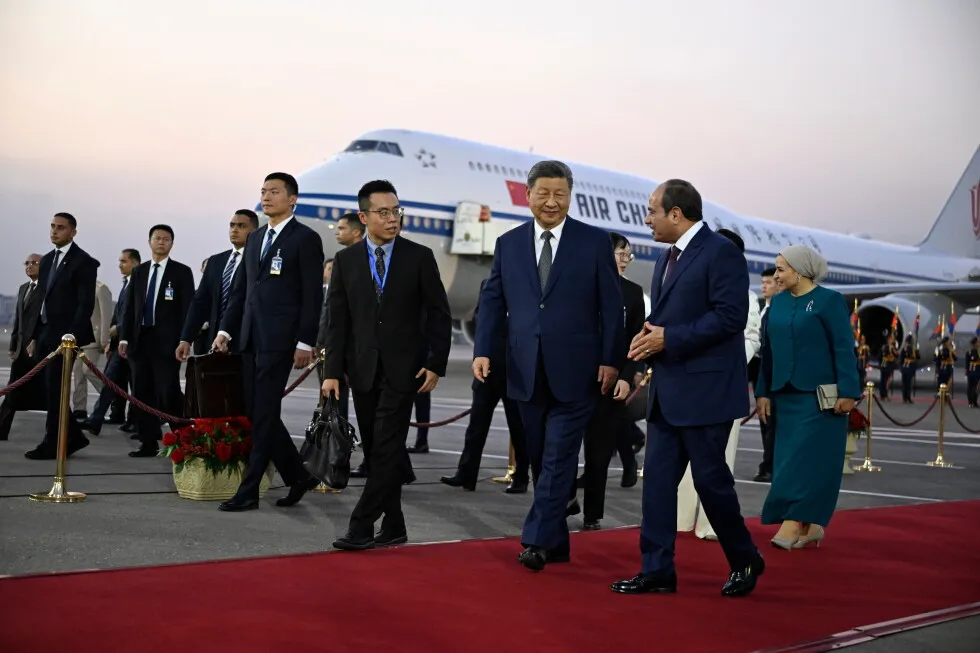
Xi visits Egypt as China seeks deeper influence across the Mideast 1 of 5 | Chinese President Xi Jinping, third from right, is welcomed by Egyptian President Abdel-Fattah el-Sissi, second from right, followed by their wives Peng Liyuan, covered, and Entissar Amer, right, at Cairo International Airport in Cairo, Egypt, Tuesday, Sept. 1, 2026. (Khaled Desouki/Pool Photo via AP) 2 of 5 | Artists perform as Chinese President Xi Jinping, centre left, is welcomed by Egyptian President Abdel-Fattah el-Sissi, centre, at Cairo International Airport in Cairo, Egypt, Tuesday, Sept. 1, 2026. (Khaled Desouki/Pool Photo via AP) 3 of 5 | Chinese President Xi Jinping, left, and his wife Peng Liyuan, covered, is welcomed by Egyptian President Abdel-Fattah el-Sissi, right, and his wife Entissar Amer, at Cairo International Airport in Cairo, Egypt, Tuesday, Sept. 1, 2026. (Khaled Desouki/Pool Photo via AP) 4 of 5 | Chinese President Xi Jinping, centre, is welcomed by Egyptian President Abdel-Fattah el-Sissi, right, at Cairo International Airport in Cairo, Egypt, Tuesday, Sept. 1, 2026. (Khaled Desouki/Pool Photo via AP) 5 of 5 | Chinese President Xi Jinping, top left, and his wife Peng Liyuan are welcomed by Egyptian President Abdel-Fattah el-Sissi, bottom centre right, and his wife Entissar Amer, at Cairo International Airport in Cairo, Egypt, Tuesday, Sept. 1, 2026. (Khaled Desouki/Pool Photo via AP) By SAMY MAGDY Updated 3:57 AM MESZ, September 2, 2026 Add AP News on Google Add AP News as your preferred source to see more of our stories on Google. Share Share Facebook Copy Link copied Print Email X LinkedIn Bluesky Flipboard Pinterest Reddit CAIRO (AP) — On the surface, Chinese President Xi Jinping’s visit to Egypt this week is a run-of-the-mill opportunity for two countries to strengthen economic and diplomatic ties. But there is deep subtext to the meeting between Xi and Egyptian President Abdel Fattah el-Sissi: China, the United States’ top global rival, is cultivating an extensive relationship with one of America’s key allies in the Middle East as it moves to expand its influence in the rapidly changing region. Xi aims to present China as a stabilizer in the region and contrast it with the United States, which for decades has been militarily entangled there — its six-month war with Iran being just the latest example. “China continues to build up its soft power reserves while the United States self-sabotages its own stock,” Amr Hamzawy, director of the Washington-based Carnegie Middle East Program, wrote in a paper earlier this year along with Kathryn Selfe, a former fellow at the program. Xi arrived Tuesday evening at the Cairo airport, which was adorned with Chinese and Egyptian flags. El-Sissi and military guards greeted him on the tarmac with a red-carpet ceremony. The leaders are scheduled to hold talks on Wednesday, and Xi plans to visit the Grand Egyptian Museum, near the pyramids of Giza. Trump’s new economic squeeze on Iran has a big challenge: China 4 MIN READ 51 Iran security chief threatens neighbors against economic measures, and other Mideast developments 19 MIN READ Iran scrambles to sustain trade as US threatens to sanction countries that refuse to break ties 19 MIN READ It has been a while since Xi has visited the Mideast Xi will be in Egypt for three days. It is his first visit there in a decade, and his first trip to the region since visiting Saudi Arabia in 2022. El-Sissi has visited China multiple times in recent years. The leaders marked 70 years of diplomatic ties by publishing friendly opinion pieces Tuesday in Egypt’s state-run newspapers. Xi wrote that Beijing and Cairo should “expand the scope of pragmatic collaboration” through development. El-Sissi lauded China’s investments in Egypt and reiterated Cairo’s support of China’s claim that Taiwan is part of its territory. Egypt views its growing relationship with China as a way to diversify its strategic partnerships. In 2023, Egypt was invited to join the BRICS bloc of nations, a grouping of major emerging economies that includes Brazil, Russia, India, China and South Africa and is seen as a counterbalance to Western-led institutions such as the G7. A year later, Egypt signed agreements with China to collaborate on its Belt and Road Initiative, a signature policy of Xi’s that seeks to build power and transportation infrastructure around the world. China has invested more than $10 billion in Egypt, building a business hub east of the capital, Cairo, and an electric rail line for industry in the Nile Delta. Annual trade between the two countries is estimated at $20 billion, according to government figures. Trade between the U.S. and Egypt was $15.7 billion in 2025. Egypt is a crucial partner in U.S. national security priorities in the region, and the countries’ leaders enjoy close ties. China has been trying to build bridges between Mideast nations In 2023, Beijing brokered a deal to reestablish diplomatic ties between Iran — its most important regional ally and oil supplier — and Saudi Arabia, a longtime U.S. ally. The agreement showcased China’s aspirations to compete with the United States for influence in the Mideast. Since then, ties between Riyadh and Tehran have frayed. Iran attacked Saudi Arabia and other Gulf countries as part of its retaliation against the U.S. and Israel, which launched the war on Feb. 28. China has cast itself as a regional mediator in other ways. It has long advocated a two-state solution to the Israeli-Palestinian conflict, which is seen by the Arab world as a linchpin to regional stability. Shortly before Hamas militants attacked Israel in 2023 and launched the war in Gaza, Xi had hosted Palestinian President Mahmoud Abbas and announced a “strategic partnership” with the Palestinian Authority. The Suez Canal is a vital alternative to the Strait of Hormuz With oil shipments through the Strait of Hormuz heavily disrupted by the Iran war, the Suez Canal — which is controlled by Egypt — has become an important alternative path for getting energy supplies out of the region. “China has good reason to strengthen ties with the country that controls the route still open,” said Muhammad Zulfikar Rakhmat, a Middle East expert with Jakarta’s Center of Economic and Law Studies. Xi views Egypt “as a base to reach the wider Arab and African world, at a time when the U.S. has less attention to spare there,” said Rakhmat. In August, China and Egypt held a multiday air exercise at several bases across Egypt — the first-ever combat exercise for China’s J-16 fighter jets and Egypt’s French-made Rafale fighters. Xi is visiting Cairo after attending a two-day conference of the 10-nation Shanghai Cooperation Organization, a political and security group billed as a counterweight to U.S. global influence. The leaders of Russia, India, Pakistan and Iran attended the conference in Kyrgyzstan’s capital, Bishkek. The trip also comes on the heels of the Trump administration’s “economic onslaught” on Iran’s financial connections around the world. The sanctions aim to isolate the Islamic Republic from its remaining economic partners, including China, which buys more than 80% of Iranian oil shipments, usually through indirect channels. Beijing says its trade with Iran has always abided by international law. Associated Press writers Noha el-Hennawy in Cairo and Huizhong Wu in Bangkok contributed to this report. SAMY MAGDY Magdy is a Middle East reporter for The Associated Press, based in Cairo. He focuses on conflict, migration and human rights abuses. twitter facebook mailto
SRCAssociated Press (AP)
LANGEN
LEANCenter
WORDS1 228
ENT11
WED · 2026-09-02 · 01:23 GMTBRIEF NSR-2026-0902-108304
NSR-2026-0902-108304News Report·EN·Political Strategy
Xi visits Egypt as China seeks deeper influence across the Mideast
Chinese President Xi Jinping visited Egypt, marking his first trip to the Middle East in years. The visit, ostensibly to strengthen economic and diplomatic ties, is seen as China's effort to expand its influence in the region and present itself as a stabilizer, contrasting with perceived U.S.
Associated Press (AP)Filed 2026-09-02 · 01:23 GMTLean · CenterRead · 5 min
Associated Press (AP)FIG 01
Reading time
5min
Word count
1 228words
Sources cited
1cited
Entities identified
11entities
Quality score
100%
§ 01
Briefing Summary
AI-generatedNEWSAR · AI
Chinese President Xi Jinping visited Egypt, marking his first trip to the Middle East in years. The visit, ostensibly to strengthen economic and diplomatic ties, is seen as China's effort to expand its influence in the region and present itself as a stabilizer, contrasting with perceived U.S. entanglement. During his three-day stay, Xi met with Egyptian President Abdel Fattah el-Sissi, with both leaders expressing a desire to expand pragmatic collaboration. Egypt views its growing relationship with China, including participation in BRICS and the Belt and Road Initiative, as a way to diversify its strategic partnerships. China has invested significantly in Egypt, with annual trade between the two nations estimated at $20 billion. This visit occurs amidst ongoing U.S. sanctions on Iran and disruptions to oil shipments through the Strait of Hormuz, increasing the importance of Egypt's Suez Canal.
Confidence 0.90Sources 1Claims 5Entities 11
§ 02
Article analysis
Model · rule-basedFraming
Political Strategy
Diplomatic
Tone
Measured
AI-assessed
CalmNeutralAlarmist
Factuality
0.70 / 1.00
Factual
LowHigh
Sources cited
1
Limited
FewMany
§ 03
Key claims
5 extracted01
Xi Jinping arrived in Cairo on Tuesday evening and was greeted with a red-carpet ceremony.
factual
Confidence
1.00
02
China continues to build up its soft power reserves while the United States self-sabotages its own stock.
quoteAmr Hamzawy
Confidence
1.00
03
Chinese President Xi Jinping is visiting Egypt to strengthen economic and diplomatic ties.
factual
Confidence
1.00
04
Xi aims to present China as a stabilizer in the region, contrasting with the US's military entanglements.
factual
Confidence
0.90
05
China is expanding its influence in the Middle East by cultivating relationships with US allies like Egypt.
factual
Confidence
0.90
§ 04
Full report
5 min read · 1 228 words§ 05
Entities
11 identifiedKey playerOppositionContextPositiveNeutralNegative
People5
Organizations1
§ 06
Keywords & salience
9 termschina influence
1.00
middle east
0.90
xi jinping
0.80
egypt
0.80
us rival
0.70
diplomatic ties
0.60
economic ties
0.60
soft power
0.50
regional stability
0.40
§ 07
Topic connections
Interactive graph Network visualization showing 51 related topics
View Full Graph Person Organization Location Event|Click node to navigate|Edge numbers = shared articles