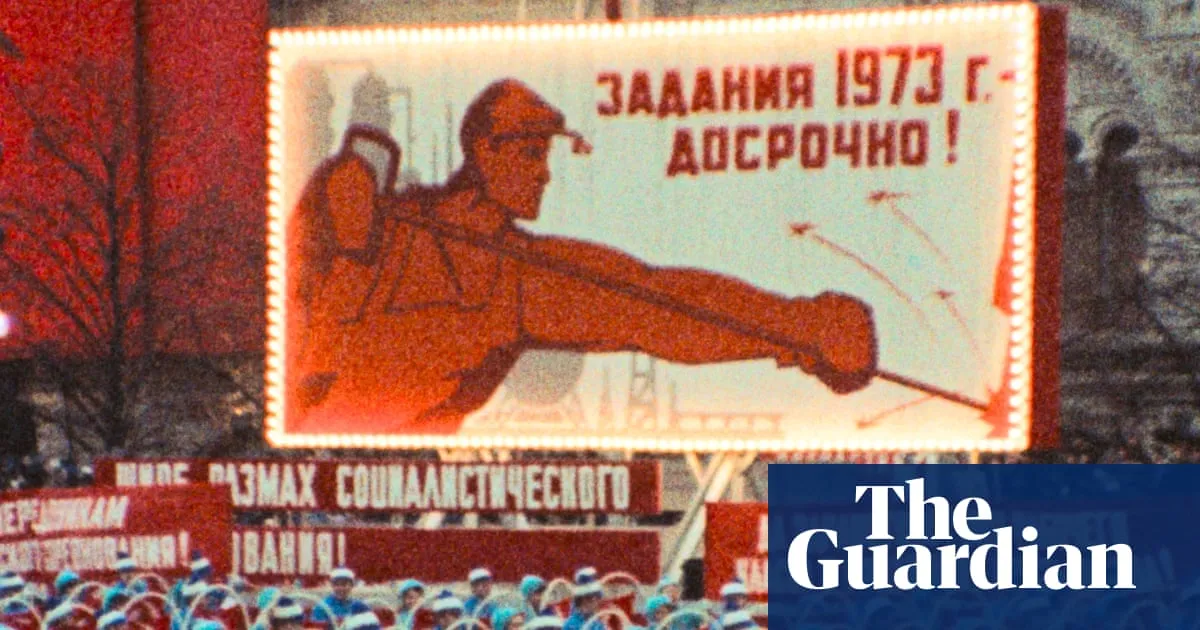
One of Ukraine’s most acclaimed film-makers has criticised the European Commission’s decision to cut off funds to the Venice Biennale over the opening of Russia’s pavilion, likening it to “a punishment in kindergarten”.The Biennale drew heavy criticism this spring when it allowed Russia to use its pavilion for the first time since 2022, despite the ongoing full-scale invasion of Ukraine.Speaking on the eve of the Biennale’s cinematic branch, the Venice film festival, the director Sergei Loznitsa said that while he would “never ever” personally visit the Russian pavilion, the row was a distraction from the EU’s own failure to enforce more effective economic sanctions against Moscow.“The question I ask myself is this: can the existence of this Russian pavilion stop this war or not?” said Loznitsa, who won wide acclaim for his 2014 documentary Maidan and last year’s Soviet-set drama Two Prosecutors, and is showing his new film Imperium out of competition on the Lido this year.Loznitsa’s new documentary Imperium uses archival footage from the early 1970s filmed in the former Soviet Union. Photograph: Essential Filmproduktion, Kino Produzioni, Société Parisienne de Production, Studio Uljana Kim - footage courtesy of AAMODHe added: “What I do know is that in the second quarter of this year, European companies imported gas from Russia at unprecedented levels, and all that money goes straight into bombs that fall on Ukraine.”According to the EU’s Agency for the Cooperation of Energy Regulators, European imports of Russian liquified fossil gas increased by 17% compared with the same period in 2025, before a full EU-wide ban on Russian gas from 2027.Loznitsa said: “This is a much more serious issue than whether there is a Russian pavilion in Venice or not. Cutting off funding to the Biennale is like a punishment in kindergarten.”While the Russian pavilion’s exhibition The Tree is Rooted in the Sky was only accessible during the pre-opening vernissage dates and has been closed to the public since 9 May, the European Commission confirmed last month that it was terminating its €2m (£1.7m) multiyear grant to the Biennale Foundation.The row is now also threatening to engulf the Venice film festival, which has a degree of institutional independence from the Biennale but will be directly affected by the funding cut.The Biennale’s management said the terminated grant used to co-finance the activities of the cinema department relating to Biennale College and the Venice Production Bridge affects “activities and a department that have nothing to do with Russia’s participation in the Biennale Arte”.In a confrontational speech before the announcement of this year’s lineup, the Biennale’s president, Pietrangelo Buttafuoco, accused the commission of “abandoning our journey”. The Biennale, he said, was not engaged in politics but “international research in the field of arts”.The president of the Venice Biennale, Pietrangelo Buttafuoco, has led the criticism of the commission’s decision. Photograph: Stefano Mazzola/Getty ImagesFor a festival that has in the past often looked more focused on attracting celebrity glitz than its competitors in Cannes and Berlin, this year’s programme is noteworthy for its political flavour and thematic focus on Russia and the countries in its sphere of influence.As well as Loznitsa’s Imperium, there is the French director Alexandre Smia’s geopolitical “disaster movie” Jupiter, in which the Russian president has survived an assassination attempt for which he blames Ukraine and seeks retribution. Andrei Kutsila’s animated documentary Letters from the Silenced Country focuses on political repression in Belarus, while the Russian-born American film-maker Julia Loktev’s five-hour documentary My Undesirable Friends: Part II – Exile follows a group of Russian dissident journalists working for the independent television channel TV Rain after they are forced to flee their country in the wake of the full-scale invasion.My Undesirable Friends: Part II – Exile stars Ksenia Mironova, left, and Valeria Ratnikova. Photograph: Courtesy Venice Film FestivalLoktev’s film circles around the question of where art and journalism stops and propaganda begins. In one scene, the journalists working for TV Rain find themselves chastised for continuing to speak of “our army” after they have registered the network in Latvia. “It’s a film about when your country does terrible things, how to take accountability,” said Loktev. “How do you speak as a citizen of your country about the awful actions and the crimes your country is committing?”The inclusion of another Russian-themed film project, Ilya Khrzhanovsky’s Dau, has brought criticism from Ukrainian authorities. The Ukrainian ministry of foreign affairs raised “profound concern” over Khrzhanovsky’s film, which tells the story of the Soviet physicist who reluctantly contributed to the creation of the first atomic bomb.“Russia has long used culture as an instrument of state policy and hybrid warfare,” the ministry said in a statement. “For the Kremlin, culture is a way to restore to sanctioned figures the respectability that politics has taken from them; to legitimise its presence where tanks cannot reach; and to appropriate the history of the very lands it seeks to erase.”skip past newsletter promotionafter newsletter promotionThe ministry said that the multi-film Dau project, once described as a “Stalinist Truman Show”, has received funding from the Russian businessman Sergey Adonyev, who has been sanctioned by the US and Ukraine, and that its Greek-born protagonist Teodor Currentzis accepted Russian citizenship granted by Putin.A still from Imperium. Photograph: Essential Filmproduktion, Kino Produzioni, Société Parisienne de Production, Studio Uljana Kim - footage courtesy of AAMODBut in a social media post, the Venice film festival’s artistic director, Alberto Barbera, rejected the description of Dau, which was principally shot from 2008 to 2011, as a “Kremlin-financed project”: “[It] is not a Russian film; it is not pro-Putin propaganda,” he said. “It is a film that denounces totalitarian regimes and their intrusion into citizens’ lives to restrict their freedom.”Unlike at the Venice art biennial, directors showing their work at the film festival do not represent a country. Dau was funded by Germany, France and Sweden, while My Undesirable Friends was made in the US and Loznitsa’s Imperium has received financial support from Germany, Italy, France and Lithuania.The comments on the festival row by the Belarus-born, Ukraine-raised and now Germany-based Loznitsa are striking, not least because his own submission to the festival applies a strongly critical lens to the internal contradictions of Russian imperialism, the role of cultural propaganda and blindspots in how the Soviet Union used to be seen from the west – specifically from Italy.The three-hour film is solely based on archival footage shot by a group of Italian film-makers who, thanks to the blessing of the Italian Communist party, were allowed to make three filming expeditions to the Soviet Union between 1970 and 1973.The footage used to make Imperium was shot by Italian film-makers on an officially sanctioned visit. Photograph: Essential Filmproduktion, Kino Produzioni, Société Parisienne de Production, Studio Uljana Kim - footage courtesy of AAMODWith filming strictly supervised by KGB handlers, the footage they amassed was meant to project the unity of the Soviet empire, showing a sea of red flags on Moscow streets as the patriotic anthem Wide is My Motherland blares from speakers.Yet the further the crew travels into the outer reaches of the Soviet Union, the more the ambiguous the images become. Local customs, from throat singing to reindeer racing to village wrestling competitions, emphasise the disparity rather than the unity of Soviet culture. In the Yakut Autonomous Soviet Socialist Republic, local people watch on with visible scepticism as a group of urban young Russians parade through the streets with guitars and fiddles.“I wanted to show that the Soviet Union collapsed not just for economic reasons, but also because it was impossible to keep so many different cultures under one roof,” said Loznitsa.Moscow’s much-mythologised propaganda arm – still detected by many behind the cultural policies of the Russian state today – appears largely ineffective in Loznitsa’s film. In one scene, the camera hovers over a small tractor parading portraits of members of the politburo through a muddy and forlorn landscape in Dagestan.“It’s a bit like the Russian pavilion in Venice now,” the film-maker said. “As propaganda, it’s just so ridiculous.”
SRCThe Guardian - World News
LANGEN
LEANCenter-Left
WORDS1 328
ENT12
WED · 2026-09-02 · 06:00 GMTBRIEF NSR-2026-0902-108387
NSR-2026-0902-108387News Report·EN·Diplomatic
Ukrainian film-maker criticises EU after it cuts Venice Biennale funding over Russia controversy
Ukrainian filmmaker Sergei Loznitsa criticized the European Commission's decision to cut €2 million in funding to the Venice Biennale. This funding cut followed controversy over the Biennale allowing Russia to use its pavilion despite the ongoing invasion of Ukraine.
Philip Oltermann European culture editorThe Guardian - World NewsFiled 2026-09-02 · 06:00 GMTLean · Center-LeftRead · 6 min
The Guardian - World NewsFIG 01
Reading time
6min
Word count
1 328words
Sources cited
3cited
Entities identified
12entities
Quality score
100%
§ 01
Briefing Summary
AI-generatedNEWSAR · AI
Ukrainian filmmaker Sergei Loznitsa criticized the European Commission's decision to cut €2 million in funding to the Venice Biennale. This funding cut followed controversy over the Biennale allowing Russia to use its pavilion despite the ongoing invasion of Ukraine. Loznitsa described the EU's action as "a punishment in kindergarten" and argued it distracts from the EU's own continued import of Russian gas, which he stated funds bombs falling on Ukraine. The Biennale Foundation stated the terminated grant, intended for its cinema department, has no connection to Russia's participation in the art exhibition. The funding cut also threatens the Venice film festival, which is institutionally linked to the Biennale.
Confidence 0.90Sources 3Claims 5Entities 12
§ 02
Article analysis
Model · rule-basedFraming
Diplomatic
Political Strategy
Tone
Measured
AI-assessed
CalmNeutralAlarmist
Factuality
0.60 / 1.00
Mixed
LowHigh
Sources cited
3
Well sourced
FewMany
§ 03
Key claims
5 extracted01
The Russian pavilion was only accessible during the pre-opening vernissage and has been closed to the public since May 9th.
factual
Confidence
1.00
02
The European Commission terminated a €2m multiyear grant to the Biennale Foundation due to the controversy surrounding Russia's pavilion.
factualEuropean Commission
Confidence
1.00
03
Sergei Loznitsa criticizes the EU's decision to cut funding to the Venice Biennale over Russia's pavilion, calling it 'a punishment in kindergarten'.
quoteSergei Loznitsa
Confidence
1.00
04
The funding cut affects activities and departments of the Biennale College and Venice Production Bridge unrelated to Russia's participation in the Biennale Arte.
factualBiennale's management
Confidence
0.90
05
European companies imported Russian liquified fossil gas at unprecedented levels in Q2, with imports increasing by 17% compared to the previous year.
statisticEU's Agency for the Cooperation of Energy Regulators
Confidence
0.90
§ 04
Full report
6 min read · 1 328 words§ 05
Entities
12 identifiedKey playerOppositionContextPositiveNeutralNegative
Organizations3
Locations4
§ 06
Keywords & salience
9 termsvenice biennale
1.00
ukraine war
0.90
eu funding
0.80
sergei loznitsa
0.70
russia pavilion
0.70
economic sanctions
0.60
venice film festival
0.50
european energy imports
0.50
cultural boycott
0.40
§ 07
Topic connections
Interactive graph Network visualization showing 3 related topics
View Full Graph Person Organization Location Event|Click node to navigate|Edge numbers = shared articles