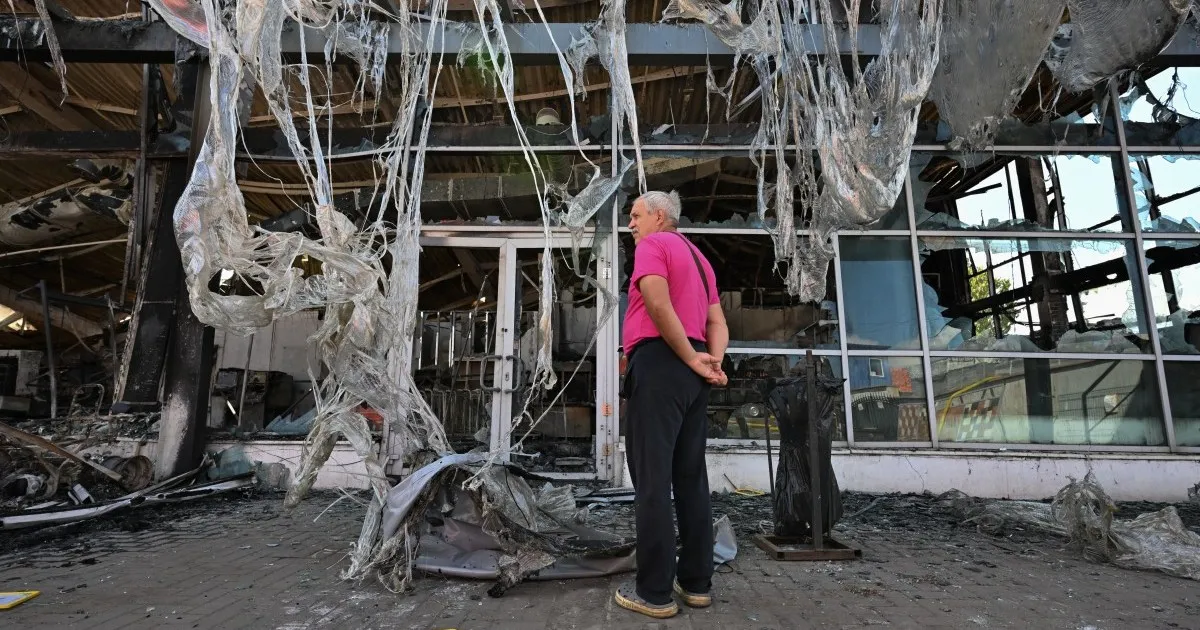
EXPLAINERWhat happens if the airspace of the world’s largest country by land mass is out of bounds because of Ukrainian drones?A man inspects damage at a burned construction materials mall after an overnight attack that Russian-installed officials blamed on Ukrainian drone strikes in Yenakiyeve, in the Russian-controlled Donetsk region, on August 14, 2026 [AFP]Published On 2 Sep 2026Ukraine’s President Volodymyr Zelenskyy has warned that Russian airspace is effectively closed because of the volume of Ukrainian drones in the sky.On Tuesday, he said that Russia, which began the war with the invasion of Ukraine in February 2022, is now “closing its own skies”.While Kyiv is not threatening civil aviation, Zelenskyy said, “there will be drones in Russia’s skies and due notice must be taken” by airlines and insurance companies.Russian President Vladimir Putin called Zelenskyy’s comments “a declaration of state terrorism”.So, can Ukraine really shut down Russia’s airspace? And what happens if the airspace of the world’s largest country becomes inaccessible?Firefighters work at a site of a building of an outpatient clinic hit by a Russian drone, amid Russia’s attack on Ukraine, in the front-line city of Kramatorsk in the Donetsk region, Ukraine, on August 30 [Oleksandr Ratushniak/Reuters]What has Zelenskyy said?Ukrainian drones have increasingly threatened or disrupted air traffic at Russian airports in recent months.As Russia has stepped up its use of ballistic missiles against Ukraine, Kyiv has struggled to intercept them due to a lack of ammunition for its air defence systems, particularly United States-made Patriot systems.Ukraine has, instead, responded by striking Russian infrastructure, oil and port facilities, and even e-commerce warehouses, deep inside Russian territory.“Today, we want to warn every airline that uses Russian airspace, every insurer and everyone who still uses Russia’s key airports: Russian airspace is becoming completely unsafe,” Zelenskyy said during his nightly address on Tuesday.“Ukraine does not threaten civilian aviation as such – not a single civilian aircraft. There will simply be drones in Russia’s skies on a scale that has to be taken into account,” he said.“Drone-infested skies are no place for civilian aviation,” Zelenskyy said on Tuesday. “The sky over Russia is currently for drones … as long as the war continues.”“We in Ukraine do not want innocent lives to be lost. That is why we are warning our partners: The safe days in Russia’s skies are over,” Zelenskyy added.Firefighters work at the site of an apartment building damaged by a Russian drone strike, amid Russia’s attack on Ukraine, in Kyiv, Ukraine, on September 1 [Gleb Garanich/Reuters]How much of a threat do Ukrainian drones pose?Unmanned drones, which Ukraine now mass-produces at low cost, have transformed the Ukraine-Russia war theatre, allowing Kyiv to take the fight hundreds of kilometres beyond the front line and increasingly into Russia’s major cities.Analysts say that the distance they can reach is now more of a concern than the damage they can inflict as they are interfering with civilian aviation well inside Russia, including around Moscow.As Ukraine has developed drone technology at an exponential rate since the start of the war, drones have become much longer-range. Ukraine says its deep-strike range has grown from about 630km (390 miles) in 2022 to 1,750km (1,090 miles) this year, with drones striking targets as far as Omsk, about 2,500km (1,550 miles) from Ukraine.When they approach Russian cities, they trigger temporary restrictions in the airspace above, halting arrivals and departures at airports until the perceived threat passes, which can take several hours. Repeated drone alerts have forced temporary restrictions at Russian airports and are increasingly causing concern for general aircraft flying through Russian airspace.“Ukraine has consistently launched more than 500 drones near daily, with multiple days exceeding 1,000 drones, according to figures released by the Russian [Ministry of Defence],” said Mark Brace, head of analysis at the aviation risk advisory firm Osprey Flight Solutions. This has caused frequent and extended airport closures and flight suspensions, he told Al Jazeera.“Essentially, Zelenskyy is articulating publicly what Ukraine has been doing for months: systematically disrupting Russian airspace.”According to data from Osprey, there has been an average of 30 Russian airport closures per day since the war began.(Al Jazeera)In an alert to its clients, Osprey Flight Solutions said that while the majority of Ukraine’s drone and missile strikes are likely to occur within 300km (186 miles) of the border between the two countries, daily attacks deeper inside Russia are likely to continue throughout the rest of 2026, including near Moscow and Saint Petersburg.“It is assessed that miscalculation and/or misidentification is likely in areas related to the Ukraine conflict,” the alert said.Last year, Putin told Azerbaijan’s President Ilham Aliyev that two Russian missiles had detonated beside an Azerbaijan Airlines plane in 2024 after Ukrainian drones entered Russian airspace, in an incident that killed 38 people.How does this impact airlines and passengers?“Russian airspace remains the single biggest structural distortion in global aviation,” Alex Macheras, an analyst based in the Middle East, said.Before February 2022, flying over Russia was the shortest path between Europe and Northeast Asia, with more than 360,000 flights a year passing over Siberia, he told Al Jazeera. Since Russia invaded Ukraine, many European and US carriers have avoided this route.As a result, many Europe-Northeast Asia routes now take two to four hours longer, Macheras said, while the Helsinki-Tokyo route has gone from nine hours to 13.“It’s a cost now factored into ticket prices, operational overheads, crew rosters, and aircraft utilisation across the entire European long-haul network,” Macheras said.Despite the ongoing war, some major airlines from countries such as China, Turkiye, the United Arab Emirates and other Gulf states have continued to use Russian airspace.US airlines have complained that carriers still permitted to fly through Russian airspace, such as Chinese airlines, enjoy a competitive advantage with shorter routes and reduced operating costs. If Russian airspace does close to these operators, this competitive advantage will disappear.Currently, Chinese carriers offer the fastest Europe-Asia and Asia-Europe connections by retaining Russian overflight rights. “Lose that, and their schedule advantage over Gulf and Turkish hubs narrows sharply,” Macheras said.Meanwhile, Turkish Airlines has built “real strategic value from its neutral access to Russian airspace, positioning Istanbul as the natural connection point for traffic that Western carriers can no longer route directly,” the aviation analyst said.He added that Indian carriers – Air India in particular – also rely on Russian airspace for efficient Delhi-London and Delhi-New York routings.Gulf carriers, from airports in Doha, Dubai and Abu Dhabi, on the other hand, the analyst argued, do not depend on Russian airspace the way Istanbul does. “A broader closure would likely reinforce the Gulf hub model, rather than damage it, as long-haul traffic gets pushed further south through the Gulf rather than through the Caucasus corridor,” he added.Is the aviation sector facing other pressures?Conflicts in the Middle East have shaken the aviation industry over the past couple of years, compounding disruptions caused by the Russia-Ukraine war.Osprey Flight Solutions’ Brace told Al Jazeera that “alternative routings through the Caucasus and Central Asia and the Middle East/Red Sea/Saudi Arabia/Gulf region are already congested due to the lack of availability of Russian airspace and the ongoing conflict in the Gulf region”.
SRCAl Jazeera
LANGEN
LEANCenter
WORDS1 181
ENT12
WED · 2026-09-02 · 14:55 GMTBRIEF NSR-2026-0902-108526
NSR-2026-0902-108526Analysis·EN·Political Strategy
Can Ukraine’s drones shut Russian airspace? What that means for airlines
Ukrainian President Volodymyr Zelenskyy has warned that Russian airspace is becoming effectively closed due to the increasing volume of Ukrainian drone activity. He stated that while Ukraine does not target civilian aviation, the presence of drones in Russian skies necessitates airlines and insurers taking note.
Yashraj SharmaAl JazeeraFiled 2026-09-02 · 14:55 GMTLean · CenterRead · 5 min
Al JazeeraFIG 01
Reading time
5min
Word count
1 181words
Sources cited
3cited
Entities identified
12entities
Quality score
100%
§ 01
Briefing Summary
AI-generatedNEWSAR · AI
Ukrainian President Volodymyr Zelenskyy has warned that Russian airspace is becoming effectively closed due to the increasing volume of Ukrainian drone activity. He stated that while Ukraine does not target civilian aviation, the presence of drones in Russian skies necessitates airlines and insurers taking note. Ukraine has been striking Russian infrastructure and facilities deep within Russian territory with increasingly long-range drones, some capable of reaching over 1,750 km. These drone incursions trigger temporary airspace restrictions at Russian airports, leading to frequent flight suspensions. Aviation risk analysts note that Ukraine has been systematically disrupting Russian airspace for months, with an average of 30 Russian airport closures per day since the war began.
Confidence 0.90Sources 3Claims 5Entities 12
§ 02
Article analysis
Model · rule-basedFraming
Political Strategy
Conflict
Tone
Mixed Tone
AI-assessed
CalmNeutralAlarmist
Factuality
0.60 / 1.00
Mixed
LowHigh
Sources cited
3
Well sourced
FewMany
§ 03
Key claims
5 extracted01
Russian President Vladimir Putin called Zelenskyy's comments 'a declaration of state terrorism'.
quoteVladimir Putin
Confidence
1.00
02
Ukrainian President Volodymyr Zelenskyy warned that Russian airspace is effectively closed due to the volume of Ukrainian drones.
quoteVolodymyr Zelenskyy
Confidence
1.00
03
Ukraine has responded to Russian missile strikes by attacking Russian infrastructure, oil and port facilities, and e-commerce warehouses.
factual
Confidence
0.90
04
Ukrainian drones have increasingly threatened or disrupted air traffic at Russian airports in recent months.
factual
Confidence
0.80
05
Ukraine mass-produces drones at low cost, transforming the war by allowing attacks deep inside Russia.
factual
Confidence
0.70
§ 04
Full report
5 min read · 1 181 words§ 05
Entities
12 identifiedKey playerOppositionContextPositiveNeutralNegative
Locations6
§ 06
Keywords & salience
8 termsrussian airspace
1.00
ukrainian drones
1.00
civil aviation
0.90
airlines
0.80
war
0.70
air defense systems
0.60
insurance companies
0.50
state terrorism
0.40
§ 07
Topic connections
Interactive graph No topic relationship data available yet. This graph will appear once topic relationships have been computed.