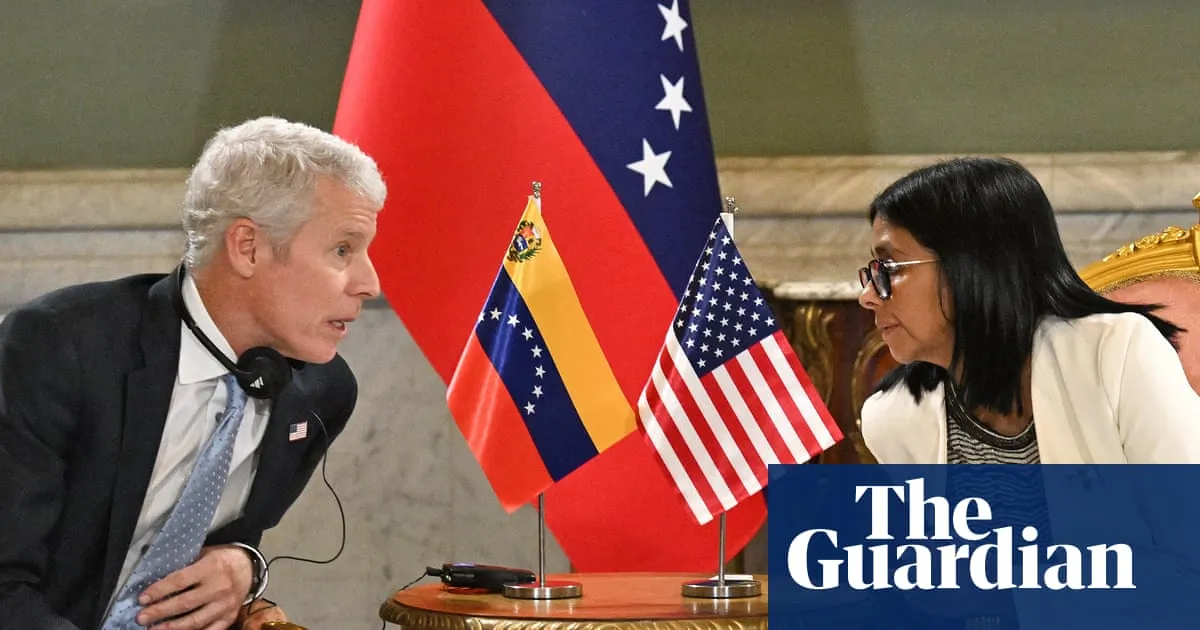
The US energy secretary, Chris Wright, has denied Washington is seeking to commandeer huge quantities of Venezuelan oil, amid growing criticism of Donald Trump’s energy deal with the country’s interim leaders.“Absolutely not,” Wright replied when asked by a CNBC journalist if the US was engaged in a “heavy-handed” attempt to “take” Venezuelan oil in violation of the South American country’s constitution.Wright landed in Venezuela’s capital, Caracas, on Tuesday night, four days after Trump announced what he called “the biggest oil deal in world history”.“I think we are seeing an absolutely historic transformation of both Venezuela and the relations between Venezuela and the US,” Wright said of the deal, which Trump has claimed will give the US control of 65bn barrels of Venezuelan oil. “This is President Trump’s grand plan to replace conflict with commerce,” Wright said.The White House says the deal will help secure US “energy dominance for the next century” as well as “purging foreign malign influence from our back yard” by excluding China and Russia from oilfields in the country with the world’s largest proven oil reserves. But there has been criticism from across the political spectrum.The Wall Street Journal’s editorial board said Trump’s deal with Venezuela’s unelected interim president, Delcy Rodríguez, “looks less like a normal commercial transaction than it does the famous scene of US businessmen meeting with the Cuban strongman in The Godfather Part II”.“The US government is essentially getting in bed with a foreign dictator and her favored capitalist,” the newspaper complained, in reference to Alejandro Betancourt, the Venezuelan tycoon at the centre of the deal.Delcy Rodríguez, Venezuela’s unelected interim president, has said the deal had ‘endless’ benefits. Photograph: Venezuelan Presidency/AFP/Getty ImagesThe economist Francisco Rodríguez told Democracy Now: “It’s clear that this is not a deal that any Venezuelan government would have entered into unless this country had been subject to an invasion, and unless its authorities had been held at gunpoint. So I think we’ve replaced gunboat diplomacy now for gunpoint diplomacy.”Delcy Rodríguez was installed as interim president on 5 January, two days after the president, Nicolás Maduro, was abducted by US special forces during a predawn raid on Caracas. Trump warned Rodríguez, who was Maduro’s vice-president, she would face an even worse fate if she did not toe the US line.Since Maduro’s capture, Rodríguez has made a series of once unthinkable concessions to US officials who their nominally socialist political movement, Chavismo, had spent years denouncing as predatory imperialists bent on stealing Venezuela’s natural resources.On Saturday, Rodríguez claimed the oil deal had “endless” benefits and would help produce more than $209bn in revenues that could be used to improve healthcare and education. “We are thinking of Venezuela’s future,” she said during a televised broadcast to the nation.The deal has dealt a body blow to Venezuela’s political opposition who fear Trump is unlikely to push for a democratic transition or fresh presidential elections given his lucrative arrangement with Rodríguez.“This is a game between the Trump administration and Delcy and her people,” one opposition figure lamented after the deal was unveiled.
SRCThe Guardian - World News
LANGEN
LEANCenter-Left
WORDS507
ENT12
WED · 2026-09-02 · 14:44 GMTBRIEF NSR-2026-0902-108534
NSR-2026-0902-108534News Report·EN·Diplomatic
Trump ally defends Venezuela oil deal amid ‘gunpoint diplomacy’ criticism
US Energy Secretary Chris Wright defended a new oil deal with Venezuela's interim leaders, denying accusations that the US is seeking to "take" the country's oil. Wright described the agreement, announced by President Trump, as a "historic transformation" of relations and a move to replace conflict with commerce, aiming for US energy dominance and to exclude China and Russia from Venezuelan oilfields.
Tom Phillips in Rio de JaneiroThe Guardian - World NewsFiled 2026-09-02 · 14:44 GMTLean · Center-LeftRead · 3 min
The Guardian - World NewsFIG 01
Reading time
3min
Word count
507words
Sources cited
5cited
Entities identified
12entities
Quality score
100%
§ 01
Briefing Summary
AI-generatedNEWSAR · AI
US Energy Secretary Chris Wright defended a new oil deal with Venezuela's interim leaders, denying accusations that the US is seeking to "take" the country's oil. Wright described the agreement, announced by President Trump, as a "historic transformation" of relations and a move to replace conflict with commerce, aiming for US energy dominance and to exclude China and Russia from Venezuelan oilfields. Critics, including The Wall Street Journal and economist Francisco Rodríguez, have likened the deal to "gunpoint diplomacy" and criticized the US government for aligning with Venezuela's unelected interim president, Delcy Rodríguez. Rodríguez, who was installed after President Nicolás Maduro's alleged abduction by US special forces, claims the deal offers significant benefits and revenues for Venezuela. The agreement has also concerned Venezuela's political opposition, who fear it may hinder a democratic transition.
Confidence 0.90Sources 5Claims 5Entities 12
§ 02
Article analysis
Model · rule-basedFraming
Diplomatic
Economic Impact
Tone
Mixed Tone
AI-assessed
CalmNeutralAlarmist
Factuality
0.60 / 1.00
Mixed
LowHigh
Sources cited
5
Well sourced
FewMany
§ 03
Key claims
5 extracted01
Economist Francisco Rodríguez stated the deal implies Venezuela was 'held at gunpoint'.
quoteFrancisco Rodríguez
Confidence
1.00
02
The Wall Street Journal's editorial board criticized the deal as resembling 'US businessmen meeting with the Cuban strongman in The Godfather Part II'.
quoteThe Wall Street Journal editorial board
Confidence
1.00
03
Donald Trump announced what he called 'the biggest oil deal in world history' with Venezuela.
quoteDonald Trump
Confidence
1.00
04
US Energy Secretary Chris Wright denies Washington is seeking to commandeer Venezuelan oil.
quoteChris Wright
Confidence
1.00
05
The White House claims the deal will secure US energy dominance and exclude China and Russia from Venezuelan oilfields.
factualWhite House
Confidence
0.80
§ 04
Full report
3 min read · 507 words§ 05
Entities
12 identifiedKey playerOppositionContextPositiveNeutralNegative
People6
Organizations1
§ 06
Keywords & salience
9 termsvenezuelan oil deal
1.00
us energy policy
0.90
gunpoint diplomacy
0.80
donald trump
0.70
energy dominance
0.60
foreign influence
0.50
nicolás maduro
0.40
delcy rodríguez
0.40
chris wright
0.40
§ 07
Topic connections
Interactive graph Network visualization showing 51 related topics
View Full Graph Person Organization Location Event|Click node to navigate|Edge numbers = shared articles