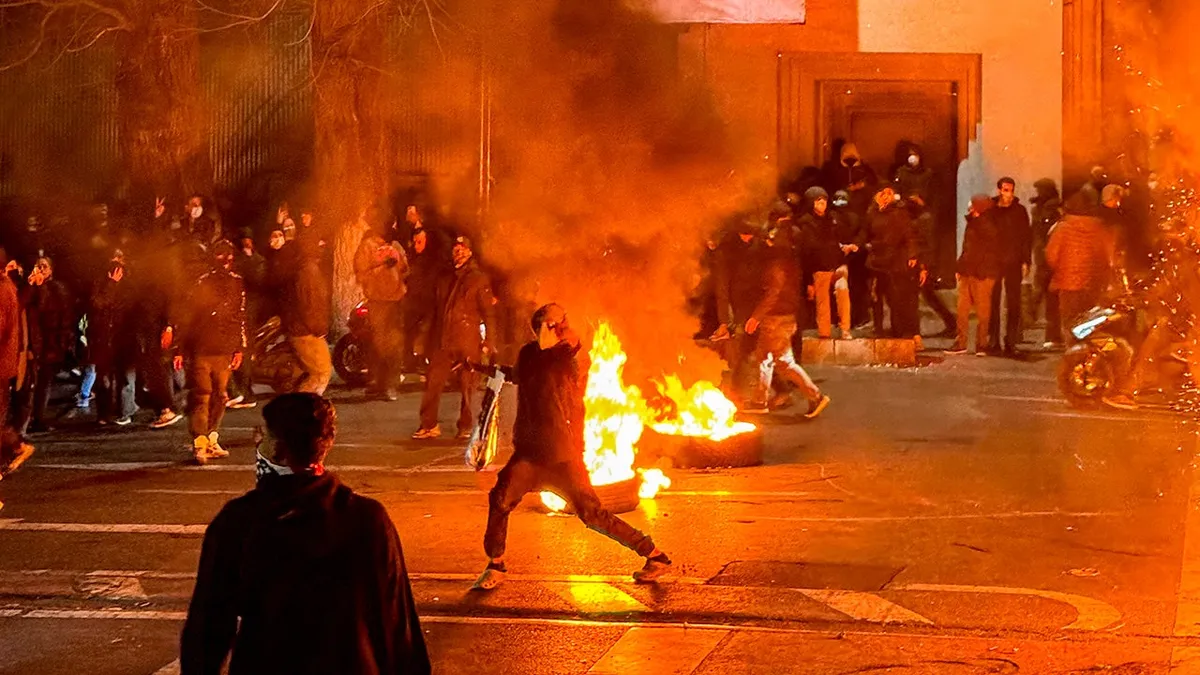
close Video Iran economy ‘on the verge of collapse’ as tensions with US escalate Miad Maleki, senior fellow at the Foundation for Defense of Democracies, tells Fox News Digital that mounting economic pressure could push Iran to escalate in an effort to force Washington back to the negotiating table. Photos credit: Reuters/Getty NEWYou can now listen to Fox News articles! Hören Sie sich diesen Artikel an 4 Min President Donald Trump revived speculation over regime change in Iran Tuesday night, openly asking when Iranians would "rise up and fight" as his administration intensified military and economic pressure on a government US officials say is increasingly vulnerable. "I'm not trying to force Iran to the bargaining table," Trump wrote on Truth Social Tuesday. "I like our position now much better, with almost total control of the Hormuz Strait, and their economy totally collapsing." "They are just playing out the inevitable," Trump added. "When are the Iranian people going to rise up and fight?" Iran regime change TALK RESURFACES AS TRUMP SAYS Tehran 'WANTS TO MEET' AMID US STRIKES In this photo obtained by The Associated Press, protesters chant slogans during an anti-government protest in Tehran, Iran, Thursday, Jan. 8, 2026. (UGC via AP) Trump did not explicitly call for the overthrow of Iran's government, and the White House has not publicly announced a policy of U.S.-led regime change. But his appeal to the Iranian population comes as the administration increasingly portrays Tehran as approaching an internal breaking point. Fox News Digital reached out to the White House for clarification Wednesday. Treasury Secretary Scott Bessent described Iran as being in a "death spiral" during remarks Monday, arguing that economic pressure was rapidly narrowing the government's options. "They are panicked. They are resorting to kinetic because they are getting squeezed economically," Bessent said told Ed Lawrence on Fox Business. COULD Iran’S REGIME COLLAPSE? EXPERTS ASSESS BESSENT’S BID TO SEVER FINANCIAL LIFELINES Protesters gather as vehicles burn, amid evolving anti-government unrest, in Tehran, Iran, in this screen grab obtained from a social media video released on Jan. 9, 2026. (Social Media/via Reuters) Bessent said Iran could eventually face one of three outcomes: "Either the IRGC are going to turn on each other, the people are going to turn on them, or they are going to come to the table and want to do a deal that they can stick with." "They are in the death throes," he added, comparing Iran's deterioration to bankruptcy occurring "slowly, then quickly." Miad Maleki, a senior fellow at the Foundation for Defense of Democracies and former Treasury sanctions official, told Fox News Digital that Washington does not need to choose between invading Iran to overthrow the government and striking another agreement with Tehran. "It's very clear U.S. government is not in the business of regime change anymore," Maleki said. "And I think it's very clear that we're not going to have boots on the ground to invade Iran. And I don't think we need that." INSIDE Tehran: IRANIANS DESCRIBE IRGC'S BRUTAL RULE, POVERTY — ASK TRUMP TO 'STAY THE COURSE' Iranians block a street while gathering during a protest in Tehran, Iran, on Jan. 9. (MAHSA / Middle East Images/AFP via Getty Images) Instead, Maleki argued Washington should "contain this regime, cut off its economic lifelines, empower the Iranian people" and prepare for another wave of demonstrations inside Iran. "We need to be prepared to support the Iranian people in a way that they can be empowered and take the government back," he said, stressing the importance of ensuring protesters maintain access to the internet so they can communicate, mobilize and make their voices heard. Maleki described Iran's leadership as the weakest it has been since the 1979 Islamic Revolution and argued that further Iranian military escalation could deepen its vulnerability rather than restore lost leverage. The debate comes as reports of localized economic protests continue to emerge from inside Iran. TRUMP SAYS Iran IS ‘DEAD’ — EXPERTS POINT TO THE REAL SIGN Tehran IS NEARING THE BRINK An Iranian woman shops in a local market in Tehran, Iran, April 28, 2026. (Majid Asgaripour/WANA (West Asia News Agency) via Reuters) The National Council of Resistance of Iran, an exiled Iranian opposition coalition, said Tuesday that workers, retirees, drivers and job-seeking young people demonstrated in several cities on Aug. 31. The group alleged security forces opened fire on job seekers in Gachsaran and Ahvaz and reported separate demonstrations over unpaid wages, inflation, fuel shortages and working conditions. Those specific claims have not been independently verified by Fox News Digital. Iran analyst Benny Sabti also told Fox News Digital that deteriorating living conditions could become a catalyst for broader unrest. "People are hungry," Sabti said, predicting Iranians would "take the streets again." "Hunger is humiliating," he said, arguing that economic desperation could eventually outweigh fear of the government's security apparatus. The political stakes are rising alongside a dramatic military escalation. US forces carried out another wave of strikes Tuesday against Iranian air-defense systems, radar installations, maritime assets and mine-laying capabilities, according to US Central Command, while Iran retaliated with missile and drone attacks against US assets across the region. People gather during a protest on January 8, 2026, in Tehran, Iran. Demonstrations have been ongoing since December, triggered by soaring inflation and the collapse of the rial, and have expanded into broader demands for political change. (Anonymous/Getty Images) For Trump, however, Tuesday night's post suggested the question may no longer be only whether economic pressure brings Tehran back to negotiations — but what happens inside Iran if it does not. Efrat (Effie) Lachter is a reporter for Fox News Digital with more than 15 years of experience covering conflict, global affairs, human rights and political accountability. She has directed and produced more than 200 documentary segments across more than 40 countries, documenting conflicts, humanitarian crises, corruption, human trafficking, gender-based violence and the human stories behind major world events. Lachter’s reporting has taken her into conflict zones and crisis areas across the Middle East, Europe, Asia and Africa. Her work has included uncovering human trafficking networks, revealing an ISIS underground torture prison in Syria, documenting the war in Ukraine and interviewing senior political figures and world leaders. She was also among the Western journalists who entered Russia after the war began to bring testimonies from Putin’s opposition. Lachter is the recipient of the 2022 Peres Center for Peace Award and was a 2023–2024 Knight-Wallace Journalism Fellow at the University of Michigan. She also won two Rockower Awards for Excellence in Reporting. She holds a bachelor's degree in communication and a master's degree in political science.
SRCFox News - World
LANGEN
LEANCenter-Right
WORDS1 103
ENT10
WED · 2026-09-02 · 16:53 GMTBRIEF NSR-2026-0902-108564
NSR-2026-0902-108564News Report·EN·Political Strategy
Trump revives Iran regime change speculation with cryptic call for people to ‘rise up'
President Donald Trump has reignited speculation about regime change in Iran by asking when the Iranian people will "rise up and fight." This comes as the U.S. administration intensifies military and economic pressure on Iran, which officials describe as increasingly vulnerable and in an economic "death spiral." Treasury Secretary Scott Bessent outlined potential outcomes for Iran, including internal conflict or popular uprising.
Fox News - WorldFiled 2026-09-02 · 16:53 GMTLean · Center-RightRead · 5 min
Fox News - WorldFIG 01
Reading time
5min
Word count
1 103words
Sources cited
3cited
Entities identified
10entities
Quality score
100%
§ 01
Briefing Summary
AI-generatedNEWSAR · AI
President Donald Trump has reignited speculation about regime change in Iran by asking when the Iranian people will "rise up and fight." This comes as the U.S. administration intensifies military and economic pressure on Iran, which officials describe as increasingly vulnerable and in an economic "death spiral." Treasury Secretary Scott Bessent outlined potential outcomes for Iran, including internal conflict or popular uprising. Experts suggest the U.S. should focus on containing the regime and empowering the Iranian people rather than direct intervention. Reports of localized economic protests within Iran continue to emerge, fueled by deteriorating living conditions.
Confidence 0.90Sources 3Claims 4Entities 10
§ 02
Article analysis
Model · rule-basedFraming
Political Strategy
Conflict
Tone
Sensational
AI-assessed
CalmNeutralAlarmist
Factuality
0.60 / 1.00
Mixed
LowHigh
Sources cited
3
Well sourced
FewMany
§ 03
Key claims
4 extracted01
Miad Maleki stated the U.S. government is not currently in the business of regime change in Iran.
quoteMiad Maleki
Confidence
1.00
02
Treasury Secretary Scott Bessent described Iran's economy as being in a 'death spiral'.
quoteScott Bessent
Confidence
1.00
03
Trump stated his administration's position on Iran is 'much better now' with control of the Hormuz Strait and a collapsing economy.
quoteDonald Trump
Confidence
1.00
04
President Trump revived speculation over regime change in Iran by asking when Iranians would 'rise up and fight'.
factualarticle
Confidence
0.90
§ 04
Full report
5 min read · 1 103 words§ 05
Entities
10 identifiedKey playerOppositionContextPositiveNeutralNegative
Locations4
§ 06
Keywords & salience
8 termsiran regime change
1.00
donald trump
0.90
economic pressure
0.80
iranian people
0.70
us administration
0.60
economy collapsing
0.50
hormuz strait
0.50
irgc
0.40
§ 07
Topic connections
Interactive graph Network visualization showing 51 related topics
View Full Graph Person Organization Location Event|Click node to navigate|Edge numbers = shared articles