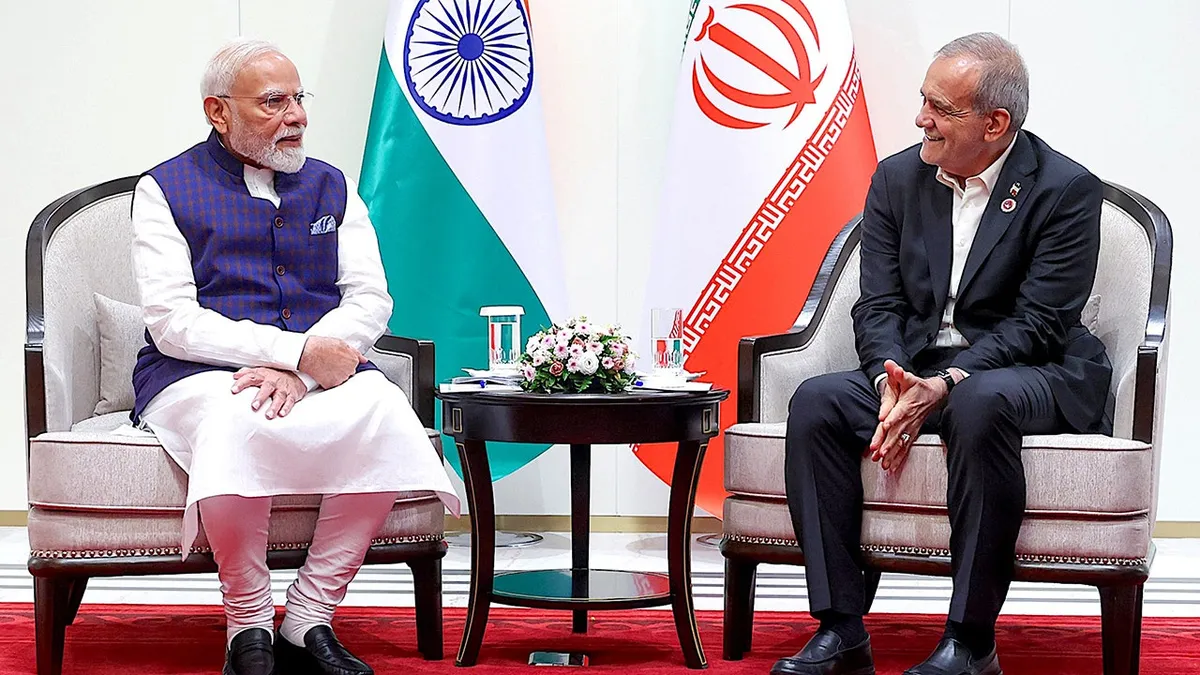
close Video Scott Bessent warns countries aiding Iran will be cut off from US dollar Treasury Secretary Scott Bessent announces powerful Secondary Sanctions on Iran. Economist Steve Moore discusses the zero-leakage strategy targeting the regime and its global facilitators, including China, on 'America Reports.' NEWYou can now listen to Fox News articles! Hören Sie sich diesen Artikel an 6 Min The Trump administration is ramping up economic sanctions on Iran through "Operation Economic Outcast," while also threatening dire Secondary Sanctions against countries that continue Iran-related business. The new policy puts countries like India and other close U.S. partners in an awkward situation. New Delhi remains a critical U.S. partner in the Indo-Pacific, but it also has commercial, energy and strategic interests in Iran that it won't likely discard, potentially putting it at odds with the Trump administration. TRUMP THREATENS 'UNPRECEDENTED' ECONOMIC CONSEQUENCES FOR ANY NATION AIDING Iran Indian Prime Minister Narendra Modi (L) holds a bilateral meeting with Iranian President Masoud Pezeshkian (R) on the sidelines of the Shanghai Cooperation Organization (SCO) Summit in Bishkek, Kyrgyzstan, on August 31, 2026. (Press Information Bureau (PIB)/Anadolu via Getty Images)) On Monday, exactly a week after the Trump administration launched its new sanctions campaign, Indian Prime Minister Narendra Modi met with Iranian President Masoud Pezeshkian on the sidelines of the Shanghai Cooperation Organization Summit in Kyrgyzstan. It was their first meeting since the war broke out six months ago. According to an Iranian readout, Pezeshkian asked Modi "to use India’s extensive contacts" to help steer the involved parties away from war and back toward dialogue, while thanking Modi for standing by Tehran. Modi reiterated that New Delhi wants to strengthen its "long-standing friendship" with Tehran and "expand and diversify" the two countries’ trade basket. "That was for Modi to signal to a domestic audience that he is not kowtowing to Trump," Council on Foreign Relations Senior Fellow Sadanand Dhume told Fox News Digital. "India-Iran relations have already been largely hollowed out by previous rounds of sanctions, so there is no question of India trying to balance between the U.S. and Iran," he added. Secretary of State Marco Rubio was asked by Fox News' Brian Kilmeade on "The Brian Kilmeade Show" Tuesday about Modi's meeting with the Iranian president. Rubio said he didn't think there was a trade deal between India and Iran — noting many countries around the world talk to Tehran — and stated, "What ultimately happens, though, is – and the President’s been very clear – is no country should be helping Iran evade sanctions. No country should be out there helping them create mechanisms by which they can generate revenue that they will then use to sponsor terrorism and try to build a nuclear weapon. And if countries decide to do that, then we’re going to have to sanction them too." U.S. Secretary of State Marco Rubio delivers remarks at the start of a ministerial meeting on political violence, at the State Department in Washington, D.C., U.S., July 16, 2026. (Jonathan Ernst/Reuters) A U.S. official echoed Rubio's comments and told Fox News Digital that, "the Administration continues to have positive discussions with our economic partners to ensure Iran never possesses a nuclear weapon." India has been among Iran’s top five trading partners in recent years, though bilateral trade has dropped dramatically since its 2018-19 peak. Iran LOSES KEY ECONOMIC LIFELINE IN MIDDLE EAST THAT TRUMP'S SANCTIONS COULDN'T REACH AS DEADLOCK PERSISTS New Delhi’s exports to Iran are concentrated on goods that can carry humanitarian exemptions, including pharmaceuticals. Iran is also the second-largest overseas market for Indian rice, with India exporting more than $383 million worth in the first six months of the year. Conversely, India resumed importing Iranian crude oil for the first time in seven years in April, after the Trump administration temporarily lifted sanctions to soften the Middle East conflict’s impact on global energy. Iranian oil shipments to India were valued at roughly $707 million in the first half of the year. India has already come into the Treasury Department's crosshairs, with the U.S. sanctioning four India-based companies and three Indian nationals over alleged links to Iranian petroleum and petrochemical trade. President Donald Trump (R) shakes hands with Indian Prime Minister Narendra Modi during a bilateral meeting at the G7 Summit on June 17, 2026 in Evian-les-Bains, France. (Anna Moneymaker/Getty Images) The Treasury Department says countries will receive a defined timeline to shut down Iran-related activity as identified by Washington. That puts banks, shippers, insurers and trade intermediaries on notice before any further penalties are imposed. The United Arab Emirates’ suspension of commercial and financial dealings with Iran has already squeezed Indian exporters, as Dubai has long served as a key hub for trade with Iran. Iran DEAL CLOCK HITS ZERO AS TRUMP DEMANDS ‘WHITE FLAG’ WITH NEW PRESSURE CAMPAIGN LOOMING So far, Washington’s initial actions have stopped short of targeting India’s wider commercial relationship with Iran. Iran, meanwhile, has warned of "grave consequences" for countries that cooperate with what it calls illegal U.S. behavior. India's interests in Iran also run beyond commerce. The Chabahar port, Iran’s only deep-water oceanic port, provides maritime routes linking India to Russia and Europe. It also gives India an access route to Central Asia that bypasses Pakistan. But U.S. sanctions uncertainty has repeatedly complicated India’s operations there. A view of commercial cargo vessels and crude oil tankers are anchored in the Gulf of Oman, off the coast of Muscat, Oman, on June 21, 2026, as they prepare to transit through the critical Strait of Hormuz. Maritime traffic along this vital global trade corridor experienced severe disruptions following heightened geopolitical tensions between the United States and Iran that escalated earlier in February. Following a diplomatic memorandum of understanding reached in mid-June, the strategic waterway is expected to fully reopen to international shipping and energy transit. (Shady Alassar/Anadolu via Getty Images) India, the world's third-biggest oil importer and consumer, has already faced the cost of the Middle East conflict, through energy disruptions, higher import costs and inflation. It has also shown it will resist U.S. pressure when core interests are at stake. For instance, it has defended ties with Russia, despite Moscow’s adversarial relationship with Washington. But experts argue Iran no longer carries the same weight. "The Russian example is strikingly different. New Delhi shares close military and diplomatic ties with Moscow that are much more important to India than its ties with Iran, notwithstanding lip service to the latter," Dhume said. "Higher global oil prices hurt India, but India weaned itself off Iranian oil imports a while back." For the U.S., squeezing major economies like India over their ties to Tehran could pose a diplomatic risk. U.S. national security officials stress the need for a workable strategic relationship with India, especially to counterbalance Chinese power. Under President Trump’s second term, once-blooming US-India relations have been under strain. Trump and Modi sought to reset the relationship just months ago, but the latest Iran sanctions could test it again. But the U.S. retains enormous leverage over India, particularly when it comes to trade. "If forced to choose, New Delhi will obviously and emphatically choose its valuable commercial relationship with the U.S. over its skimpy trade ties with the Islamic republic," Dhume said. The timing is notable, with Chinese President Xi Jinping reportedly set to visit India for next week’s BRICS summit. Russian President Vladimir Putin and Iranian President Masoud Pezeshkian are also expected to attend. Xi, Putin and Modi at BRICS (MAXIM SHIPENKOV/Pool via REUTERS) Analysts say the impact will ultimately depend on how aggressively Washington moves from warnings and diplomacy to actual Secondary Sanctions. That is particularly true with India, where more aggressive enforcement risks further straining U.S. relations with a strategically important partner. "The U.S. should learn from its own past success in quietly persuading India to generally kick its Iran oil habit." Dhume said. "Quiet diplomacy works better with India than bluster. This is the key lesson from the past that the Trump administration appears to be forgetting." The Indian government did not respond to Fox News Digital requests for comment. Kyra Colah works as a Writer and Associate Producer for Fox News.
SRCFox News - World
LANGEN
LEANCenter-Right
WORDS1 361
ENT12
THU · 2026-09-03 · 11:46 GMTBRIEF NSR-2026-0903-108819
NSR-2026-0903-108819News Report·EN·Diplomatic
India's Modi-Iran meeting comes amid US warnings of sanctions on Tehran's trading partners
The Trump administration is intensifying sanctions on Iran, threatening secondary sanctions on countries continuing business with Tehran. This policy places India, a key U.S.
Fox News - WorldFiled 2026-09-03 · 11:46 GMTLean · Center-RightRead · 6 min
Fox News - WorldFIG 01
Reading time
6min
Word count
1 361words
Sources cited
3cited
Entities identified
12entities
Quality score
100%
§ 01
Briefing Summary
AI-generatedNEWSAR · AI
The Trump administration is intensifying sanctions on Iran, threatening secondary sanctions on countries continuing business with Tehran. This policy places India, a key U.S. partner, in a difficult position due to its commercial, energy, and strategic interests in Iran. Indian Prime Minister Narendra Modi met with Iranian President Masoud Pezeshkian, where Iran requested India's help in de-escalating conflict and thanked New Delhi for its support. Modi reiterated India's desire to strengthen ties and diversify trade with Iran. U.S. officials warned that countries aiding Iran in evading sanctions would face penalties. While India's trade with Iran has decreased due to previous sanctions, it remains a significant trading partner, particularly for rice and recently resumed oil imports. The U.S. has already sanctioned some Indian entities for alleged links to Iran's petroleum trade.
Confidence 0.90Sources 3Claims 5Entities 12
§ 02
Article analysis
Model · rule-basedFraming
Diplomatic
Economic Impact
Tone
Mixed Tone
AI-assessed
CalmNeutralAlarmist
Factuality
0.70 / 1.00
Factual
LowHigh
Sources cited
3
Well sourced
FewMany
§ 03
Key claims
5 extracted01
Indian Prime Minister Narendra Modi met with Iranian President Masoud Pezeshkian on the sidelines of the Shanghai Cooperation Organization summit.
factual
Confidence
1.00
02
The Trump administration is ramping up economic sanctions on Iran through 'Operation Economic Outcast' and threatening secondary sanctions.
factual
Confidence
1.00
03
No country should be helping Iran evade sanctions or generate revenue for terrorism and nuclear weapons development.
quoteMarco Rubio
Confidence
0.90
04
Modi reiterated that New Delhi wants to strengthen its 'long-standing friendship' with Tehran and 'expand and diversify' trade.
quote
Confidence
0.90
05
Pezeshkian asked Modi to use India's contacts to steer parties away from war and back toward dialogue.
quoteIranian readout
Confidence
0.90
§ 04
Full report
6 min read · 1 361 words§ 05
Entities
12 identifiedKey playerOppositionContextPositiveNeutralNegative
People5
Locations4
Events2
§ 06
Keywords & salience
10 termsus sanctions on iran
1.00
secondary sanctions
0.90
india-iran relations
0.90
trump administration
0.80
narendra modi
0.70
masoud pezeshkian
0.70
economic consequences
0.60
indo-pacific
0.50
shanghai cooperation organization
0.50
trade basket
0.40
§ 07
Topic connections
Interactive graph Network visualization showing 51 related topics
View Full Graph Person Organization Location Event|Click node to navigate|Edge numbers = shared articles