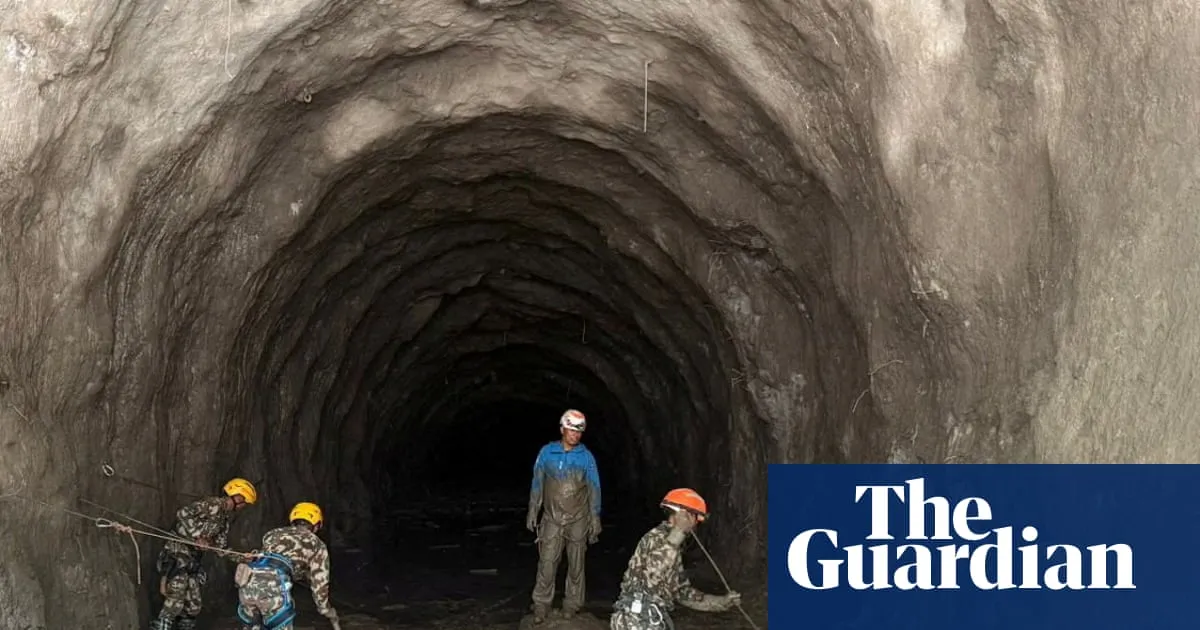
Nepal authorities have said they are “confident” that dozens of workers in Nepal’s Rasuwagadhi hydropower plant are still alive, more than a week after deadly flash floods left them trapped in an underground chamber.Authorities said that at least 639 workers were still missing from hydropower plants built along Nepal’s Bhote Koshi and Triushuli rivers.Most of the projects were destroyed when a surge of water, debris and mud came coursing down the river valley last week, triggered by the collapse of a melting glacier on the border between Nepal and China-controlled Tibet.The deadly flash floods reached up to 100mph (160km/h), according to scientists, and travelled more than 60 miles down the river valley, wiping away whole villages, bridges, and hydropower dams.At least 1,252 people have been confirmed dead from the floods. More than 4,200 remain missing.According to a preliminary estimate by the UN Development Programme, the disaster created at least 2.2m tonnes of debris, including parts of buildings, rocks and sediment. Large boulders and flood waters deluged the hydropower tunnels, blocking off the entrances, and some were buried deep in mud.Rescue efforts have increasingly centred on these tunnels, where authorities believe workers may have survived for more than a week due to air pockets. So far, more than 270 people have been rescued from the hydropower projects.A turquoise-green house stands tall amid sludge near Trishuli River in the aftermath of flash floods. Photograph: Arun Sankar/AFP/Getty ImagesSpeaking on Wednesday, officials said they believed 46 people were still alive in an underground room in Rasuwagadhi hydropower plant, and efforts were ongoing to locate them using excavators and other heavy equipment.“We are very confident that they must be alive after one week because … they have food and water over there in the building,” Amhsu Kiran Shahi, a board member of the Nepal electricity authority, told Reuters.Durga Gurung, 60, said his brother Jhappad Bhujel was among those trapped in a hydropower tunnel. “Right now, we are just relying on God,” he told the Guardian. “We have not been given any information about whether the people inside are alive or not.“Neither the army nor the people from the electricity authority are telling us anything. So many days have passed that we have reached a point where it feels like all we can do is hope for a miracle.”“Our relatives are sitting inside a dark tunnel,” he added. “How long can they possibly survive?”The area around Rasuwagadhi hydropower plant before the flash flood. Photograph: Maxar/DigitalGlobe/Getty ImagesMajor rescue operations were under way or planned at four hydropower projects. Two sites – the Rasuwagadhi hydroelectric project and the Upper Trishuli 3A facility – where about 90 people are missing, offered the strongest prospect of finding survivors because of the presence of air inside the tunnels, Shahi said.The Rasuwagadhi hydroelectric project is located in Rasuwa district, about three miles away from the border with Tibet, which was one of the areas of Nepal hardest hit by the floods, and remains almost inaccessible except by helicopter. “This is the only project where it’s possible to walk through the tunnel,” Shahi said. “The army tried doing that three days ago, but they didn’t find the room. We are going in again.”At the Upper Trishuli 3A facility, another project hit by the floods, it took rescue workers almost six days to find the tunnels because of the thick mud. The authorities believe about 30 to 40 people may still be alive in the tunnel. “We are expecting [survivors] in there because we are told there is a dry space inside. We are trying to break into the tunnel now,” said the Nepali army spokesperson Raja Ram Basnet on Wednesday.The army said the search and rescue operation would go on for as long as there was hope for survivors, but that efforts would also continue to recover the dead bodies. “We are using every technology available in Nepal right now, and we are taking help from the Indians, Chinese, Koreans. We have experts from Australia too,” added Basnet.Families of those still trapped in the projects have returned to the Nepal electricity office for the past eight days, in the hope for information. Laxmi Adhikari’s brother Jeevanlal Adhikari had gone to the Trishuli 3A Hydropower Project to test the machines, when the floods hit.She accused the authorities of withholding information from the families, and of not acting fast enough to save their relatives. “We have been running from one ministry to another and from disaster management authority to another government office, trying to find my brother,” she said. “We keep going from place to place, but the rescue operation has not been accelerated.”She said the lack of answers made the wait even more painful: “When the water came rushing in, where did he go? Did he manage to get to safety? They haven’t even given us definite information about whether our people are alive or not.”Nepal has invested more than $9bn (£6.7bn) in building hydropower dams across the mountains, huge sums given the country’s small economy. According to preliminary surveys, the floods debilitated or destroyed 11 hydropower plants and knocked out about 10% of Nepal’s total electricity-generation capacity.According to the authorities, more than 20,000 houses will have to be rebuilt in the aftermath of the flood. Nepal has put the cost of recovery at more than $5bn (£3.7bn).
SRCThe Guardian - World News
LANGEN
LEANCenter-Left
WORDS884
ENT12
THU · 2026-09-03 · 11:25 GMTBRIEF NSR-2026-0903-108832
NSR-2026-0903-108832News Report·EN·Human Interest
Dozens of trapped hydropower tunnel workers in Nepal could still be alive, official says
Nepal authorities are confident that dozens of workers trapped in a hydropower plant tunnel on the Nepal-Tibet border may still be alive over a week after deadly flash floods. The floods, triggered by a melting glacier collapse, caused widespread destruction, killing at least 1,252 people and leaving over 4,200 missing.
Hannah Ellis-Petersen and Gaurav Pokharel in KathmanduThe Guardian - World NewsFiled 2026-09-03 · 11:25 GMTLean · Center-LeftRead · 4 min
The Guardian - World NewsFIG 01
Reading time
4min
Word count
884words
Sources cited
3cited
Entities identified
12entities
Quality score
100%
§ 01
Briefing Summary
AI-generatedNEWSAR · AI
Nepal authorities are confident that dozens of workers trapped in a hydropower plant tunnel on the Nepal-Tibet border may still be alive over a week after deadly flash floods. The floods, triggered by a melting glacier collapse, caused widespread destruction, killing at least 1,252 people and leaving over 4,200 missing. Rescue efforts are focused on hydropower tunnels, where officials believe air pockets could have allowed workers to survive. At the Rasuwagadhi hydropower plant, authorities believe 46 people are alive in an underground room, and efforts are underway to reach them. Similar hopes exist for 30 to 40 individuals at the Upper Trishuli 3A facility. International assistance is being sought for the ongoing rescue and recovery operations.
Confidence 0.90Sources 3Claims 5Entities 12
§ 02
Article analysis
Model · rule-basedFraming
Human Interest
Environmental
Tone
Mixed Tone
AI-assessed
CalmNeutralAlarmist
Factuality
0.70 / 1.00
Factual
LowHigh
Sources cited
3
Well sourced
FewMany
§ 03
Key claims
5 extracted01
A relative expressed despair, stating they have received no information and are relying on hope for a miracle.
quoteDurga Gurung
Confidence
1.00
02
Deadly flash floods triggered by a melting glacier collapse killed at least 1,252 people and left over 4,200 missing.
statistic
Confidence
1.00
03
The disaster created at least 2.2 million tonnes of debris, including parts of buildings, rocks, and sediment.
statisticUN Development Programme
Confidence
0.90
04
Nepal authorities are confident that dozens of workers trapped in the Rasuwagadhi hydropower plant are still alive.
factualNepal authorities
Confidence
0.90
05
Officials believe 46 people are still alive in an underground room at the Rasuwagadhi hydropower plant due to air pockets, food, and water.
factualAmhsu Kiran Shahi
Confidence
0.80
§ 04
Full report
4 min read · 884 words§ 05
Entities
12 identifiedKey playerOppositionContextPositiveNeutralNegative
Organizations3
§ 06
Keywords & salience
9 termsflash floods
1.00
hydropower plant
1.00
trapped workers
0.90
rescue efforts
0.80
melting glacier
0.70
nepal
0.60
river valley
0.50
debris
0.50
air pockets
0.40
§ 07
Topic connections
Interactive graph Network visualization showing 51 related topics
View Full Graph Person Organization Location Event|Click node to navigate|Edge numbers = shared articles